


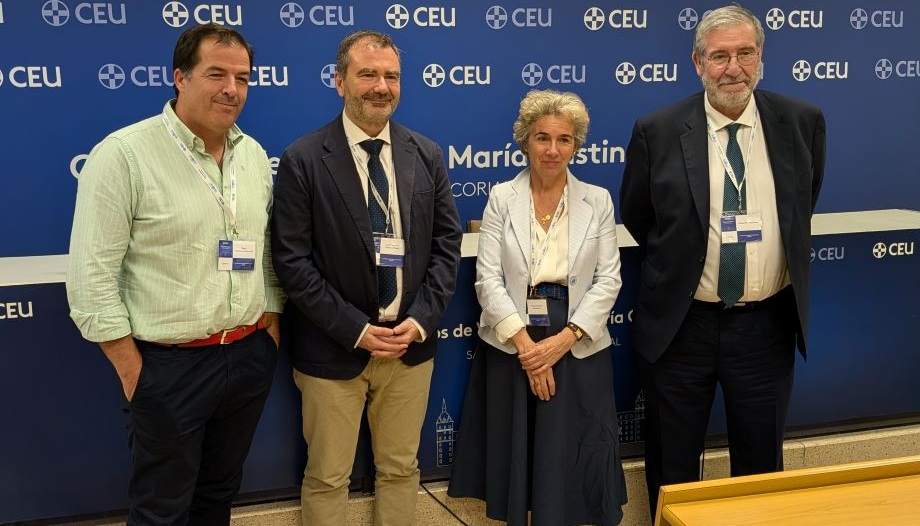
“The Catholic revival is real and surprising, and there is evidence of it,” stated journalist and historian José Francisco Serrano Oceja a few days ago in El Escorial. After the euphoria surrounding the Pope’s visit, that reality seemed like a given, but one might think there is perhaps a touch of excessive optimism in that statement. However, there is a growing body of evidence attesting to the so-called “religious resurgence.”.
That topic, along with the presence of Catholics in society, has been the focus of several summer courses held by CEU San Pablo University in El Escorial. “We have lived through a period in history when people have turned their backs on God, but it seems that is changing,” confirmed Teresa Herranz, CEO of “El Adelantado de Segovia.”.
Jose Francisco Serrano, during a panel discussion on “Faith and Public Life: A Matter of Consistency,” explained that this shift toward Catholicism is reflected in the data from a study conducted this year by the Pluralism and Coexistence Foundation, which is affiliated with the Ministry of the Presidency. According to the polls, this shift toward Catholicism is particularly evident among men aged 18 to 32. “This is a first in history,” Serrano noted, since until now, women have generally been the ones most closely tied to religion.
It is worth noting in this regard that in the Report Spanish Youth 2026, the tenth edition of the comprehensive study on youth conducted by the SM Foundation, shows that religion is gaining ground as an important value for young people. Having started from a marginal position, it has now reached its highest level of importance since these reports began: currently, 38.4 % of young people consider faith “quite or very important” in their lives.
In addition, the percentage of young people who identify as Catholic—including non-practicing Catholics—rises from 31.6 % in 2020 to 45 % in 2025, while explicitly non-religious views decline (agnostics and non-believers).
During another roundtable discussion as part of the CEU course “A Project for the Common Good in Spain,‘ Pablo Sánchez Garrido, secretary for causes of canonization at the National Association of Propagandists, provided further context regarding those figures. He noted that, while there is a resurgence of religious devotion, other figures remain concerning, such as the decline in canonical marriages, the practice of the sacraments, and the number of cases of abortion and euthanasia. Nevertheless, he noted: ’The fact that this resurgence of faith concerns newspapers like ”El País’ is not a bad thing.”.
Against Clericalism
Serrano, a professor of journalism at CEU San Pablo University, historian, and columnist, highlighted in his remarks the need for consistency among Catholics. “Do we believe in Vatican II? It speaks of the autonomy of temporal realities, of the Christian’s presence in society, and of their call to the apostolate, which stems from their status as baptized Christians.” However, he admitted, “I don’t know if this awareness has really taken hold.”.
He explained that clericalism still exists, which amounts to a situation where “the faithful have been dispossessed. In other words, we used to live comfortably under a regime of Christendom, where society was religious by inertia. But that situation no longer exists.” He acknowledged that Spanish society remains fundamentally Catholic, “but the time has come for the laity, based on the autonomy of the laity’s actions.”.
Serrano highlighted two lessons he has learned about public life as a believer: “First, that the Christian life is a continuous ‘nunc coepi’—a constant beginning anew”; and second, that what matters is making friends. First, becoming friends with God. And creating a world of friendship.”.
Christian Consistency
Journalist and filmmaker Borja Martínez-Echevarría also spoke at that course, stating that he hoped the so-called “Catholic moment” would help “free us from clericalism.”.
He also pointed out that, when discussing the lack of religious practice, one must take into account data that qualifies that statement, such as the fact that in the municipality of Madrid alone, more than a thousand Masses are celebrated on Sundays.
When discussing the coherence between faith and public life, he explained his personal experience. After working as a journalist, he now makes films (he directed, for example, a documentary about Medjugorje and another about Eugenia, a girl with cerebral palsy), driven by a mission to evangelize. His latest film, for instance, focuses on healing from abortion. “Certainly, as an investment, it’s been a disaster,” he admitted. However, “I received a WhatsApp message from a Catholic girl who had become pregnant, and the film had helped her decide not to have an abortion. That makes up for everything,” he said.
Teresa Herranz, CEO of “El Adelantado de Segovia,” spoke about the challenges of maintaining Christian integrity in the current climate. In her case, she recalled, when she took the helm of the newspaper, she had to face resistance from some editors, who even filed a complaint against her with the press association, accusing her of censorship—precisely because she was trying to correct the anti-Catholic atmosphere that prevailed. She says she pressed on, undeterred by the opposition.





 Español
  English
  Italiano
  Français
  Deutsch
  Polski