


Between 300 and 400 million people each year embark on a journey—a pilgrimage—for religious reasons. Religious tourism is one of the segments of the global tourism industry that attracts the largest number of visitors. Specifically, in the Americas, there are 3,000 registered Catholic shrines, hundreds of active pilgrimage routes, and the largest Catholic population on the planet, yet the region lacks coordinated public policies, systematic data, and structured products. This is one of the conclusions of the International Congress on Religious Tourism “Land of Living Faith – ”El Salvador 2026,” held in the Central American nation, a country experiencing strong growth in this sector.
The paradox is that in this field, “in the Americas we’re invisible—no one sees us,” according to Adrián Lomello, an Argentine who serves as the coordinator for the Americas at the Global Religious Tourism Network. He provided some figures: “According to UNWTO, there are 300–400 million religious tourists worldwide each year, generating $18 billion in economic impact; 22 million annual visitors to Guadalupe, 12 million to Aparecida (Brazil), 7 million to Luján (Argentina)…”. Even more modest sites, such as “the festival of the Virgin of La Tirana in Chile, which draws 250,000 people to a town of 15,000 inhabitants.”.
It is significant that 20% of the sites inscribed on the World Heritage List are linked to religious heritage (not only Catholic, of course), and that nearly 80% of the elements of intangible cultural heritage are related to religious practices.
An example of the interest in religious tourism is the host country of the conference itself, El Salvador. Its Minister of Tourism, Morena Valdez, stated that seven years ago, an event like this would have been unthinkable there: in the historic center, “they would tell you, ”Don’t get out of the car.’” The figures for this tourism boom are as follows: 4.1 million international visitors by 2025, 2.5 million by June 2026, more than $3.6 billion in foreign exchange earnings, and more than 340,000 jobs.
According to the minister, “the peace and security process we have now in El Salvador is a miracle from God.» Her goal is to make El Salvador a leader in religious tourism “not only in Central America, but throughout Latin America.”.
The Louis XIV Route
The First International Congress on Religious Tourism, “Land of Living Faith – El Salvador 2026,” took place over three days in July at the National Library of El Salvador, organized by the Tourism and Society Think Tank (TSTT) and the Global Religious Tourism Network.
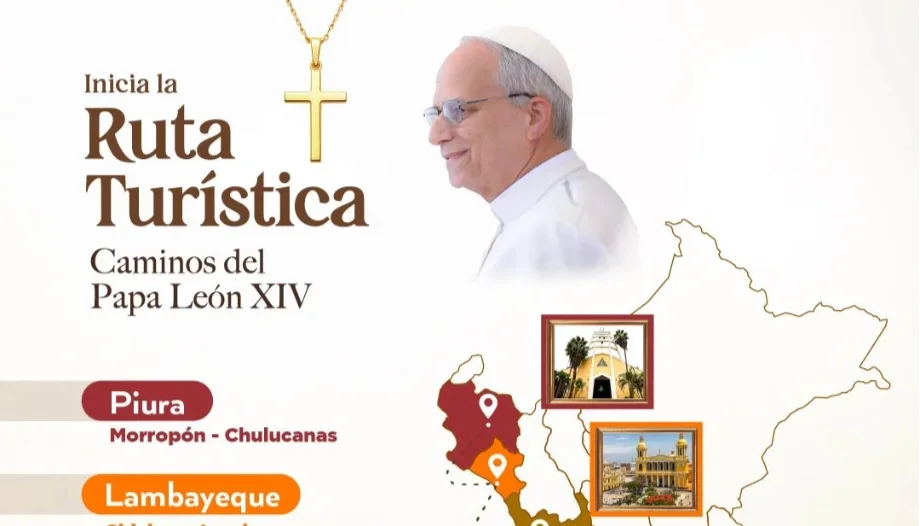
During the meeting, among other initiatives, the new “Paths of Pope Leo XIV” route in Peru was unveiled. This is the first state-sponsored religious tourism route, linking the four regions of the Pope’s pastoral journey—Piura, La Libertad, Callao, and Lambayeque—with 29 tourist attractions and 10 complementary sites. The government has invested 10 million soles (about 2.5 million euros).
The tour weaves together faith, archaeology, and nature: the Cathedral of Chiclayo, the Shrine of Our Lady of Peace—which the Pope will visit from November 10 to 14—the Cross of Chalpón de Motupe, which attracts one million visitors annually; the Divine Child of the Miracle of Eten—a contender to become the world’s sixth Eucharistic city—, the Chapel of Santo Toribio de Mogrovejo on the 300th anniversary of his canonization, the Pómac Forest, the Royal Tombs of Sipán Museum—the «Tutankhamun of the Americas»—and the Pimentel spa.
Other initiatives
The event also promoted the first Ibero-American Forum of Cities with Marian Shrines, a civil society initiative that will take place in Luján, Argentina, on October 19 and 20, bringing together 23 mayors and 23 bishops from dioceses with national Marian shrines.
Mario Maldonado Samayoa, former Deputy Minister of Cultural Heritage and former Guatemalan representative to UNESCO, recalled his country’s Holy Week, designated by UNESCO as Intangible Cultural Heritage of Humanity in 2022, which brings together 7,000 people on Good Friday in a procession lasting more than 12 hours, organized by 42 volunteer committees working without pay. In this region of Central America, the regional nomination of the devotion to the Christs of Esquipulas—practiced in El Salvador, Guatemala, Honduras, Nicaragua, Costa Rica, and Panama—was announced, with the aim of securing its inscription in December.
As another highlight of religious tourism in the Americas, Fabián Rojas, mayor of Zipaquirá (Colombia), recalled his work with the diocese to promote the Salt Cathedral, “Colombia’s first wonder.” He announced the Colombian religious tourism conference, which would take place “180 meters underground.”.
We couldn't leave out a mention of The Basilica of Guadalupe, the world's most visited shrine, with 22 million pilgrims a year; it can accommodate seven million people in three days and employs more than 400 people.
More than just visiting sacred sites
At the conclusion of the conference, attendees signed the so-called “San Salvador Manifesto: For Religious Tourism That Humanizes, Transforms, and Develops Regions.” “It is not merely a matter of visiting sacred sites, but of participating in experiences that connect human beings with the transcendent, with the historical memory of peoples, and with the symbolic richness of their traditions,” the text states.
He warns: “Economic development must not take precedence over the spiritual essence of this practice. The excessive commercialization of sacred spaces jeopardizes their profound meaning. It is necessary to establish management models that foster respect for sacredness, preventing places of worship from becoming mere tourist attractions devoid of meaning.”.
“We recognize the importance of the spiritual dimension as the core of religious tourism. Beyond its tangible effects, it offers people the opportunity to pause, reflect, and reconnect with what is essential. In a global context marked by speed and fragmentation, these spaces of silence and contemplation take on incalculable value.”.
The statement distinguishes between religious tourism and pilgrimage. “Pilgrimage involves an explicitly spiritual motivation, marked by sacrifice, devotion, and the journey itself as a transformative experience. Religious tourism, on the other hand, encompasses a broader reality that includes cultural and historical motivations. Far from being opposed, these two phenomena can complement each other and enrich the visitor’s experience.”.
Finally, he explains, “This San Salvador Manifesto is presented as an invitation to rethink religious tourism from a holistic, ethical, and humanistic perspective.”.





 Español
  English
  Italiano