


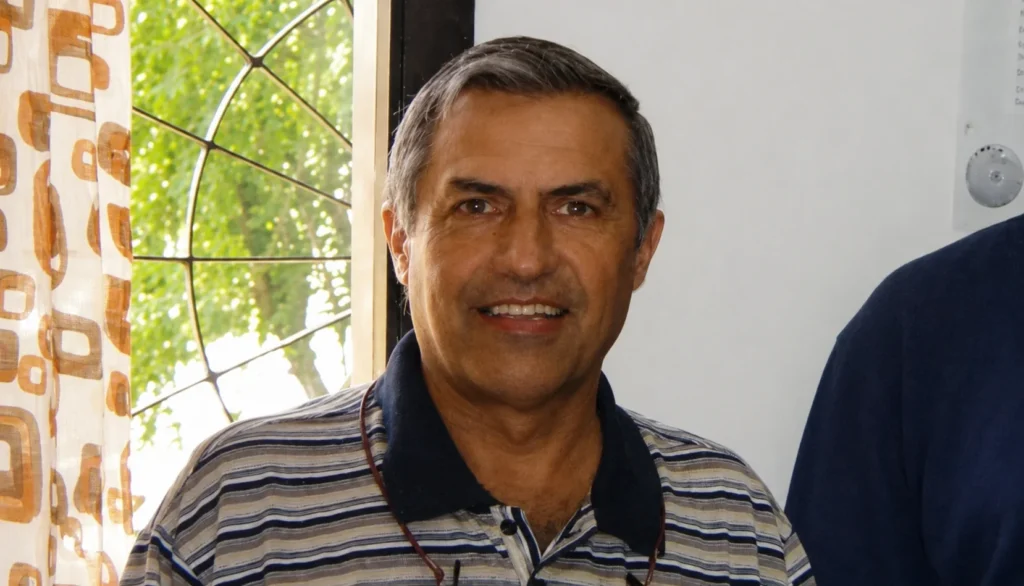
There are priests we imagine sitting behind a desk, and priests we see under the trees, out in the open, sharing their lives with a tribal community. Father Alejandro is one of the latter. A Comboni Missionary from Cantabria, he arrived in Chad in 1978 with the hope of spreading the Gospel. Forty-nine years have passed. Today he is the dean of his congregation in the country, and he remains in Sarh, Chad’s third-largest city, with a parish comprising 25 communities of the faithful, 180 baptisms last Easter, and 50 young people who are eager to serve and live out the faith with all its demands.
What was your arrival in Chad like?
—There were nearly a dozen of us Comboni Missionaries who arrived in 1978, spread across three communities, working on initial evangelization with a fledgling catechumenate that needed to be strengthened. We drew inspiration from the experience of the White Fathers in Burundi, Uganda, and Burkina Faso. The result was a catechumenate lasting three and a half years, with a focus on the family.
Why do they focus on the family?
—Because here it is very difficult to instill the Christian perspective on marriage. In rural areas, women are not held in high social regard: they are largely treated as commodities to be exchanged between families. We must highlight what the Gospel teaches: that women are mothers, educators, and wives on the same level as their husbands in God’s plan. This must be proclaimed and preached constantly.
Most of the country is Muslim—what was Islam's message to the people?
—Their message is clear: “Become Muslims, because you’ll have plenty of women and financial opportunities.”. It's that straightforward. And that carries weight in a society where polygamy is culturally entrenched. Currently, Muslims make up about 55% of the population.
Today, as the Christian presence in Chad approaches its 100th anniversary—Chad will celebrate this centennial in 2029—Catholics account for about 20% of the population, and Protestant churches account for another 24%. But this growth is primarily due to adult baptisms. Last Easter, the Diocese of Sarh recorded 3,500.
Were almost all of them adults?
—Adults and young people, yes. The rules for the baptism of children are so strict that very few are baptized. Both parents must be baptized; they must actively participate in community life—not only in religious practice but also in community service—and it must be evident that the children’s Christian upbringing is guaranteed.
And how do we provide pastoral support to those who cannot yet be baptized?
—There is an informal category: people we call friends or supporters. They participate in parish life, in meetings, and in celebrations. They are members of the community who have received a baptism of desire. This is of enormous importance, because it maintains a weekly connection with the community rather than leaving them out in the cold.
What other forms of community life support this ministry?
—One of the traditions passed down from a Jesuit who worked in the area is the Lenten retreats: three days in the open countryside where communities leave their homes to pray, go to confession, and discuss their pastoral cases.
When you say «outside,» do you literally mean outdoors?
—Yes, in the countryside, under the trees. For those who have jobs, it takes place over three consecutive Sundays. In my parish, there are groups of 150–200 people who participate in these in-depth retreats. They come to present their situations, to seek confession, and to talk about what they’re going through. That’s where many of the year’s confessions take place. And people also come who cannot receive the sacrament but who want a blessing or to talk about their situation—so they can move forward and not feel alone.”.
How do you feel when you return to Spain and see the contrast?
—When I celebrate Mass in my hometown during vacation, I see how Spanish society has changed. Few people participate in the sacramental life—mostly older people, and hardly any young people. What a difference. In Sarh, I have 50 young people between the ages of 14 and 16 who help with the liturgy and ask me to lead retreats for them. When a 17-year-old girl tells you she wants to become a nun, you realize that our pastoral work is making an impact. When a young man who’s just finished his college entrance exams considers a life of missionary work, I tell him: “Whenever you’re ready, come see me, and we’ll begin a process of spiritual accompaniment to help you discern.” Working this way is very fulfilling.
During his most recent trip to Africa, Pope Francis spoke candidly about the issue of cohabitation among the African clergy. How is this issue being addressed in Chad?
—This problem here may be less severe than in other places, but it clearly exists as well. The bishops are clear: if a man has children, he should leave the priesthood so that he can properly care for them and his wife. If he later wishes to continue supporting the Church—with his family situation in order and a job that provides for him—he may do so.
How can these situations be prevented?
—With a strong community life: it is better to close a parish than to have an isolated priest. We strive to ensure that they live in teams, pray together, and are able to talk and share. And if there is a problem—with alcohol or anything else—we must address it head-on. Spiritual life, community life, and pastoral life are the three pillars we strive to nurture. In some dioceses, after ten years of priestly ministry, priests are sent to study for one or two years to renew their spiritual life. Just as they are called to provide spiritual guidance, they also need to receive it.
What, ultimately, does the Gospel do in a society like Chad's?
—A town without a Christian community has its own way of life, its own character. When the Gospel enters, it begins to work. The Lord has His own ways of transforming people. He gives meaning to human relationships and family life. He gives them perspective and hope. And that is truly remarkable.






 Español
  English
  Italiano
  Français
  Deutsch
  Polski
  简体中文
简体中文