



 ""The best way to help families is to leave them in peace": pro-life advocate in Vilnius
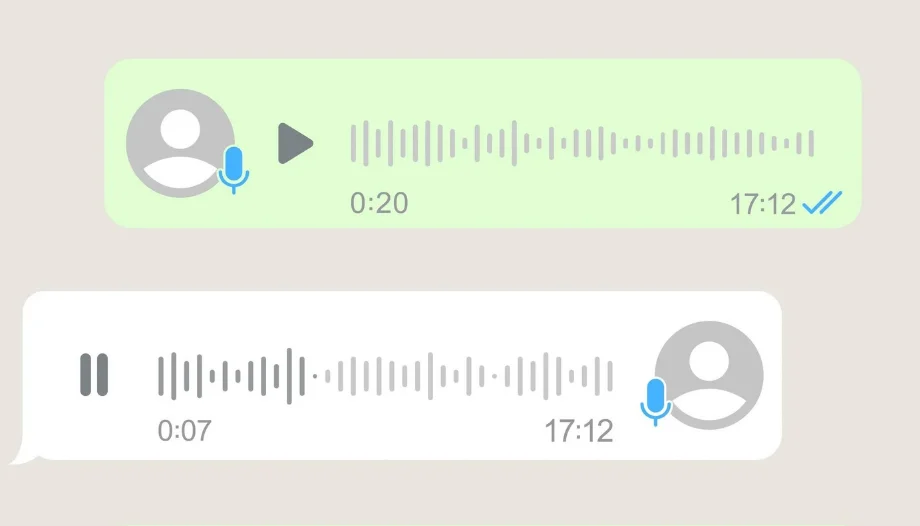
Imagine you’re in the middle of a busy workday and then your phone buzzes with a notification from Whatsapp or Messenger. You see a contact's name, but instead of a clear text message, there is only a grey audio wave and a timestamp showing you received a voice message that is 4 minutes and 42 seconds long.
Now to find out what this person needs, you cannot simply glance at your screen for two seconds and read text. You must either pause your music, reach for your earphones, step out of a quiet room, or hold the phone awkwardly to your ear in public. And when you finally press play, the first forty-five seconds consist of ambient traffic noise, sighing, and verbal filler: “Hey… so, um, I was just thinking… let’s see, what was I going to say? Ah, right…”
What was meant to be a quick exchange has now become a scavenger hunt for basic information.
My repeated experiences with receiving voice messages have made me ponder if perhaps this mode of communication contains a potential problem. My concern is focused on violations of charity, the wastage of time and if the discipline of clear communication is damaged via the use of voice messages.
The Language of the Heart
It goes without saying that morally, spiritually and theologically, voice messages are not inherently evil or sinful. In fact, in one specific context, they are beautiful.
When a mother sends an audio clip of her toddler laughing to a far-away grandmother, or when spouses send short, love-filled voice messages saying "I'm praying for you today" or "I love you," the voice message is doing exactly what it was made to do. In these moments, the tone is the message. The emotion, the cadence, and the presence conveyed through the human voice are the primary gifts being given. Here, efficiency does not matter, because affection is not an administrative task.
The problem arises when we take a medium built for affection and force it onto everyday logistics, work requests, and informational updates.
Chaotic Communication
In the Summa Theologiae, Saint Thomas Aquinas defines prudence as “recta ratio agibilium”, where he explains that prudence is the right reason applied to action. Hence prudence dictates not merely the truth of what we communicate, but the governance of how we communicate to ensure the good of our neighbor.
Meanwhile the Catholic philosopher Josef Pieper, notable for raising awareness of Aquinas's philosophy in the early 20th century, viewed prudence as the foundational virtue for all other virtues. In his view, prudence is viewed as the capacity to see reality as it truly is and to transform objective truth into good action.
Collectively this means that when we communicate, we must understand the situation of the person receiving our messages and objectively ensure that we understand the reality they are in and the reality of what our medium of messaging imposes onto them.
Written text requires the sender to do the heavy lifting upfront. Before we type a sentence, our brain must organize our thoughts, edit out fillers, and distill meaning. Writing requires a small act of self-discipline and a micro-sacrifice of our time to ensure that the reader can consume our thoughts effortlessly in seconds. This internal filtering process embodies the rational stewardship of the Logos (John 1:1).
A voice message inverts this act of service. The sender gets to talk freely while driving, walking a dog, or making coffee. The reciever is then forced to act as an unpaid editor, listening in real-time and sifting through verbal fillers to extract the actual point of the message.
While it is understandable that typing a message requires work and effort, and sending a voice message is quicker and easier, does that not sound selfish? Is not prioritizing our own lazy convenience over our neighbor’s peace and attention a subtle failure of self-sacrificial love?
The Nightmare of Dates, Times, and Details
The imprudence of voice messaging becomes obvious when handling concrete logistics. Consider a message like this: "Hey! So for next Tuesday—wait, no, Thursday—let's meet at Cafe Elma on 4th street around 7:30 PM. Or maybe 8:00 PM if Mark comes. Also bring that €50 you owed me from last week."
If this is sent as a text, the recipient can glance at it, lock their phone, and easily search "Cafe Elma" later to confirm the details.
If this exact message is buried inside a two-minute voice note, it becomes a permanent inconvenience. Three days later, standing in a parking lot, the recipient cannot search for a voice message. They must scrub back and forth through an invisible timeline, listening to the voice message just to remember if the meeting was at 7:30 or 8:00.
When a message contains dates, times, locations, numbers, or action items, sending it via voice note is an administrative failure. It locks practical truth inside a box of time, making life harder for the person we are supposed to be helping. In this case a phone call would be prudent since both participants can communicate, discuss and finalise details in real time.
We must also consider the fact that not everyone replies instantly to a message. Some people prefer to re-read a text, discern the best course of action and then reply. It becomes harder to formulate a response to a message when that message is conveyed in audio form. It requires multiple replays and consumes much time.
Redemptio Temporis
Saint Paul urged the early Christians to "redeem the time, because the days are evil" (Ephesians 5:16). Hence "Redemptio Temporis" encourages us to use our time wisely and to reclaim it from worldly distractions. At its core, time is not an infinite commodity, rather it is a finite gift entrusted to us by God for prayer, family, work and genuine service.
Some may argue that when we flood our friends' and colleagues' inboxes with voice messages, we contribute to what Pope Benedict XVI warned against in Caritas in Veritate and his message for the 43rd World Communications Day, namely, a technological culture that offers the illusion of proximity while generating spiritual noise and superficiality. We steal small moments of quiet from someone’s day and replace them with the chore of audio decoding.
Practicing prudence in our digital communication does not mean abandoning technology. It simply requires an act of ascetic consideration, similar to what classical spiritual authors like Saint Alphonsus Liguori called the mortification of personal convenience for the good of another.
Before pressing the record button, we ought to ask whether the format serves the listener or merely satisfies our own ease. Unless we are transmitting affection, sympathy, or song, charity perhaps suggests us to exercise the discipline to pause, organize our thoughts and write them down rather than speak them out.






 Español
  English
  Italiano
  Français
  Deutsch
  Polski
  简体中文
简体中文