



The papacy has never been a single “type”. Some popes arrive as statesmen, others as scholars while others as missionaries. Some are forged by suffering, others by the long discipline of governance. The Church does not choose from a catalogue. Providence provides a pontiff with a history and that history tends to surface in the way he leads.
If you want the quickest clue to Pope Leo XIV, it is not a slogan or a school of theology, rather it is a degree. He is a mathematician and that says a lot.
He studied at the Augustinian run Villanova University and graduated with a degree in mathematics in 1977, before entering the Order of Saint Augustine later that year. That detail is not decorative; it is diagnostic since it tells you what kind of mind is now sitting on the Chair of Peter.
Mathematics does not merely train you to be “good at sums”. It trains you to be relentless about structure. You learn to spot patterns, test assumptions and prove what you claim. Most importantly, you learn the order matters.
Get the sequence wrong and even correct elements produce a false result. Get the sequence right and the problem clears. Slowly and cleanly, like the first rays of sunlight driving away the darkness of confusion.
This is the mental habit that Pope Leo XIV brings into a Church that often feels pulled in four directions at once.
When numbers meet Augustine
Then comes the second formation, which is not academic but rather spiritual in nature.
The Pope is an Augustinian. And one of St Augustine’s core insight is that spiritual disorder usually comes not from loving bad things, but from loving good things in the wrong order. The tradition calls it ordo amoris — the right ordering of love.
It is also profoundly practical. Christ himself gives a sequence when asked for the greatest commandment: love God first, then love your neighbour. The point is not sentimental but rather proportional. Put God first and the rest finds its way and measure. Putting anything else first and even noble loves become burdens.
Here the Pope’s two lenses begin to overlap. Mathematics insists on right sequence. Augustinian logic insists on right ordering. Together they form an instinct: to settle first things first, so that we may have the peace to do what must be done.
The Leadership Implication
Seen through that lens, Pope Leo XIV’s likely governing style comes into focus.
He will not chase every urgent headline. He will not treat the Church like a machine to be optimised. He will return, again and again, to first principles. What is the Church for? What must be protected so that everything else remains Catholic? What must be simplified so that mission does not drown in motion?
Because the modern Church does not suffer from a lack of good priorities. It suffers from an excess of them. Evangelisation concerns, safeguarding the needs of the poor, doctrinal formation and clarity, internal unity, external diplomacy and so on. All necessary. All good. But not all first. And not all at once.
That is where a mathematician’s discipline becomes pastoral. It refuses the tyranny of “everything now”. It forces a harder question: what must come first so that everything else becomes possible?
The Consistory that revealed the method
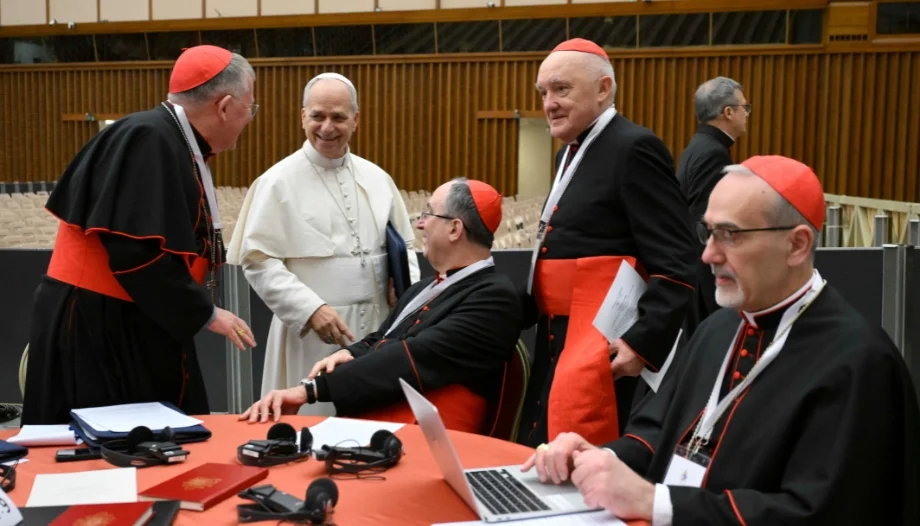
That is why Leo XIV’s first extraordinary consistory, held 7–8 January 2026, mattered. Not because it produced instant headlines. But because it showed a method.
“I am here to listen,” he told the cardinals at the opening. He asked them to speak succinctly so all could speak. Then he used an old Roman maxim — Non multa sed multum: not many things, but much.
This was not the language of a man eager to dominate the room. It was the language of someone trying to bring order to the agenda before trying to “solve” it, with a focus of depth.
And the first concrete result fits the narrative almost too neatly.
From four proposed themes, the cardinals voted by a clear majority to focus future reflection on mission and synodality, leaving curial reform and the liturgy for later. Pope Leo XIV told them he needs “to be able to count on you” as the Church moves forward. He framed the consistory in Christological terms. Explaining that it is not the Church that attracts, but Christ; and division, he warned, scatters the faithful.
What makes this approach unique is that Pope Leo XIV has already signaled that this consultative rhythm will continue. A second extraordinary consistory is scheduled for 27–28 June, and Vatican reporting indicates he wants these meetings to become regular, even annual. The Pope has also confirmed the October 2028 Ecclesial Assembly, pointing to a long horizon rather than quick fixes.
In the grammar of a mathematician-Augustinian, this was the first bracket. The rest of the equation will follow. For now, the order is set: God first, then the work.
Founder of "Catholicism Coffee".




 Español
  English
  Italiano