



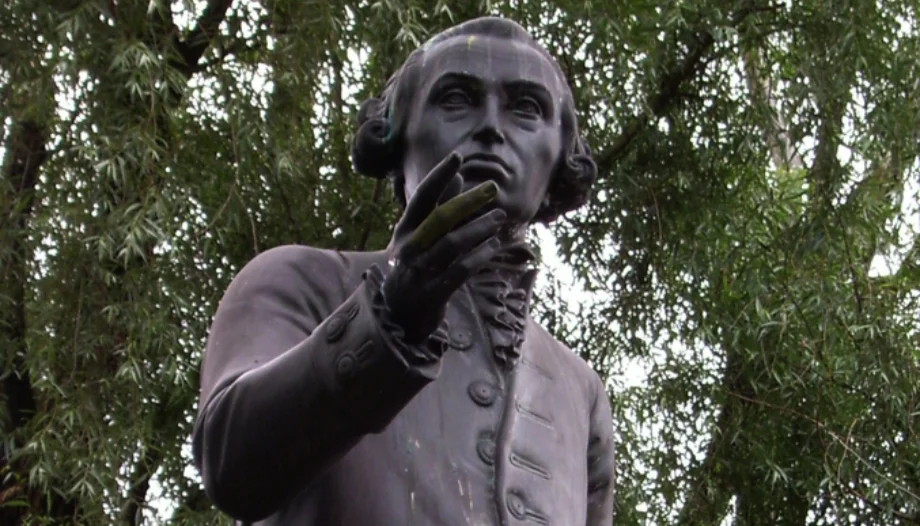
 "The Discourse on Method by René Descartes."John Locke's "Essay Concerning Human Understanding".David Hume's "Inquiry Concerning Human Understanding".
A shorter version of this article can be here.
"My soul," it accused me, "and I trembled—"
As Tongues of Diamond had reviled
Everyone else accused me—and I smiled—
My Soul—that morning—was my friend—
Her favor—is the best form of disdain
Toward the Artifice of Time—or Men—
But her disdain—it would be easier to bear
A finger of enameled fire—
Emily Dickinson
(My soul—he accused me—and it was a torment—
as if tongues of diamond had rebelled.
Everyone else accused me—and I just smiled—
My soul—that morning—was my friend—
Her favor—that is the greatest disdain
toward the artifice of time—or of men—
But his disdain—he'd rather put up with
a red-hot iron finger— )
“Act in such a way that the maxim of your will could at all times also serve as the principle of a universal law.” Immanuel Kant
(Act in such a way that the maxims of your will also serve as the basis for a general law)
A) Presentation
It is a commonplace in philosophy that everyone who acts—even those who commit the gravest crimes—acts for the sake of some good, that is, for something that, in some way, they have understood—whether mistakenly or not—to be good for them. The moral question, then, is not whether or not we tend toward the good—which is beyond doubt—but rather what we regard as good, that is, what our reason, in its practical use, presents to the will as its own good (the practical use of reason is contrasted with its speculative use—that is, the use by which we merely know the truth of things, without any reference to how we are to act upon them. The subtle distinction between practical reason and the will is rather Thomistic. In several passages of Kant’s book, it becomes clear that for this philosopher, “practical reason” is synonymous with “will.”)
The determinations of our reason, in its practical application to our will, are of two kinds: they can be personal maxims—that is, resolutions we adopt as our own ways of acting (Kant gives as an example the maxim of working and saving in youth so as not to suffer poverty in old age); or they can be moral norms, which we may also call moral laws, since they are universal: these are the modes of behavior that our practical reason holds every person ought to follow. These are, therefore, abstract and a priori; that is, they do not concern the desire for something concrete and known from our experience, but rather a determination by which practical reason directs our will toward a general way of acting. Their very form—by which they can be proposed as the principle of universal legislation—makes them, in and of themselves, practical laws, and the freedom of this pure will lies in its independence from the material conditions that distinguish one individual from another. It is, therefore, pure practical reason—that is, prior to any specific ordering of our practical reason. It is a pure will within us, in the sense that it is a norm that must govern our specific volitions. The dictates of this pure practical reason are not demonstrable, in the sense that we can deduce them from prior knowledge; rather, they serve as our starting point for demonstrating the morality of specific actions.
The most universal of these maxims is what Kant calls the “Fundamental Law of Pure Practical Reason”—that is, the first moral law that our conscience imposes on us as a categorical imperative, meaning without any proof whatsoever; rather, all other moral laws can be derived from it, to the point that it can be considered the form of any moral law:
“Act in such a way that the maxim of your will may always, at the same time, serve as the principle of a universal law
In other words, act in such a way that your conduct can be held up as a universal standard—or, to put it simply: as you feel everyone else should act. To make this more familiar to us, let us note that this is simply another way of expressing the Golden Rule, which Jesus said sums up the Law and the Prophets: “Do unto others as you would have them do unto you.” In fact, this golden rule is found, exactly as stated, in the moral teachings of all the great religions, so that it is regarded as the foundation of every moral norm. St. Jerome explains it very well: “Justice is God’s judgment, which He inscribes in the hearts of humankind: Do not do to others what you would not want done to you.” Who does not know that murder, adultery, theft, and all forms of greed are the evils we would not want inflicted upon ourselves? If we did not all know that these things are evil, no one would complain when they are done to them.”
However, Kant, of course, sets forth this principle in a way that reflects the universality of the norm as much as possible, since universality is a central theme throughout Kant’s thought. Indeed, when I ask myself whether I would want this particular course of action to be the way others always act toward me, what I am actually asking is whether I would want all people, in general and at all times, to act in this way. The answer we give to this question is the moral value of this action.
Regarding the way in which this first and general moral law serves as the form for all others, Kant asserts that when we ask ourselves whether a norm of behavior is universalizable, what we are actually asking is whether the very nature of human action would be destroyed if everyone acted in that way, for example, if everyone were to systematically lie. There is no doubt that this would destroy our relationships. Human society itself would be impossible. Lying is, therefore, immoral.
“What! But each person if one were to allow oneself to deceive others when believing it would provide an advantage, or were to consider oneself authorized to end one’s life as soon as one is overcome by a complete weariness of it, or were to view the misery of others with complete indifference—and if you were a member of such a society, would you find yourself there of your own free will? Now, everyone knows that if they secretly allow themselves to deceive, that does not mean they permit everyone else to do so, or that if they behave without compassion, unnoticed, that does not mean everyone else will immediately share that same disposition toward them… If the maxim of action is not of such a nature that it withstands the test of being a law of nature in general, it is morally untenable. Even the most ordinary mind judges this way; for the law of nature always lies at the foundation of all its judgments, even the most ordinary ones…”
Thus, it is not that the moral law tells us what is good or what is evil, nor that it inclines us toward the good or toward the evil, but rather that what is good or evil is what our conscience, in its moral judgment, dictates or commands us to reject, thereby ordering our multitude of desires.
And why does the moral law bind me? Every man knows the answer: because it is my duty. Its coercive power lies in the fact that if I were to act otherwise, I could not help but feel self-contempt. Duty compels reason as an approval or disapproval of ourselves, depending on how we act; as a feeling, yes, but not one of pleasure, rather a feeling of respect for a certain way of behaving, for an example that is universal and humbles the particularistic selfishness of other behaviors. It is the behavior that, when seen in others—even in people of the humblest station, perhaps even in one’s own subordinates—inspires even in the most powerful ruler a feeling, perhaps unacknowledged, of respect. It is the inevitable respect we feel for the universality we perceive in that specific way of acting: this is how everyone—and I, too—should act. It is the innate respect for that universality that our petty and self-serving behaviors cannot achieve—behaviors we may indeed dare to engage in, but would never dare to propose as universal, or to suggest that others do the same to us. It is the deep humiliation of the powerful figure who cannot help but acknowledge, in the depths of his heart—and perhaps very much against his will—the superiority of an action he cannot help but admire, even as he despises himself.
In fact, not all of us can achieve happiness, but we can all fulfill our duty: “Fulfilling the categorical imperative of morality is within everyone’s reach; fulfilling the conditional, empirical precept of happiness is rarely possible, and even then only with regard to a single intention.”
Kant also expresses all this in more philosophical terms—let those who can understand it do so—but these terms do not add much more to what has already been expressed in these plain terms. Let us recall that he had previously asserted, in his Critique of Pure Reason, that our speculative knowledge is achieved through a priori forms of our own faculty of cognition—forms that are therefore universal and equally valid for everyone, since we all possess the same faculty of cognition. They are “a priori” because they are not derived from any experience but are innate in us, and they are “forms” because they in some way constitute the form—or rather, “give form”—to all experience. In the realm of sensuous knowledge—or knowledge through images or intuitions—these a priori forms, which must therefore be called pure intuitions, are space and time; in the realm of the understanding—that is, knowledge through concepts—the a priori forms of that faculty, or pure concepts, are what philosophy had come to call categories, or modes of predication (kategorein = to accuse, to say something about something or someone); among them was the philosophically primary category of causality, a bastion of classical philosophy that had been toppled in the philosophy immediately preceding Kant by David Hume; and finally, in that higher speculative cognition that is our reason—our cognition through ideas—there are also three a priori principles or pure ideas: The World—that is, the unity or harmony in everything external to me—the unity I presuppose and whose pursuit is my attempt at understanding. I, that is, my own unity, which exists within me, for I am one, not one hundred and fifty. And God, the guarantor of unity between the World and me—that is, the guarantor that the faculty of knowledge given to me has not been deceptive—Descartes’s favorite theme. Well then, the argument of the book we are now discussing—Kant’s Second Critique—is that a priori knowledge also exists in practical reason, that is, in the human will. That a priori knowledge, or pure will, which exists within us without being directed toward any specific object but rather in a general sense, is the moral law.
This is the categorical imperative within us, not deduced from anything nor subordinate to anything, but rather, on the contrary, it directs the will through the sense of duty that is innate in man—a sense of duty from which man cannot detach himself (and even at times, much to his regret); it is an a priori principle in practical reason, which also derives its universality from this; and it is the form of every concrete determination of our will. Continuing with this parallel, Kant observes that the role of this a priori principle was passive in speculative reason, in the sense that it served us for that passive observation of reality which is the knowledge of what reaches us through the senses. In contrast, the role of a priori reasoning now, in the realm of practical reason, is active, for it determines the will in that creation of reality which our actions constitute.
Kant then addresses the question that has distinguished the major ethical systems proposed in philosophy. Generally speaking, there is agreement that the object of the will is the Good, by the very definition of this concept. In this sense, the primary object of the will must be called the Supreme Good—that is, the one whose pursuit as a final goal is the primary driving force behind all human action; it is that which the will seeks in every concrete action. However, the various moral schools have differed in their conception of the nature of this Supreme Good.
Kant recalls that the Epicureans identified Happiness as the Supreme Good of the will. For them, happiness is what every person ultimately seeks through their actions, and this should not be interpreted as separate from the pursuit of virtue, for it is through a virtuous life that happiness is attained.
The Stoics, on the other hand, identified the Supreme Good with Virtue, arriving at positions similar to those of the Epicureans, since they also equated the virtuous life with the happy life, viewing happiness as always the consequence of virtue.
Both, then, agreed that Happiness is equivalent to Virtue, viewing the former as a consequence of the latter; but the Epicureans identified Happiness as the Supreme Good, and said that to attain it we must act virtuously; whereas the Stoics placed the Supreme Good in Happiness, understanding Virtue as a necessary consequence of it. There is, therefore, more nobility in Stoic moral philosophy than in Epicurean philosophy.
But in any case, and in considering both moral schools, Kant believes that both were mistaken, for it is not true that a happy life necessarily follows from a virtuous life in this world: someone who has lived with complete integrity may in the end find themselves deprived of everything and even led to the gallows. Kant finds it helpful that in his own German language, “Good” is “Gute,” as opposed to “Böse,” or evil, and that a precise distinction is made between “Gute” and “Whol,” a word that comes to mean well-being. The fact is that, for Kant, the Supreme Good that our moral conscience proposes to the will is the Fulfillment of Duty, and if one wishes to call the fulfillment of duty a virtuous life, then let us say that the supreme good is the virtuous life—but purely and selflessly, without expecting anything in return, without expecting it to lead us to happiness in this life.
It leads us, however, to a certain analogue of happiness, and Kant is pleased to find the expression in his own language: it leads us to “being content with oneself.” Kant gives the example of a man who refused to be bribed by a king (Henry VIII), who wanted him to give false testimony so that he could execute someone (Anne Boleyn), and upon his refusal, stripped him of his office, his wealth, his fame, and finally even his life, for he was put to death while despised by friends and family, since everyone believed the witnesses the king had brought against him to exact revenge. It cannot be said that his integrity was rewarded with happiness, but what is certain is that deep in his heart he was pleased with himself. As he climbed the steps to the scaffold, he would have thought that he would have done the same thing all over again.
In fact, Kant points out that this ethical conception is consistent with Christian teaching, in which the Supreme Good of the will—the driving force behind all its actions—is love of God above all else, and in which every virtue is a virtue only if it is directed toward that selfless end, which is love. To help us see the connection with his ethical conception, he reminds us that love of God does not consist in a sensory experience, as can be the case with human love, but rather in a radical and profound movement of the will: according to the literal teaching of Jesus himself, it is not the one who says “Lord, Lord” who loves God, but the one who keeps his commandments. It is, therefore, a matter of fulfilling our duty.
In fact, already at the end of the *Critique of Speculative Reason*, when our idea of God had emerged as a mere a priori of speculative reason, this way of restoring the reality of God in *Practical Reason* was already hinted at: It is not that I know this is my duty because I know that God has commanded it of me. Rather, I know that there is a God who commands it of me, because I know that it is my duty.
In the *Critique of Practical Reason*, however, he places greater emphasis—in comparison with other ethical systems—on the undeniable theme of the universal longing for happiness. Kant understands that the error of the Epicureans and Stoics was to equate a happy life with a virtuous life, which, as has been noted, is clearly not necessarily the case in this life. By doing so, the ancients lost the possibility of tracing back, precisely for that reason, to the existence of God, and they also lost the possibility of proving, precisely for that reason, the immortality of the soul, as the sole guarantee of the fulfillment of that longing for happiness in every human being. The happiness of the soul beyond this life is the reward for a virtuous life governed by one’s conscience. Thus, although only in the end, the fulfillment of duty and happiness are identified with one another. And so in Christianity, where thes The Beatitudes—Jesus Christ’s great promise of happiness—are not something that will come to pass here on earth, but rather a hope for eternity. For Christianity, like any moral system properly understood, is not a doctrine about how to be happy, but about how to become worthy of happiness. And for Christians, the ultimate end of man is not primarily not its own happiness, nor even its ultimate bliss, but rather—like the purpose of all creation—the glory of God.
We also recover, within the realm of speculative reason, the idea of freedom—which was the subject of an antinomy in the *Critique of Speculative Reason*, that is, a situation of perplexity that was resolved there by setting aside causality, and thus our freedom, as an a priori form of our knowledge, rather than a reality. In the Critique of Practical Reason, causality—which in the Critique of Pure Reason remained a mere possibility—is restored in all its reality, for without it there would be no moral responsibility, and one could not speak of good or bad acts; rather, everything would be of equal value: There would therefore be no merit in virtue, and thus no reason whatsoever for a virtuous life to be rewarded with happiness, in this life or the next. Immanuel Kant, as an analyst of his own philosophy, observes that in the realm of practical reason, the three ideas of the Self, the World, and God, as well as the principal category of causality, are restored as realities. All of these had been left in the Critique of Pure Reason as mere “possible” realities, but not knowable in the speculative realm, where they appear only as a priori forms of our own cognition. (In this way, Kant understands that he has given Hume his due by removing the category of causality from speculative reason, but at the same time he has surpassed him by restoring it in practical reason.).
But he recommends proceeding with caution: it is not that now, in the realm of speculative reason, these are reclassified as “noumena”—that is, as something known through sensory experience— for God, the soul, and causality will always remain, so to speak, something hidden from us, something we do not see.
At this point in his discourse, Kant wonders whether nature has not, in fact, acted toward us like a stepmother by concealing from our faculty of knowledge those realities—God and the immortality of the soul—that would guarantee a happy ending for those who fulfill their duty. But he immediately adds that, on second thought, it has been better this way, because in that case it would have been the desire for the reward that would have motivated us, and not the noble and selfless sense of duty.
The last part of this work deals with the methodology of practical reason (I have not included it in the already very lengthy texts). It is a very brief appendix, with interesting recommendations on the proper cultivation of our moral conscience. No sermon on our moral duty would have any influence on us if that sermon were not already within us. In fact, an interest in moral judgment is innate in all people. This becomes evident when, for example, at a social gathering, the conversation turns to speculative topics: most people do not tend to take much interest in them. But if, suddenly, the conversation takes a turn and it comes to judging some action by a specific person, even the most disinterested are drawn into the discussion, and everyone feels compelled to offer an opinion. Young people express opinions on these matters—and often accurately—even if they have not previously sought a thorough education. And even children—if they are of sound mind—easily distinguish noble behavior from petty behavior. But the speculative question of what constitutes good or evil is problematic only for philosophers, since to the average person these notions are as natural as the distinction between the left hand and the right hand. Return to the example from the story of the attempted bribe to get someone to slander Anne Boleyn, so that she could be sentenced to death by the courts, allowing Henry VIII to get rid of her. When he refused to yield, he was stripped of all his possessions, and his friends—and ultimately even his own family—were persuaded to revile and abandon him, until he was finally led to his execution. This is not, then, exactly a pleasant or happy situation, and it therefore offers neither the child nor the young person any sentimental or flattering moral lesson about how life rewards those who fulfill their duty. But there is no doubt that the young person listening to it immediately understands which side represents duty, and which side represents pettiness and ignobility, and is filled with deep admiration and respect for that admirable example—respect and admiration that are innate in human beings.
The method of a good moral education would therefore consist in recounting specific actions and judging them—and then assessing the intentions that motivated those who acted in that way. This would free the heart from those burdens that secretly enslave and oppress it, and elevate it above the facile sentimentality of the rewards that life offers for effort and virtue. The human heart, now free and no longer weary, would be left with no other motive than the fulfillment of its duty.
He then concludes his two *Critiques*—of speculative reason and of practical reason—with those famous and unforgettable words:
“Two things fill the mind with ever-renewed and growing admiration and awe, the more often and the longer one reflects on them: The starry heavens above me, and the moral law within me"
(Two things fill the mind with ever-new and ever-increasing admiration and respect, and all the more so the more frequently and carefully one reflects on them: the starry sky above me, and the moral law within me)
Note: I have consistently referred to the earlier work—which he titled *Critique of Pure Reason*—as the *Critique of Speculative Reason*, and I have done so for the sake of simplicity. The author himself acknowledges, at the beginning of the second work, that they should have been titled that way. The argument he offers to justify his confusing titling is flimsy. The fact is that in both spheres of reason—speculative and practical—Kant finds that pure reason, that is, a priori knowledge, is present (although my critique of both critiques will be that a priori knowledge is found only in practical reason: moral conscience).
B) Texts
Practical reason, in and of itself and without being reconciled with speculative reason, endows a supersensible object of the category of causality—namely, freedom—with reality.
Practical principles are propositions that embody a universal determination of the will, a determination to which various practical rules are subordinate. They are subjective or maxims when the condition is regarded by the subject as valid only for his or her own will; conversely, they are objective or practical laws when the condition is recognized as objective—that is, valid for the will of every rational being.
This practical rule, for a being in whom reason is not the sole foundation for the determination of the will, is an imperative—that is, a rule designated by a “ought” that expresses the objective compulsion (Nötigung) of the action… Maxims are principles, but not imperatives… The rule is objective and universally valid only when it holds true regardless of the subjective and contingent conditions that distinguish one rational being from another.
If all matter—that is, every object of the will (as the basis of determination)—is separated from a law, nothing remains of that law but the mere form of a universal legislation.
Which form is most suited to universal law and which is not is something even the most ordinary mind can discern without any instruction.
Thus, the moral law—of which we ourselves are immediately conscious (as soon as we formulate maxims of the will)—is what presents itself to us first and foremost, and reason presents it as a foundation of determination that no sensible condition can override—indeed, one that is entirely independent of such sensible conditions—which leads precisely to the concept of freedom… But how is the awareness of that moral law also possible? We are conscious of pure practical laws in the same way that we are conscious of pure theoretical principles, by observing the necessity with which reason prescribes them to us and the separation from all empirical conditions—a separation that reason points out to us. The concept of a pure will arises from the former, just as the awareness of a pure understanding arises from the latter.
Fundamental Law of Pure Practical Reason: Act in such a way that the maxim of your will could always, at the same time, serve as the principle of a universal law
The practical rule is, therefore, unconditional and, consequently, represented as a categorically practical a priori proposition, by virtue of which the will is determined, objectively, absolutely, and immediately (by the practical rule itself, which is therefore a law here)
Reason, which is incorruptible and bound by its own principles, always compares, in an action, the maxim of the will with the pure will—that is, with itself—regarding itself as a priori practice.
The sole principle of morality consists in the independence of all matter from the law (that is, from a desired object) and, at the same time, in the determination of free will by means of the universal legislative form alone… That independence, however, is freedom.
A practical precept that involves a material (and therefore empirical) condition should never be regarded as a practical law.
The exact opposite of the principle of morality is that the principle of one's own happiness is taken as the basis for determining the will.
Morality—the voice of reason in relation to the will—would be completely destroyed if it were not so clear, so difficult to stifle, and so perceptible even to the most vulgar of men.
The boundaries of morality and self-respect are so clearly and distinctly drawn that even the most untrained eye cannot fail to distinguish whether something belongs to one or the other.
The principle of happiness, while it may provide maxims, can never provide them in a way that is compatible with the laws of the will, even if universal happiness were taken as the object.
It is always within everyone’s power to fulfill the categorical imperative of morality; to fulfill the conditional, empirical precept of happiness, however, is possible for most people only rarely, and even then only with regard to a single intention.
The person who has lost the game may be angry at himself and his recklessness, but if he is aware that he cheated in the game (even if he won as a result), he must despise himself as soon as he measures himself against moral standards.
More refined, though just as false, is the view held by those who acknowledge a moral sense… according to which the awareness of virtue is immediately intertwined with contentment and pleasure, and that of vice with restlessness of mind and pain.
Thus, that contentment or uneasiness of mind cannot be felt before one becomes aware of the obligation, and that state cannot serve as the basis for it.
The very form of universal legislation—made possible by our maxim—must constitute the supreme and immediate foundation for the determination of the will.
Speculative reason was denied any knowledge beyond the objects of experience, and therefore any knowledge of things as noumena. However, speculative reason preserved the concept of noumena—that is, the possibility and even the necessity of conceiving them—and… thus, for example, freedom is entirely compatible with the principles and limitations of pure theoretical reason. [Freedom remained possible in the Critique of Pure Reason]
I always consider what [a particular maxim] would be like if it were a universal law of nature… [For example:] It is clear that, in this way, everyone would be compelled to be truthful… [Another example, considering the possibility of suicide:]The maxim I adopt, in light of my free disposal of my life, is immediately determined if I ask myself what it would have to be like for nature to be preserved in accordance with the law of that maxim… No one could arbitrarily end their life, since such a constitution would not be a lasting natural order, and so on in all other cases.
Thus, the difference between the laws of a nature to which the will is subject and those of a nature that is subject to a will (with regard to what pertains to its free actions) lies in the fact that, in the former, objects must be the cause of the representations that determine the will, but in the latter, the will must be the cause of the objects, such that the causality of this cause has its basis of determination exclusively in the pure faculty of reason, which for this reason can also be called pure practical reason.
Whether or not the causality of the will is sufficient for the reality of objects is left to the judgment of the theoretical principles of reason
Reason has its cause in a rational being; that is to say, pure reason can be regarded as a faculty that immediately determines the will.
Moral law is given, so to speak, as a fact of pure reason, of which we are aware a priori
Moral law is, in fact, a law of causality based on freedom, and therefore on the possibility of a supersensible nature
Theoretical reasoning was forced to accept at least the possibility of freedom
We have thus expanded our knowledge beyond the limits of the sensible world—an aspiration that the Critique of Pure Reason had declared to be futile in pure speculation
The objective reality of a pure will—or, in other words, of pure practical reason—is given a priori in the moral law.
I do not seek a theoretical understanding of the constitution of a being insofar as it possesses a pure will; it is enough for me simply to designate it as such, and consequently merely to link the concept of causality with that of freedom (and, inseparably, with the moral law, as the ground of its determination)
Whol [pleasant] or Übel [bad, unpleasant] always refers to our state of pleasure or displeasure… Good (Gute) or evil (Böse), on the other hand, always refer to the will, insofar as the will is determined by the law of reason to make something its object. … Good (Gute) or evil (Böse) thus properly refers to actions, not to a person’s state of sensation.
What we must call good (gut) must, in the judgment of every reasonable person, be an object of desire, and evil (das Böse) an object of horror in the eyes of everyone; therefore, this judgment requires not only the senses but also reason.
The possession of reason does not elevate him above mere animality if that reason serves only to perform the functions that instinct performs in animals
The concepts of good and evil are, in a sense, consequences of the a priori determination of the will
A priori practical concepts relating to the supreme principle of freedom can immediately become knowledge, without needing to await intuitions to acquire meaning, and this is for the remarkable reason that they themselves bring into being the reality of what they refer to
What! If everyone if one were allowed to deceive others when believing it would be to one’s advantage, or were considered authorized to end one’s life as soon as one is overcome by a complete weariness of it, or viewed the misery of others with complete indifference—and if you were a member of such a society, would you find yourself there of your own free will? Now, everyone knows that if he secretly allows himself to deceive, that does not mean he permits everyone else to do so, or that if he behaves without kindness, without being noticed, that does not mean he will immediately have everyone else against him in that same disposition… If the maxim of action is not of such a nature that it withstands the test of being a law of nature in general, it is morally untenable. Even the most ordinary mind judges this way; for the law of nature always lies at the foundation of all its judgments, even the most ordinary ones…
The driving force of human will (and of the rational being created by God) can never be anything other than moral law; consequently, the objective basis for determination must always be the sufficient subjective basis for the determination of action
Moral law inevitably humbles every person when he or she compares the sensual inclinations of his or her nature with that law
Fontenelle says: “I bow before a great lord; but my spirit does not bow.” I might add: Before a man of low and ordinary standing in whom I perceive a rectitude of character to a degree of which I am not aware in myself, I will bow my spirit, whether I wish to or not, even if I were to hold my head high to remind him of my superiority…. Far removed from the feeling of pleasure is the feeling of respect… Respect is the tribute we cannot deny to merit, whether we like it or not; we may, indeed, choose not to show it outwardly, but we cannot, nevertheless, fail to feel it inwardly.
Respect is a tribute we cannot deny to merit, whether we like it or not.
The respect we show such a person (or, more precisely, the principle that his example embodies) is therefore not mere admiration.
An action that is objectively practical according to that law—excluding all grounds for determination based on inclination—is called a duty, which, by virtue of that exclusion, encompasses practical compulsion (Nötigung) within its concept.
It is respect for the law as the sole means of determining one's will that gives rise to the awareness of acting in accordance with duty.
Duty! A sublime and mighty name. You who contain nothing pleasant that carries with it insinuating flattery, but rather demand submission—though without anything that arouses natural aversion in the soul or frightens it… What is your noble origin?Where lies the root of your noble lineage, which proudly rejects any kinship with the passions?… It can only be that which elevates man above himself (as part of the world of the senses), linking him to an order of things that only the understanding can conceive.
Hasn’t every man, even one of only moderate integrity, sometimes noticed that if he has refrained from telling a lie—one that was otherwise harmless and would have extricated him from an unpleasant situation—it was only so that he could look at himself in private without despising himself?… To live and yet be unable to tolerate seeing oneself as unworthy of life… Such is the nature of the true driving force behind pure practical reason.
Distinguishing the principle of happiness from that of morality does not imply that the two are opposed, and pure practical reason does not require that we renounce our pursuit of happiness, but only that, in matters of duty, we should not take it into account.
Reason seeks the unconditional totality of the object of pure practical reason, under the name of the supreme good. Defining that idea is the doctrine of wisdom, and this, in turn, is philosophy, in the sense that the ancients attributed to this word
Consequently, although the supreme good is the sole object of pure practical reason—that is, of a pure will—it cannot for that reason be regarded as the foundation for the will’s determination; rather, only the moral law must be regarded as the foundation.
The Stoic maintained that virtue was the supreme and complete good, and that happiness was merely the awareness of possessing it… The Epicurean maintained that happiness was the supreme and complete good, and that virtue was merely the means of attaining it….
But the maxims of virtue and of personal happiness are, with respect to their highest practical principle, entirely heterogeneous.
Happiness and morality are two distinct elements of the supreme good… It is morally necessary, a priori, to bring about the supreme good through the freedom of the will.
We must be careful not to undermine and distort, through false praise, the moral foundation of our resolve—a kind of false madness that bases our resolve on feelings of personal joy. The true and proper driving force is the law itself.
But isn’t there any word that denotes—not a pleasure like the word “happiness,” but rather a satisfaction in one’s own existence, an analogue of happiness that must necessarily accompany the awareness of virtue? Yes, there is, and that word is “self-contentment.”.
That pleasure cannot be called happiness because it does not depend on the positive occurrence of a welcome, nor can it be called, strictly speaking, bliss.
The principles of the pursuit of happiness cannot in any way produce morality. Therefore, morality constitutes the highest good (as the first condition of the supreme good), while happiness—though a secondary element of that good—is the morally conditioned but necessary consequence of the former.
The immortality of the soul as a postulate of pure practical reason… The complete conformity of the will to the moral law is holiness, a perfection of which no rational being in the sensible world is capable at any moment of its existence. But since it is nevertheless required as practically necessary, it can be found only in a progression extending to infinity toward that complete conformity… An infinite progression that is possible only under the assumption of a lasting personal existence in infinity
The existence of God as a postulate of pure practical reason … That same law must also lead to the possibility of the second element of the supreme good, namely, the happiness appropriate to that morality … that is, to postulate the existence of God as necessarily belonging to the possibility of the supreme good.
In moral law, there is not the slightest basis for a necessary connection between morality and happiness
It is also posited that there exists a cause of all of nature, distinct from nature itself, which contains the basis for that connection—that is, for the exact correspondence between happiness and morality
The supreme cause of nature—insofar as it must be presupposed for the supreme good—is a being who, by reason and will, is the cause (and therefore the creator) of nature; that is, God.
Those who see the purpose of creation as the glory of God (assuming that this is not conceived anthropomorphically as a desire to be exalted) have arrived at the best expression of this truth. For nothing honors God more than what is most precious in this world: respect for His command.
The postulates of pure practical reason in general. These postulates are those of immortality, freedom… and the existence of God.
Now, these are ideas of reason that cannot be derived from any experience, which I would have to think about in terms of categories in order to understand them.
Of the concepts through which we conceive of a pure being of understanding, nothing remains but that which can be demonstrated as the possibility of conceiving a moral law… although knowledge of God exists only in the practical relationship.
However, it is impossible to arrive at the concept of God and the proof of His existence through metaphysics as a certain conclusion based on our knowledge of this world, for to do so we would have to know this world as the most perfect whole possible.
I see order and purpose in nature before me, and I do not need to resort to speculation to be certain of their reality; rather, I need only assume the existence of a divinity as their cause in order to explain them.
Now then, is our knowledge truly expanded in this way by pure practical reason—so that what was transcendent in the speculative realm is now immanent in the practical realm? Undoubtedly, but only in a practical sense. For we do not, in truth, thereby come to know either the nature of our soul, or the intelligible world, or the Supreme Being, as they are in themselves; rather, we have subsumed their concepts under the practical concept of the supreme good—as the object of our hope—entirely a priori through pure reason, solely by means of the moral law, and also solely in relation to the moral law itself, in view of the object it prescribes.
[If God had made Himself present to our speculative reason, like any other reality—if He had allowed Himself to be seen], most actions in accordance with the law would be motivated by fear, few by hope, and none out of duty; and the moral value of actions—upon which alone the value of the person and even that of the world depends in the eyes of supreme wisdom—would not exist.
[In speculative reason], the Ruler of the world allows us to surmise his existence and majesty, but not to see or clearly demonstrate them; in contrast, the moral law within us, without promising or threatening us anything with certainty, demands selfless respect from us.”
[Thus], the inscrutable Wisdom through which we exist is no less worthy of veneration for what it has denied us than for what it has granted us.
c) Criticism
My criticism is not directed at the content of Kantian ethics—a wise project by a man of integrity for whom I have nothing but praise (a truly admirable treatise)—but rather at its foundation, a point on which I will disagree. I agree that, once the Critique of Pure Reason has been written, once speculative reason has been deprived of the possibility of reaching God and human freedom—the foundations of religion (the bond between creature and Creator)—the best thing to do is to write the Critique of Practical Reason, that is, to recover them in the practical realm. That is why I raise my objection not to this Critique but to the two works as a whole—something I obviously could not have done until I had also outlined the content of the Critique of Practical Reason. It is the total philosophical project—the one described by the two books—that interests us and to which I am going to offer a critique, because it is this project that will ultimately influence subsequent philosophy, as we will discuss shortly.
Said Aristotle that the skeptic doesn't bother him, because as soon as he starts saying something, he contradicts himself, and if he says nothing, he isn't a nuisance either, since he's right there beside him, quiet as a plant. Well, although I appreciate this humorous trait of the Stagirite, I don’t think he’s right, and in fact, history has proved him wrong. The skeptic can say something without contradicting himself: he can say “I’m going to do this,” just like that, without any justification whatsoever, since any justification he might offer would amount to a self-contradiction. In a word, the way out of all skepticism is practice. The replacement of theory with practice, of the norm with what I am going to do, of truth—grounded in the way things are—with my will. Ultimately, the will takes the place of being as the ultimate foundation.
Well, I believe that Kant’s philosophical stance as a whole is that of a skeptic: with our speculative knowledge, we cannot prove the existence of God, nor the immortality of the soul, nor freedom. We can know nothing as it truly is, since what we know are the a priori forms of our own cognition, and even if one of these a priori forms is God, this is not the God who truly exists independently of us. Since we cannot know any forms other than those of our own cognition, we recover these fundamental realities through our practical reason—that is, we do not attain them in the realm of cognition but in that of the will. In Kant, this happens in a marvelous way: we arrive at God because we grasp the moral law as given in our will. But what will remain as a legacy for philosophy is the gesture: Being, as it is, has been wrested from cognition and recovered in the realm of the will—exactly the gesture of the skeptic.
We will see this in the work of his foremost follower, Arthur Schopenhauer. In his work The world as will and representation Schopenhauer first treats the world as a mere representation, as something that undoubtedly appears in our knowledge. But, he then asks, what is it that is represented? What takes the place of the “thing-in-itself” in Kant’s work? What, ultimately, takes the place of reality when we know? And the answer is striking (though expected by anyone familiar with the skeptic’s line of reasoning). The answer is: What is represented is the will.
What is represented in knowledge is not being, but the will! The will, then, placed precisely in the place of being! What was implicit in Kant, in the philosophical gesture of the two Critiques taken together, is now made fully explicit in Schopenhauer, who has not only restored coherence to Kant—as he himself states is his intention—but has made it explicit, the very core of his philosophy, and even the title of his book. The path toward Nietzsche’s philosophy of the will is thus now open.
Nietzsche, for whom Schopenhauer was the greatest of philosophers in his youth, later renounced him and thereby rid himself of what he considered superfluous—representation—since the will alone was enough for him. That is the essence of the world, the will to live, and to that end, in the conflict of the wills to live among different individuals, the will to survive by imposing itself on others. In this way, the better individuals will survive the inferior ones, and the species will improve: *The Twilight of the Idols*. Nietzsche considered himself a posthumous author. And, unfortunately, he was.
If we combine this critique from the *Critique of Practical Reason* with the earlier critique from the *Critique of Pure Reason*, we can see that Kant serves as a prelude to nineteenth-century philosophy, which in turn serves as a prelude to twentieth-century political history. For those of us familiar with that history, this is not the highest praise we could have bestowed upon Immanuel Kant’s two Critiques.
Complutense University of Madrid. SCS-Spain.







 Español
  English
  Italiano
  Français
  Deutsch
  Polski