




 Georges Lemaître: when the universe is born between science and faithThe temptation to divinize the universe
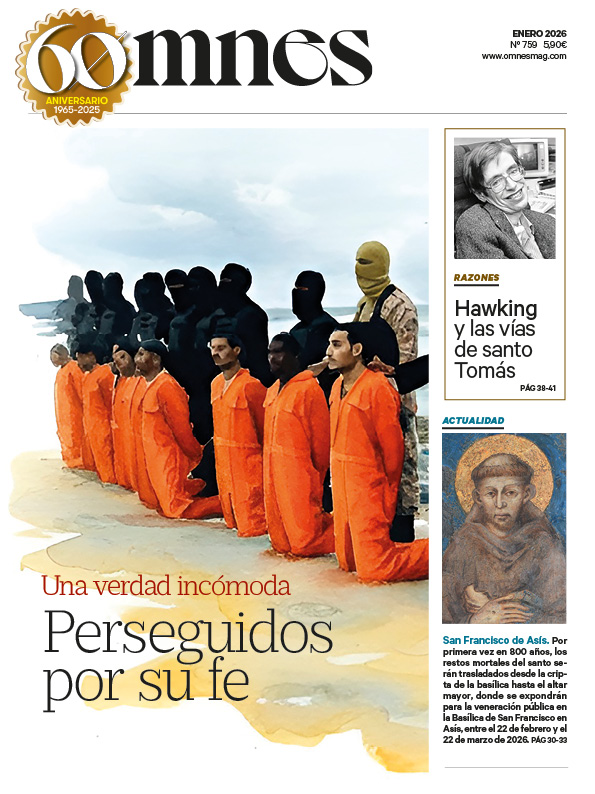
If we were to ask which author and which book have most shaped our current view of the cosmos, the answer would be almost unanimous: Stephen Hawking and his celebrated History of time. Without being the first to talk about cosmology, more than 25 million copies sold support this publishing phenomenon and the physicist who wrote it. The stated goal from the beginning is to unravel the mysteries of the universe with those who dare to look beyond: “where did the universe come from, how and why did it begin, will it have an end, and, if so, what will it be like?”.
From Aristotle to contemporary cosmology, from the immensity of the universe to the minuscule scale of quarks, Hawking guides us on a fascinating journey from the initial singularity to black holes, trying to glimpse what the God who created everything might be like. Along the way, the book addresses topics as diverse as space-time, creation, relativity, indeterminacy, origin, destiny, causality, divine freedom, belief, the anthropic principle, fine-tuning, the “boundaryless” universe and imaginary time. All of them, impregnated with philosophical and theological reflections, require a contextualized reading, such as the one proposed by Stephen Hawking (1942-2018). Critical study of “History of time: from the big bang to black holes”. This work seeks to complement from philosophy the journey that Hawking undertakes from classical physics to glimpse the thought of God.
Confirmed hypotheses and discarded hypotheses
Hawking's explanation of the picture of the universe according to 20th century physics is captivating. Big bang, The cosmic expansion, cosmic expansion, initial and boundary conditions, singularity, space-time curvature, quantum indeterminacy, subparticles, fundamental forces, black holes and even the famous Hawking radiation are clearly exposed. Although highly speculative hypotheses that time has left behind are also presented.
This is how science works: it launches new hypotheses based on what is scientifically known. However, most of these hypotheses do not survive when contrasted with reality. Only a privileged few prevail. For this reason, the ideas that Hawking puts forward in the last chapters of his book have been discarded. All except the one that refers to the need to search for a unifying theory for the two great theories of physics: general relativity and quantum mechanics.
However, it is important not to confuse this unification of theories with a “theory of everything”. Hawking, however, aspires to a physical theory that explains everything. In this framework, and if this were possible, God would cease to be necessary to justify a universe as ordered and singular as ours.
Hawking's proposal
Hence Hawking's bold proposal of a self-contained universe “without boundary”. This hypothesis has been rejected from physics because there is no continuity between models with imaginary time and models with real time; but it can also be refuted from philosophy, since a model can never explain reality itself. It would be like saying that a hologram of a person gives a reason for the person.
Scientific activity is much richer than the simplification to which Hawking subjects it, who reduces it to finding laws in nature and fixing the initial conditions for these laws. Even so, this starting point serves him, first, to relegate God to the role of provider of initial conditions, and then, having reduced divine action to that moment, to formulate his “boundaryless” universe. How? Let us say “rounding off the fine point of the beginning of the universe” so that mathematically there is no beginning; and thus concluding that, if his hypothesis were true, God would not be necessary.
This conclusion that “it is not necessary to invoke God as the one who lit the fuse and created the universe.”, is without foundation. Indeed, by failing to demonstrate that the universe is self-contained, the question of God as Creator is revived. Hawking's intention to replace the classical argument of God as First Cause with a theory of everything should rather lead us to rediscover the soundness of that classical argument.
Fine adjustment
Perhaps the time has come to look again at the universe with wonder, as Hawking does, and note how finely tuned are many physical constants essential for it to exist. Among them, the density of the universe (Ω), the acceleration of the expansion (Λ), the three spatial dimensions; fundamental constants such as the strong nuclear interaction (ε), the ratio of electromagnetic to gravitational forces, the masses of the neutron and proton; or the fine-tuning of the mass-energy distribution in the big bang.
But not only that. Also deeply striking is the order we see in biology, where complexity and nonlinearity of interactions reign harmoniously and where embryology reveals that the order of nature, not only spatial but also temporal, is a true symphony that unfolds in time.
That from something as poor, minimal and seemingly chaotic as the big bang, The only way for something as richly complex as conscious beings to emerge is if, in that “poor “The seed of the “..." was already present at the beginning.“wealth”. Something that refers us, not to a shapeless chaos, but to a Logos Creator, a Subsistent Being by himself, from whom all created beings participate in his being and to whom all created beings have as their foundation. This relationship of dependence, this participation in Being, seems to be a very appropriate way to understand the richness of the concept of creation, without remaining only with the two most common meanings: to understand creation as divine action or to understand creation as created reality.
The deserved credit
In addition to restoring God to the place that by common sense and philosophical reasoning He seems to occupy as Creator, we should recognize that belief and trust are part of our way of knowing. We all have belief systems, even scientists; and many times they are deeply rational. Believing and reasoning are not opposites, as Hawking suggests, but complementary. That is why it is also fair to value what “believed” thinkers such as Aristotle, whose knowledge, well contextualized, allows us to appreciate the truth of his ideas and reasoning, despite the difficulties of his time.
In this Critical Study The ideas presented so far are developed in more detail and some of Hawking's contributions, little or not at all recognized, are also vindicated.
The First Cause
Among the arguments that Hawking examines in his book, it is striking that he barely dwells on one of the most relevant: that of the necessity of a First Cause, not only in a chronological sense -as a beginning-, but in an ontological sense, that is, as a necessary foundation of the contingent. In his formulation, Hawking affirms: “One argument in favor of an origin (...) was the feeling that it was necessary to have a ‘First Cause’ to explain the existence of the universe.” (p. 28).
Some terms, such as origin, may be misleading if their analogical use is not considered. In fact, origin can allude both to the beginning of something and to its foundation. For this reason, the quoted phrase gains in precision if it is substituted for origin by basis. Likewise, the use of sensation in this context seems inappropriate, as it suggests a subjective impression rather than an argumentative reasoning. Finally, the verb have introduces the idea that certain individuals need an explanation, but not necessarily all, which weakens the universal character of the argument.
Taken together, the sentence could be rephrased as follows: An argument for a foundation [of the universe] was the reasoning that it was necessary for a ‘First Cause’ to exist to explain the existence of the universe.
This reconstruction reflects more faithfully the position of those who sustained this argument: it was not simply a sensation, but a rational reflection on the necessity of a First Cause. Let us see what this argument consists of in order to better understand the philosophical perspective that many thinkers have defended over the centuries in affirming that God can be the ultimate foundation of the universe.
Aristotle and Thomas Aquinas
The expression First Cause comes from Aristotelian thought, in particular from his conception of the First Motor, which in the scholastic tradition was applied exclusively to God. The other causes, that is, those created or belonging to the intramundane realm, are called second causes, inasmuch as they depend on the first and are subordinated to it. In Aristotle's philosophy, the first cause is that which gives the reason for the existence of a thing. Thus he expresses it: “We do not believe we know something if we have not first established in each case the ‘why’, which means to grasp the first cause.”(Aristotle 1995, II-3, 194b). This statement, applied to the universe, suggests that understanding it implies intuiting or recognizing that its First Cause is God.
The argument for the existence of God as First Cause is of the following type a posteriori, The most well-known formulations of this reasoning are the five ways of St. Thomas Aquinas, which constitute a philosophical approach, not based on revealed theology. The best known formulations of this reasoning are the five ways of St. Thomas Aquinas, which constitute a philosophical approach, not based on revealed theology.
Context of the argument
To establish the framework of the argument, we could reflect on how we know people through their manifestations, and transfer this principle, by analogy, to the philosophical question of the knowledge of the existence of God. We can ascertain the presence of an individual through the traces he leaves in the world, such as tilling a field, beautifying a space or composing a verse. We do not gain access to the person in his essence, but we do affirm his existence through his effects on reality; and, indirectly, we could infer his need for nourishment, his sense of beauty or his desire to communicate. This mechanism is the one we apply when trying to decipher our ancestors through the fossil and cultural remains that survived. By extension, one could reasonably sustain the existence of a God with a personal character by observing with wonder and awe the complexities of our universe, and in particular human nature.
A further step would be to get to know the person through direct sensory perception. However, this initial contact would be insufficient without observing his behavior. The deepest way to know him would be, in fact, through the manifestation of his external works and especially if he reveals to us his inner universe. That is to say, when she confides to us what she harbors in her spirit, the motivations for her actions, her ideas and her feelings. But this intimate dimension remains hidden, unless the person decides to reveal it. This is where the idea that God is not only accessible through his external works, but that he also longs to reveal himself personally, makes full sense. This second type of knowledge constitutes the object of theology, which is not limited to the reality that human reason can attain through the observation of all its dimensions, but embraces the possibility of a personal self-revelation of God.
In the Christian perspective, this revelation is consummated in the incarnation of a God who becomes man and manifests himself to concrete individuals through his words and actions. However, this is not the God of whom Hawking speaks, nor is it the focus of our present reflection. Ours is an enterprise of philosophical argumentation. Therefore, let us examine more rigorously the argument of St. Thomas associated with the concept of First Cause.
Difficulties in demonstrating the existence of God
In approaching this argument, Thomas Aquinas begins his exposition by resolving certain logical objections concerning the divine existence. The first difficulty resides in the fact that all demonstration requires knowledge of the nature of the subject about which one reasons, and of God, precisely, we do not know his essence. Of God we cannot really know what he is, but rather what he is not. The question then arises: how can we prove his existence? Or, formulated in another way, what do we mean when we affirm that he exists?
For Aquinas, our knowledge of things is based on sensible experience, and this is the starting point for accessing the existence of God. It is possible for us to know the effects that God produces and the way in which these effects are related to the Cause that originates them. The argumentation starts, therefore, with the definition of God that is constructed from the effects that we perceive. This definition is not God Himself, but in some particular way expresses and manifests the divine essence. The initial definition taken is: “God is something that exists above all things, that is the principle of all things, and that is separate from all things.” (Twetten, On Which ‘God’ Should Be the Target of a ‘Proof of God's Existence).
What it means to be First Cause
In this formulation, the crucial element is to determine the nature of God as a cause. To achieve this, St. Thomas first establishes its distinction from other causes by means of negation, pointing out that it is a cause essentially different from the others; secondly, he makes clear its relation to other realities: it is the first cause and is separate from them. That is to say, the point to investigate is the existence of the First Cause, understood not in a temporal sense of origin or beginning, but in a sense of fundamental perfection, transcendent and distinct from all subsequent causes.
A First Cause is postulated which is, necessarily, unique. A cause that is not located among the realities of the universe, which are all contingent (including parallel or sequential multiverses, if they exist). A cause that is transcendent to the universe and superior to it. This is what is required for the unfolding of the five ways: a singular First Cause, distinct from the second causes and separate from them...“and we call this God”, as each of the five ways concludes.
Other difficulties
The second logical objection states that we can only demonstrate the existence of God from His effects, but these effects do not maintain a proportion with Him, since they are finite in nature. Nevertheless, a single effect of sufficient universality (such as motion or causality) is sufficient to infer the existence of its cause. Such an effect would be sufficient to prove the existence of God, even if it fails to express or faithfully represent His essence, much less His complete essence.
Finally, the third logical difficulty lies in the fact that these paths are not demonstrations of a mathematical or experimental nature, but their starting point is clearly metaphysical. They begin with observable phenomena, but considered from a metaphysical perspective, which makes them inaccessible to those philosophies that reject abstraction. They are therefore ineffective in persuading agnostics who also adopt a skeptical stance, since they do not accept the validity of abstraction. In order to accept the path of these ways, it is essential to admit the existence of an external world, to validate the objectivity and reliability of knowledge, and to accept that human reason can go beyond the merely sensible.
The purpose of Thomas Aquinas in formulating these five ways is to provide metaphysical thinkers with five rational ways to demonstrate the soundness of Theology, insofar as the existence of the God who, according to the theologian, reveals himself can be affirmed. That is, from a philosophical perspective, one can conclude the reasonableness of God's existence, which legitimizes theological practice based on Revelation.
With this exposition, I believe that it strengthens the idea that the First Cause argument is much more than a mere sensation. We could even venture that, by means of an investigation whose starting point is no longer the senses, but scientific knowledge that goes beyond our ordinary experience, these five ways of St. Thomas could be the object of a contemporary reformulation. For example, the first in the light of what is known about inertia, the second considering the findings about physical causality, and the fifth based on current knowledge about the fine-tuning of universal constants.
Professor of Anthropology and Ethics at the University of Navarra.




 Español
  English
  Italiano