



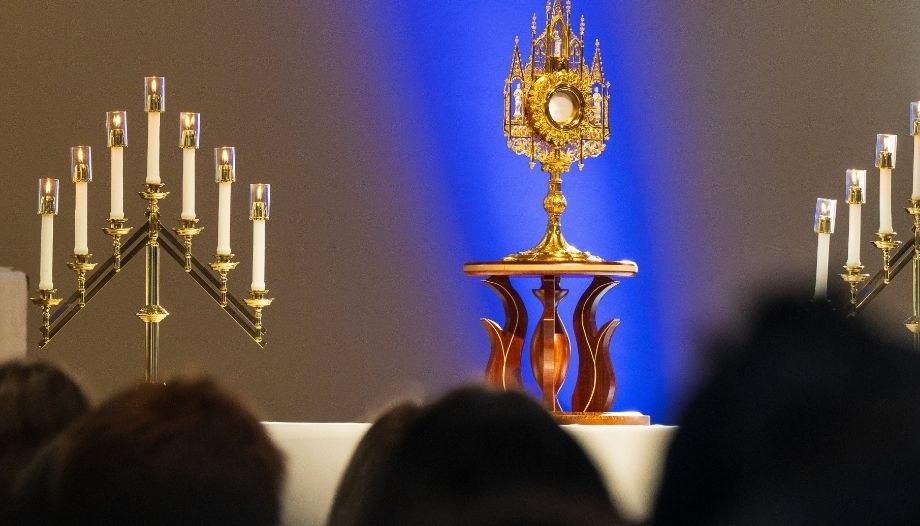
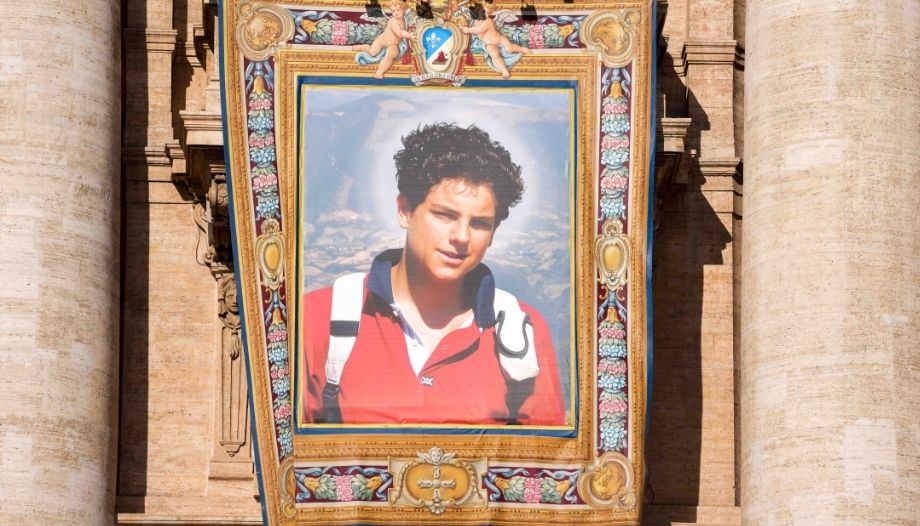
Fathers of the Church such as St. Augustine, St. Ambrose, St. Cyril or St. John Chrysostom, and great mystics and saints of the modern and contemporary age, such as the young St. Carlo Acutis, have expressed their love for the Holy Eucharist in various ways.
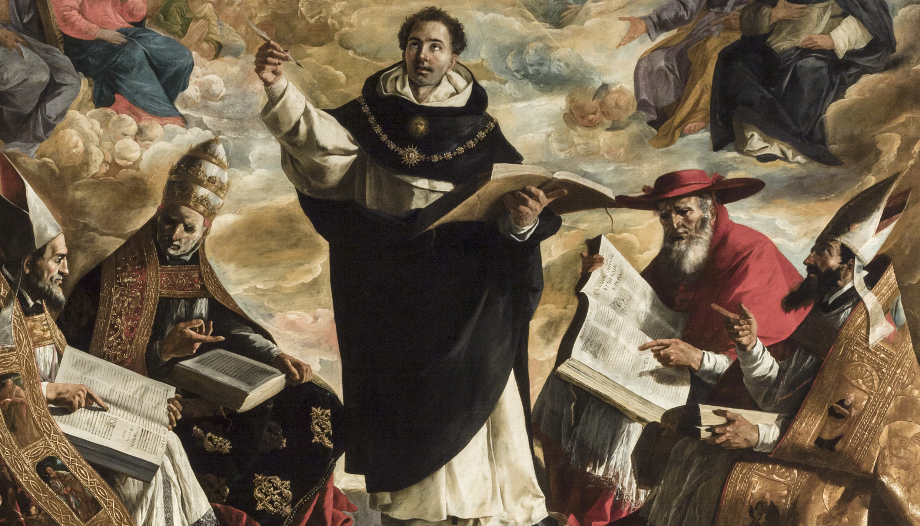
Perhaps as a preamble we should mention one who is not from the first centuries, but from whose pen have come some of the most beautiful and profound words ever written on the mystery of love of the Eucharist. This is St. Thomas Aquinas (1224/1225-1274).
The Eucharist, “the sacrament of the Passion of our Lord”.”
The Eucharistic devotion of the so-called Angelic doctor (see Benedict XVI, audiences of the days 2 y June 23rd 2010), occupies a central place in his life and work. For him, the Eucharist was not only a theological theme, but the “sacrament of sacraments,” in which Christ is truly, really and substantially present.
In his Summa Theologica he develops in depth the doctrine of the real presence and transubstantiation, but this intellectual clarity goes hand in hand with an intense life of prayer: tradition has it that he celebrated Mass with profound recollection, and that he spent long hours in adoration before the Blessed Sacrament.
For the Feast of Corpus Christi
A key moment of this devotion occurred in the 13th century, when Pope Urban IV instituted in 1264 the feast of Corpus Christi by means of the bull ‘Transiturus de hoc mundo’. The Pope commissioned Thomas Aquinas to compose the official texts for the new solemnity.
And Aquinas responded with an extraordinary work that unites doctrinal precision and spiritual beauty. From his pen were born hymns such as Pange lingua, Lauda Sion, Adoro te devote (traditionally attributed) and Sacris solemniis (from which comes the Panis angelicus), which explain the Eucharistic mystery-the real presence, the sacrifice, the spiritual food-and invite to humble adoration.
But let us look at some of these poems, and others that have come from great Fathers of the Church and saints, which are still prayed, or sung, especially on Holy Thursday and Corpus Christi.
Adoro te devote
(St. Thomas Aquinas, XIII c.)
I worship you with devotion, hidden God,
truly hidden under these appearances.
To you my heart submits itself completely,
and totally surrenders to contemplate you.
In judging You, sight, touch and taste are mistaken;
but the ear is enough to believe firmly;
I believe all that the Son of God has said:
nothing is truer than this Word of truth.
In the Cross was hidden only the Divinity,
but Humanity is also hidden here;
however, I believe and confess both,
and I ask for what the repentant thief asked for.
I do not see the sores as Thomas saw them.
but I confess that you are my God:
make me believe more and more in You,
that I may hope in You and love You.
Memorial of the Lord's death!
Living bread that gives life to man:
grant that my soul may live from You
and may I always savor your sweetness.
Lord Jesus, good Pelican,
cleanse me, O unclean one, with your Blood,
of which a single drop can release
of all crimes to the whole world.
Jesus, whom I now see hidden,
I pray that what I long for may be fulfilled:
that when I look at your face face to face:
may I be happy to see your glory.
Amen.
Pange lingua gloriosi (Tantum ergo)
(St. Thomas Aquinas, s. XIII)
Sing, tongue, the mystery
of the glorious Body
and of the Precious Blood
than the King of nations,
born of a fertile mother,
poured out as a ransom for the world.
(...)
Let us worship, then, prostrate
so great a Sacrament;
and that the ancient rite
yield to the new one.
Let faith supply
the incapacity of the senses.
To the Father and the Son
praise and rejoicing,
health, honor, power
and blessing;
and the one coming from both
equal glory. Amen.
Lauda Sion Salvatorem
(St. Thomas Aquinas, XIII c.)
Praise, my soul, your Savior;
praise your guide and shepherd
with hymns and songs.
Proclaim his glory as much as you can,
for he is above all praise,
and you can never praise him enough.
(...)
Behold the bread of angels,
made food for pilgrims;
true children's bread,
that should not be given to dogs.
(...)
Good Shepherd, true bread,
Jesus, have mercy on us:
feed us, defend us,
make us see the goods
in the land of the living.
Ave verum corpus
(Medieval tradition sometimes attributed to Pope Innocent VI, 14th century).
Hail, true Body,
born of the Virgin Mary,
that you truly suffered
and you were immolated on the cross for man.
Panis angelicus
(author, St. Thomas Aquinas, 13th century)
Bread of the angels
is made the bread of men;
bread from heaven
puts an end to the figures.
Oh admirable thing!
eat the Lord
the poor, the servant and the humble.
‘Anima Christi, Soul of Christ, sanctify me.
(Author: Traditionally attributed to Pope John XXII (XIV century), and also to St. Ignatius of Loyola, XIV-XV century).
Soul of Christ, sanctify me.
Body of Christ, save me.
Blood of Christ, embryo me.
Water from the side of Christ, wash me.
Passion of Christ, confess me.
O good Jesus, hear me.
Within your wounds, hide me.
Do not allow me to turn away from you.
From the evil enemy, defend me.
At the hour of my death, call me.
And send me to you.
So that with your saints I may praise you
forever and ever. Amen.
O sacrum convivium
St. Bonaventure (attributed)
O sacred banquet,
in which Christ is received;
the memory of his Passion is renewed;
the soul is filled with grace
and we are given the pledge of future glory.
Prayer of St. Bonaventure
(San Buenaventura)
Pass over, sweetest Jesus and my Lord,
the marrow of my soul with the softest
and most salutary dart of your love;
with true, pure and most holy apostolic charity,
so that my soul may faint
and always melt only in loving you and in desire to possess you:
who sighs for you, and is faint to be in the courts of your house;
longs to be detached from the body to be united with you.
Make my soul hunger for you,
Bread of angels, food for holy souls,
Our daily bread,
full of strength of all sweetness and flavor,
and of all soft delight.
On the real presence of Jesus
Author: St. Teresa of Jesus, XVI century
Complete poems
No heart is enough
to so much wonder:
may God be on earth
and in such a small host.
La Fonte
Author: St. John of the Cross, 16th century, (often interpreted in a Eucharistic key: Christ as a hidden and real source).
How well I know the spring that flows and runs,
although it is night...
(...)
That eternal source is hidden,
that I know well where it has its manida,
even though it is nighttime.
Aquesta eterna fonte is hidden
in this living bread for giving us life,
even though it is nighttime.
Here the creatures are being called,
and of this water they are filled, although in the dark
because it is nighttime.
This living fountain that I desire,
in this bread of life I see it,
even though it is nighttime.
Fathers of the Church, saints
Some have numerous texts on the Eucharist, such as St. Augustine, although their style is rather theological or homiletic, although in many cases they are beautiful texts, even poetic. Some fragments are extracted.
Saint Augustine of Hippo
“This bread which you see upon the altar,
sanctified by the word of God,
is the Body of Christ.
Be what you receive,
and receive what you are:
the Body of Christ”.
Saint Ambrose of Milan
“If the word of Christ could make out of nothing that which did not exist,
will you not be able to change the things that exist into what they were not?
It is not what nature has formed,
but what the blessing has consecrated”.
Saint Cyril of Jerusalem
“Do not consider bread and wine as mere elements,
for they are, according to the Lord's declaration,
the Body and Blood of Christ.
Even if your senses suggest otherwise,
that faith may strengthen.”
St. John Chrysostom
“How many say: I would like to see his face, his clothes, his sandals!
Well, here you see it, here you touch it, here you eat it.
He is given to you not just for you to see,
But that you may touch it and receive it within you.”
Saint Alphonsus Maria de Liguori
“Be assured that of all the moments of your life,
the time you spend in front of the Divine Sacrament
will be what will give you the most strength during your life,
more comfort at the moment of death
and for eternity”.
St. Francis de Sales
“Two classes of people should take communion frequently:
the perfect ones to stay perfect
and the imperfect ones to reach perfection”.
Saint Therese of the Child Jesus
“It is not to remain in a golden ambula that
Jesus descends every day from heaven,
but to find another heaven,
that of our soul, where it finds its delights”.
Saint Curé of Ars
“If only we knew the value of the Holy Sacrifice of the Mass,
what zeal we would not have in attending it”.
Saint Teresa of Calcutta
“When you look at the crucifix,
you see how much Jesus loved you then.
When you look at the Sacred Host,
You see how much he loves you now.
Saint Manuel Gonzalez
“There He is! It's Him! Jesus in the Tabernacle!
He is not alone: he lacks your company!”.
“There is Jesus in the Tabernacle: a whole God who comes from heaven,
performs the miracle of wisdom and love,
he remains silent and still,
happy to be loved, whether you treat him well or badly...
and repeat that love forever.”
Saint Josemaría Escrivá
“Jesus' humility: in Bethlehem, in Nazareth, on Calvary....
But more humiliation and more annihilation in the Most Holy Host:
more than in the stable, and than in Nazareth, and than on the Cross.
Therefore, how obliged I am to love the Mass!
(“Our” Mass, Jesus...).
Saint John Paul II
(from the encyclical Ecclesia de Eucharistia, 2003).
“The Eucharist is not just a sign or a symbol:
in it Christ gives himself to us,
and that is why the Church lives from the Eucharist”.
“The Eucharist is the sacrament of love.
that Christ has for us:
in it he gives us himself
so that we can
live like Him and love like Him”.
San Carlo Acutis
“The Eucharist is my highway to heaven.”.
“The more we receive the Eucharist,
the more we will
like Jesus,
so that on earth
we will have a foretaste of Heaven”.




 Español
  English
  Italiano