


The founding of the Order of the Immaculate Conception took place during a period of great religious vitality on the Iberian Peninsula. The figure of Saint Beatrice of Silva (1424-1492), born into a noble Portuguese family, also allows us to trace the historical figures who accompanied the birth and development of the Order, such as Isabella I of Castile, Cardinal Cisneros, and Saint Paul VI, who canonized her in 1976.
A lady-in-waiting to Isabella of Portugal, the future Queen of Castile through her marriage to John II, with whom she would have her youngest children, Prince Alfonso and the future Isabella I of Castile, Beatriz de Silva was imprisoned by the queen in a chest in Tordesillas. Tradition recounts that during the three days of her confinement, Beatriz experienced a vision of the Virgin Mary, who invited her to dedicate her life to God and to found an order consecrated to the Immaculate Conception of Mary.
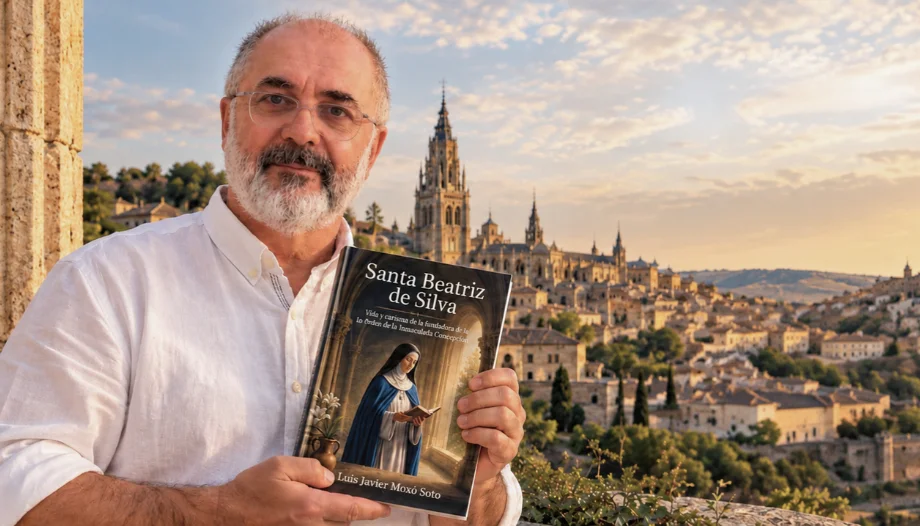
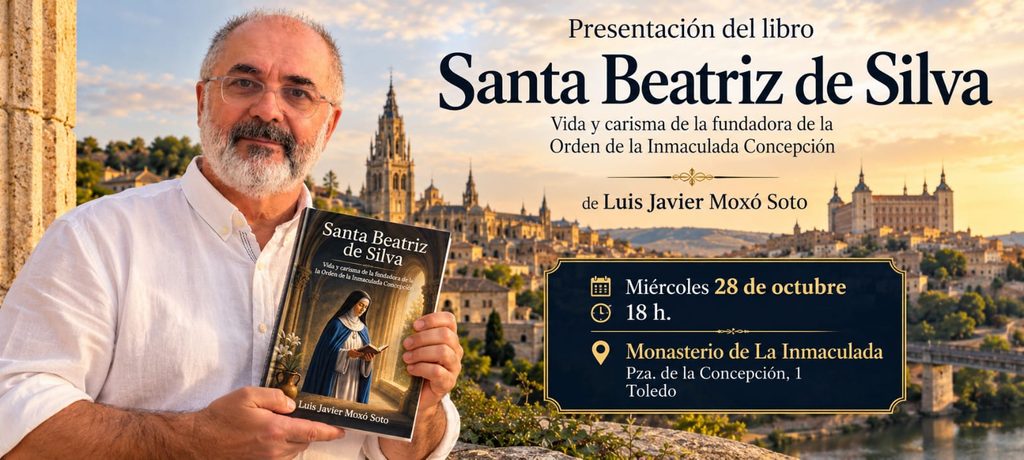
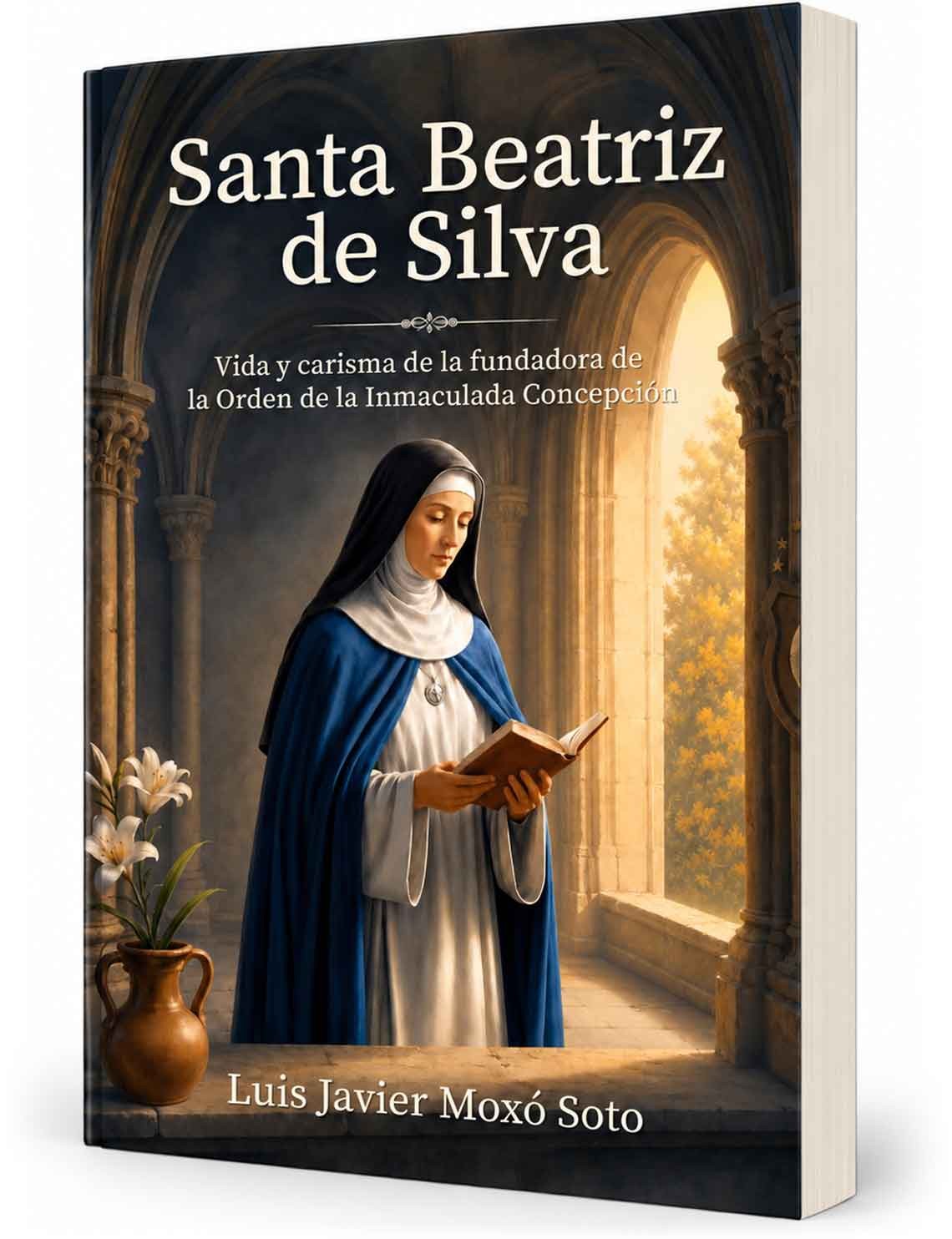
Luis Javier Moxó Soto, a well-known Catholic writer and communicator, author of '‘Entangled by Christ’The book recounts the life and charism of Saint Beatrice. It is published by Xerión and has a foreword by Fr. Santiago Cantera Montenegro, OSB.
“Devotion to the Immaculate Conception was already alive before 1854”
The title of her book combines “life” and “charisma.” What is the unique charism of Saint Beatrice?
—The center is a form of contemplative life for women, uniquely dedicated to honoring the mystery of the Immaculate Conception of Mary. It is not simply a matter of adding a Marian devotion to an existing religious rule. The Immaculate Conception shapes the identity of the community: its habit, its prayer, its founding memory, and its understanding of purity of heart, humility, and availability to God.
Put simply, Beatriz did not merely found a new house of nuns. She gave rise to a family that sought to make visible in the Church the beauty of a life entirely dedicated to God under the sign of Mary conceived without sin. This core remained stable even as the legal structure of the community underwent several phases.
The dogmatic definition of the Immaculate Conception came in 1854. Can one speak of an Immaculate Conception Order in the 15th century without falling into anachronisms?
—We must avoid two extremes. It would be wrong to imagine that Beatrice technically anticipated the dogmatic definition that Pius IX would formulate centuries later. But it would also be false to think that devotion to the Immaculate Conception of Mary was born in 1854. It was a mystery intensely celebrated, debated, and loved in medieval Christian piety, with particular strength in Franciscan and Hispanic circles.
The Conceptionist nuns lived this mystery before its solemn definition. The Church, with the dogma of 1854, did not invent this faith: it solemnly defined it as revealed truth.
Why is the Franciscan affinity so important in this story?
—Because the Franciscan world was one of the great spheres for the dissemination and defense of devotion to the Immaculate Conception. Beatriz's spirituality has a clear affinity with Franciscan values.
This affinity should not obscure the complexity of the institutional journey. The bull of Innocent VIII in 1489 initially placed the foundation under the Cistercian rule. In 1494, two interventions by Alexander VI steered the community toward the rule of Saint Clare and the guidance of the Observant Franciscans. Finally, in 1511, Julius II granted the Conceptionists their own rule.
The Church gradually gave that charism an increasingly suitable form.
“Charisma often precedes its legal form”
What do you want to emphasize about this process of ecclesial recognition?
—That grace and institution are not opposing realities. An authentic spiritual experience needs to be discerned, protected, and guided. Otherwise, it can be reduced to an individual impulse. But rules cannot replace the grace that justifies them either. In a healthy foundation, both dimensions ultimately converge.
It is very significant that the founder died without witnessing the full consolidation of the Order: she laid the foundations; other generations received the responsibility of developing them without losing the original spirit.
What was Isabella the Catholic's role in the founding?
—The queen was a providential and concrete mediator. It is important to speak precisely: Beatrice's sanctity is not explained solely by the support of a powerful protector, but without a house, resources, and social legitimacy, a foundation can hardly be sustained. The bull of 1489 confirms that Isabella had given Beatrice a house and the church of Santa Fe in Toledo, where she was already living with other women.
The case illustrates an ecclesial reality of its time: many women played a notable role in reforms, foundations, and networks of piety. They are not interchangeable figures nor do they form a uniform group, but alongside Beatriz, names like Beatriz Galindo and Teresa Enríquez appear.
That female presence deserves to be known in all its diversity.
The book presents Toledo as a theological place, not just a geographical one.
—Yes, the city plays a part in the saint's spiritual biography. Toledo is not merely the backdrop for a story that could have unfolded anywhere. Beatriz was welcomed there for many years within the circle of Santo Domingo el Real, the nascent community moved there to Santa Fe, and she died there. The city was the place where her trial became a shared vocation.
“To contemplate is to take seriously that God acts”
Beatriz's biography is marked by a very long period of secrecy. How can we avoid interpreting this as mere resigned passivity?
—Christian waiting is not inactivity. In Santo Domingo el Real, Beatriz was not “doing nothing.” She lived a concrete fidelity: prayer, penance, spiritual life, learning about community life, and maturing in a calling that had not yet taken visible form. Activity does not always coincide with what can be recounted, shown, or measured.
This is one of the saint's most profound lessons. There are human and ecclesial processes that require time. Today we are educated to demand immediate results and to interpret any delay as failure. Beatrice reminds us that a work can be born precisely when no one sees it.
“Mission is born from prayer”
What can the contemplative life contribute to the mission of the Church today?
—It gives its heart. Not in a sentimental sense, but in the most real sense: the Church cannot be reduced to structure, social action, management, or communication. All of that may be necessary, but it needs a source. Contemplation proclaims that primacy belongs to God and that mission is born of prayer.
The Conceptionist nuns arrived in Mexico around 1540, in a young Church linked to the work of Friar Juan de Zumárraga. Their presence demonstrates that evangelization cannot be sustained solely through external activity. It requires communities that pray, celebrate, intercede, and remind everyone that apostolic fruit is not simply the result of human strategy.
What idea would you like the reader to end the book with?
—With the conviction that holiness is not a museum ornament. Saint Beatrice does not propose an escape into the past, but a question for the present: what do we do with our wounds, our haste, and our need to be recognized? She responds with a life that was not defined by offense, but by self-giving.
And I would like the reader to understand that the Immaculate Conception is much more than a beloved image. It is the name of a promise of grace: God can make human life new. The story of Beatrice and her daughters has been, for more than five centuries, a silent witness to that possibility.
The book 'Saint Beatrice of Silva. Life and charism of the founder of the Order of the Immaculate Conception', by Luis Javier Moxó, it is presented October 28, 2026 at 6:00 p.m. in Toledo, Mother House of the Order of the Immaculate Conception.





 Español
 English
 Italiano
 Français
 Deutsch
 Polski