



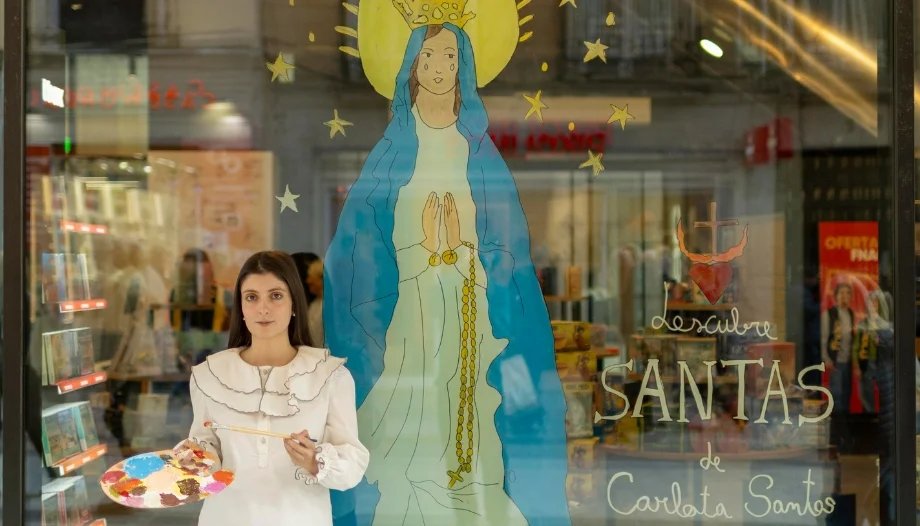
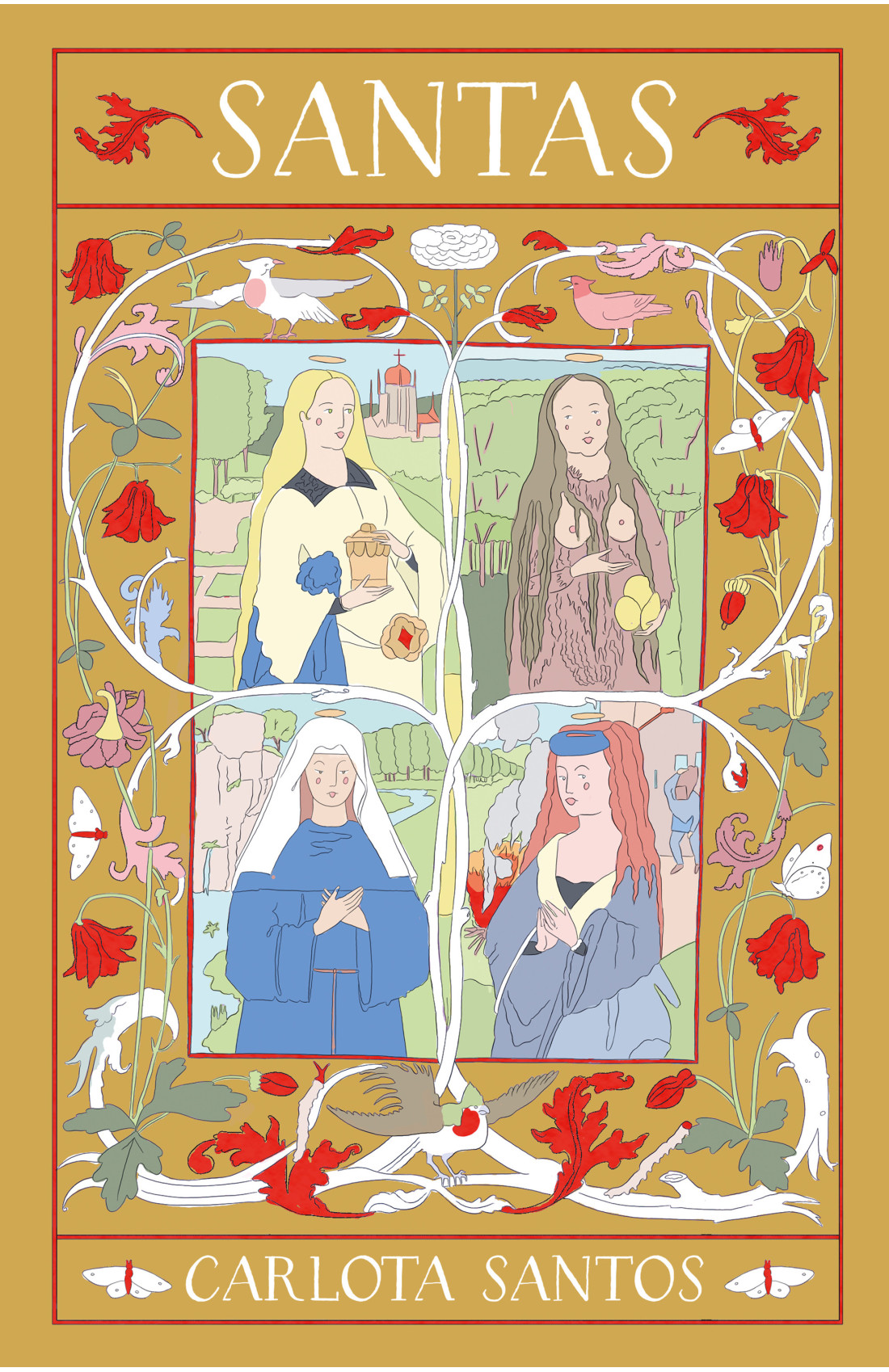
In a society that advocates for the empowerment of women, illustrator Carlota Santos (@carlotydes on Instagram) makes a counterpoint with his new book Santas. After exploring esotericism and New Age, Carlota began an «intellectual search» and found truth in Christianity. That is why she dedicates her new book to female referents of sanctity. She tries to show that the Church has always valued women, demystifying the idea that Catholicism does not recognize their importance.
Through her illustrations and stories, the artist celebrates lives of holiness and virtue, offering historical references that inspire both believers and those who approach her out of cultural curiosity.
In this interview, illustrator and architect Carlota talks about her conversion, her new book and why she believes that saints remain universal examples of virtue.
How was your transition from esotericism to Christianity?
-I went to a Catholic school, but I never fully connected with the message of Jesus at that time. I did confirmation by tradition, not by conviction. But I have always been a person who has always been very interested in classical art and symbolism.
As a result of a visual interest in tarot, I began to delve into similar subjects such as astrology and cards. All from an artistic point of view. But, in exploring it from an artistic point of view, it is inevitable to get contaminated from a spiritual point of view.
I ended up very disenchanted with everything related to the New Age, because it seemed to me that, at bottom, it boils down to a promise to feel good. Then I began to wonder, on a personal level, if in addition to these tools for wellness there was some truth, something objectively good that really existed.
From there I started researching different religions and, in parallel, the idea of doing a book on Christianity came up. It was at that moment that I started to really explore the different religious traditions. And I connected in a very deep way with the message of Jesus, as I had never done before, neither in school nor in other stages of my life. It had a huge impact on me.
I wanted to make Santas from a feminine point of view to vindicate that women in the Church have been recognized from the beginning.
In what way do you try to express in «Santas» that women in the Church are perfectly valued?
-In the course of more than two thousand years of history, there have been more than three thousand saints. What I am trying to show with this selection of fifty women, presented in chronological order, is that the Church has always recognized and valued them.
They are women who, although they all share the same goal - the good and Jesus - each one has expressed it in a different way, with her own gifts and her own personality. And yet they have all been recognized by the Church.
There are from the first martyrs, who suffered persecution and death, often for defending their ideas and standing firm in their principles, to women with intellectual concerns who were able to develop their talents in environments such as monasteries, where they found the space to fully dedicate themselves to study and thought.
On a day like 8M, what do you think saints can contribute today to the debate on feminism, dignity and the role of women in society?
-Santas are not fads, nor something passing as an attitude. Today's feminism defends the attitude of «empowerment». On the other hand, the model of the saints is more universal because each one of them defends virtues that transcend time. They are eternal references in their radical defense of the good and service to others.
Has there been any saint that has particularly touched you?
-A figure I already knew, but I have been able to go deeper and I also took the opportunity to read her own book and her memoirs, is St. Therese of Lisieux. Her main idea is that holiness is attained through small daily works, that it is not necessary to make great gestures, but to live it in everyday life. And that really touched me.
In the book you tell about your rediscovery of Christianity, what was the turning point?
-I had a small, very sudden rapprochement with God before I delved into Christianity, which was a totally absurd detail.
I remember I was having a drink with my friends when suddenly I started to see some birds there, and I thought they were so beautiful that I said to myself «how could God not exist if nature is so beautiful? I saw God in nature, and from then on I started reading and researching about different religions, about how each religion sees God, and I identified Christianity well from the first moment, and so I fully reconnected with Catholicism.
In your intellectual quest, did you overcome any prejudices?
-Yes, for example, the concept of sin. When I was a teenager and they explained to me what sin was, I saw it more as a series of prohibitions imposed by the Church. Now, however, I understand that sins are things that are going to harm you, that harm you. And God, in his infinite love, wanted to warn us about them.
I am fortunate to be a curious person and every doubt that has arisen regarding what the Church says I have investigated about it and I have been understanding the reason for many things. Obviously there is always a faith factor, because not everything is one hundred percent intellectual. It is rather reason enlightened by faith. But there comes a time when you have to trust.
Having explored esotericism, do you think a Christian can turn to yoga, tarot or explore such practices?
-My personal opinion is no. Simply because a Christian must have a radical trust in God. If you rely on other things, you are no longer fully trusting in Him. It is not compatible.
In fact, tarot and casting cards, the Church says, is dangerous. You can generate a dependence on knowing what is going to happen, on trying to control everything. And there is nothing less in keeping with the Christian than to be in perpetual worry about controlling what is going to happen. We are in God's hands and we must trust in his plans.
In today's society, one can feel a search for spirituality that hides a search for God without knowing how to identify him. From your personal experience, how would you encourage young people not to remain in superficial spiritual fashions?
-Each one has his own journey. St. Augustine, for example, went through stages far from God and explored other themes before finding Christ. The important thing is to truly seek, because, as the Bible says, he who seeks will find and he who knocks will be received.
It is also an active process: God reaches out, but it is up to us to take the step. If the search is sincere, even if it is difficult, it will lead to Jesus; staying on the surface can lead to more esoteric paths. There are no magic formulas, but the key is sincerity and constancy in that search.
You have illustrated 50 santas, what do you learn from doing this book?
-On the one hand, I have done a lot of research on Western art and how saints have been represented throughout history, and this has enriched me a lot both culturally and as an artist.
I have also gained a great deal of depth. With this book I have been able to see, by exploring so many different lives, that there is not just one model of holiness. And that is very inspiring, because you see how you can apply their virtues to your life or how it helps you to reflect on what you are doing right and what you are doing wrong. This book has also brought me much closer to the Gospel. To explore it in a more intimate way.
Speaking of the Gospel... On your YouTube blog you say that you intend to illustrate the Bible. Tell us about this project
-It all started when a publishing house contacted me to illustrate a literary classic. At first I thought of Shakespeare, because I like him a lot and it fits my style, and I started with A Midsummer Night's Dream, my favorite work.
After a few months, I said to myself, “Why not propose the Bible?” I had had that idea for some time, and when I told my editor about it, they agreed. Since the Bible is a lot, we decided to focus on the Gospel.
I am now in the initial planning stage. It is a huge project, with many illustrations, and I want to define well the axes to do it carefully.
Santas




 Español
  English
  Italiano