



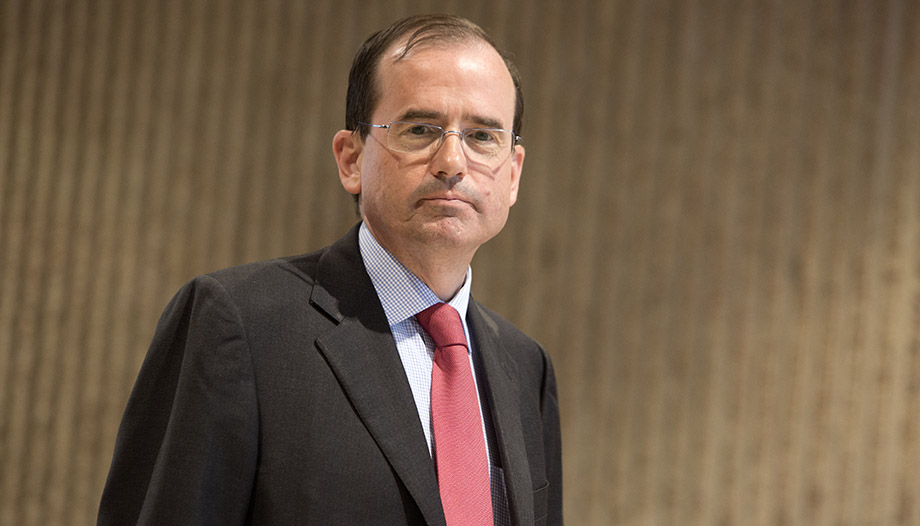
We interviewed Alfonso Aguiló Pastrana, one of the most recognized voices in the educational field in Spain and abroad. He has dedicated a large part of his professional life to educational management, pedagogical reflection and the promotion of projects with a Christian identity. He has been director of the Tajamar School in Madrid and currently chairs the Arenales Educational Network, which brings together more than thirty centers in Europe, Africa and America, as well as the Spanish Confederation of Educational Centers (CECE), which represents approximately one third of the country's private and state-subsidized education. In addition, he advises educational institutions in dozens of countries and is the author of more than four hundred articles and a dozen books on education, society and anthropology.
From your experience as a manager, what would you say is the most difficult thing today in providing a truly Catholic education?
-It is difficult to make a general diagnosis, because different things happen to each project. But, globally, we see various scenarios. There are projects that are doing very well; others, on the other hand, have lost a lot of their Christian identity; others maintain it in the pastoral area, but less so in the basic issues; others the other way around; and others have lost almost all public manifestation of the faith.
In addition, there is another important problem: there are people with a very clear Christian identity but who are not good managers. There are also good managers with a weak Christian identity. The challenge is not to choose between one thing or the other, but the unity of all aspects. The Christian vision attends to the person and the school as a whole.
If I had to underline something today, I would say that the Catholic school should distinguish itself especially for its good formation in the use of reason and for its interest in all knowledge. There are moral problems, yes, but I think there are even greater problems related to the lack of rigorous thinking. If a person learns to think well and to be a good person, Christian identity finds a well-fertilized path for growth.
«Here there is a growing problem: a minority of very demanding families, protected by overly protective regulations, is generating a culture of distrust. The teacher feels unprotected, loses authority, and that deteriorates the personal encounter, which is the most valuable aspect of education.».
Alfonso Aguiló
You mentioned the intellectual and academic dimension. What other elements do you consider essential for a school to be truly Christian?
-The viability of the project is essential. If a family provides an excellent Christian education but mismanages its resources, something is wrong. The same is true of a school. Economic and organizational viability is also part of making the talents work. Christian identity does not consist in being a character out of reality, with very lofty speeches, but who then ruins the projects he directs.
I relate it very much to the parable of the talents. We have received talents and we are called to make them work: in the more strictly business management aspect -because a school is also a business- and in the aspect of identity, purpose and mission.
In your opinion, what is the key role that parents should play at school, and what problems or conflicts currently arise in the relationship between the family and the school?
-It is fundamental to achieve the protagonism of parents, in line with the magisterium of the Church: family and school must act in a coordinated manner. But sometimes this protagonism is confused with the government of the center.
In a good hospital, the patient and his family are at the center, but they are not the ones who diagnose, operate or manage. In the school, something similar happens: the family must be central in educational care, not necessarily in technical management.
Here there is a growing problem: a minority of very demanding families, protected by overly protective regulations, is generating a culture of distrust. The teacher feels unprotected, loses authority, and this deteriorates the personal encounter, which is the most valuable aspect of education.
This is not a problem in Catholic schools or in education in general; it also occurs in medicine and other professional fields.
Do you think the current regulations are influencing this situation?
-There is a tendency to protect -with all good intentions- the rights of the child, but with a collateral effect: the teacher feels legally too vulnerable. Without authority it is not possible to generate culture, and without culture there is no real education. School is not only the transmission of content -that is clearly a downward trend-. What is on the rise is the human community that is created, and this is affected by an excess of defensiveness.
I believe that it is necessary to revise certain regulations to give authority back to the teacher. Without authority, a healthy educational culture cannot be generated. I am not talking about eliminating norms, but adjusting them. All laws need revision; that is democracy.
In many countries, the idea seems to be growing that anyone who wants Catholic education should pay for it in full. What is your opinion on this matter?
-That idea is profoundly mistaken. In almost every country in the world there is public funding of private education because, after World War II, it was understood that in order to move away from the horrors of totalitarianism, more must be done to make society plural, and for that it needs plural education. And for access to it to be plural, it must be financed.
Only between 7 % and 10 % of the population can afford private education without public support. If there is no funding, there is no real freedom of choice. The State does not finance the Church: it finances families who want an educational project in accordance with their convictions. Not to do so would be discriminatory. Just as political parties or trade unions -private institutions that operate in the public sphere- are financed, it is natural that there should be private educational centers financed with public money that guarantee pluralism, freedom and democracy. To deny this is neither modern nor democratic; it is a step backwards in terms of rights.
«There is a tendency to protect - with all good intentions - the rights of the child, but with a collateral effect: the teacher feels legally too vulnerable.».
Alfonso Aguiló
In the United States there are organizations that evaluate the “catholicity” of universities and educational centers through qualitative analysis and objective data. Do you think something like this would help in other countries?
-I am in favor of metrics, because they help to complement impressions. But measuring who is “more Catholic” is risky. It would be like ranking who is a better person.
The criteria for “being Catholic” should not be set by a private entity, but by the Church, and I sincerely do not think it is in its interest to do so. What does seem reasonable to me is to analyze objective elements: presence of the sacraments, prayer, social action, quality as a human community, care for creation, etc. Then each family will give more weight to some or others according to its sensibility. This plurality is very healthy in the Church.
You are part of the General Council of the Church in Education of the Spanish Episcopal Conference. What fruit do you expect from this work?
-I believe that one of the most interesting fruits is to generate a culture of collaboration among the institutions. Historically, each charism has taken great care of its own, which is logical and very positive, but there has been a lack of communion between charisms. The Christian message of fraternity should also be manifested in greater institutional collaboration within the Church.


 Español
  English
  Italiano