



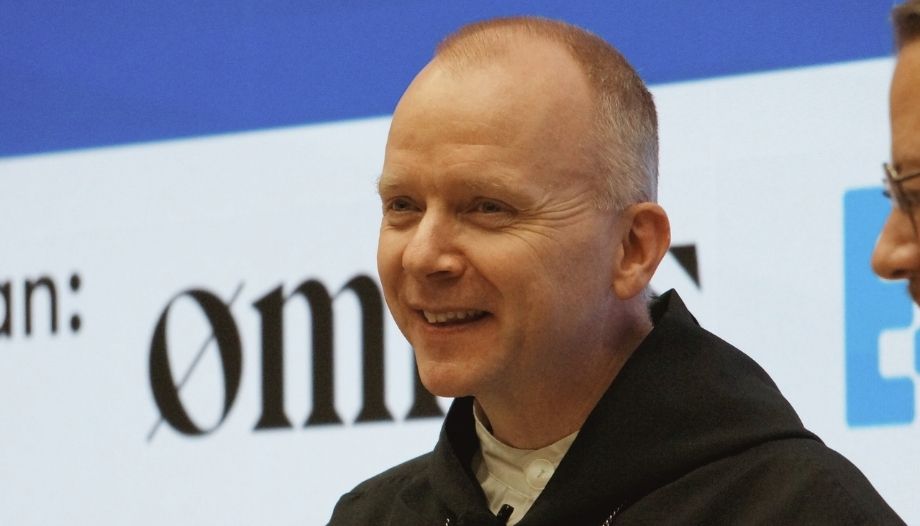
A few days ago, the Bishop of Trondheim, Erik Varden visited Madrid. In the hand of this media, of the Editorial Encuentro, where he has published his book Wounds that heal, and the Ángel Herrera Oria Cultural Foundation, Varden was the guest star of a Omnes Forum which brought together more than 250 people.
Shortly before, the Trappist monk and Norwegian bishop spoke with Omnes about the proposal of prayer and Christian reflection through the wounds of Christ that he makes in his latest publication in Spanish, as well as other current issues.
At once close and profound, Varden stresses that the universal experience of suffering and limitation changes, completely, under the prism of faith, through which “it takes on a totally different dimension and we begin to have the possibility of seeing our own wounds as potentially life-giving and life-enhancing.”.
At the beginning of Wounds that heal, You point out - as one of the characteristics of our society today - the number of people who identify with their wounds. As Christians, how do we balance the awareness of being wounded but also saved?
-To some extent, I think that's where we need faith, or at least some high moral ideal; some perception of life that allows us to transcend ourselves to see meaning outside and beyond my own experience.
Because, if I believe that I am the ultimate reality of my existence, if I suffer, that is the totality of my reality. Then, of course, I want to tell everybody about it and I shut myself up. But that's where we need something to aspire to that is outside of ourselves.
I refer to transcendence in general terms because, obviously, there are people who are not Christians or non-believers and who sometimes live with great courage wounds, illnesses, losses.
Obviously, if you are a Christian and you believe that God has entered into our human nature and has allowed himself to be wounded in our nature, in order to heal our wounds, then, of course, it takes on a whole different dimension and we begin to have the possibility of seeing our own wounds as potentially life-giving and life-enhancing, and potentially also as sources of healing. That is the fundamental paradox.
That is why I put, in the book, as an epigraph that phrase from Isaiah: “By his wounds we are healed”. To the extent that we allow our wounds to join their wounds, then our wounds can also be sources of healing for ourselves and for others.
As Christians, the Passion does not end in itself, but in the Resurrection. How can we live these two sides of the same coin - the Paschal faith and the way of the Passion - without excluding one or the other?
-What you point out there is the fundamental Christian challenge: Not to lose ourselves in a vague cloud of optimism, which would be a caricature of the resurrection, and not to lose ourselves in the depths of darkness and pain.
The best remedy is to enter deeply into the life of Christ as it is presented to us in the Scriptures and as it is presented to us in the liturgy of the Church. To live the liturgy fully.
Ultimately, this is a tension that is resolved in every Mass, which is a living presence of the Passion and yet an absolutely resolute affirmation of the Resurrection. So I think the key would be to live deeply the Eucharistic life.
Have we lost the Catholic reflection on the suffering of Christ out of fear, rejection or misunderstanding of this possibility that later, however, emerges in every life?
-There is some truth in that. One of the wonderful things about being Catholic is that we have a long experience to draw on, which, if we care to remember it, helps us to see ourselves in perspective. Most of the time, we don't bother to remember, so we become obsessed with our own reflection.
When you look at the history of the Church there have been times and periods when the mystery of the Passion has been at its highest expression and times when it has been partially eclipsed by other parts of the Mystery. That's natural, because it's extremely difficult to keep those extremes we talked about earlier in constant tension. And, you know what, I'm happy to reproduce it in the book in the image of the smiling Christ in the monastery of Lerins, in the south of France. Because that image is, to some extent, the crystallization of a collective perception. He has achieved gentleness, a gentleness in the midst of the Passion that is totally insensitive. He has managed to internalize this idea that the Passion is a source of joy, which is what we proclaim on Good Friday.
That phrase hits me like a punch in the stomach every Good Friday. It is through the cross that joy enters the world. From the perspective of someone who has no faith, that seems like an absurd, even perverse statement, but we Christians believe it to be true.
After the Second World War - which was obviously an immense trauma, and more so in Spain, with the trauma of the Civil War - there was in Europe a very determined effort to rebuild, to move forward. And that will to rebuild and rebuild coincided, obviously, with the 50s and 60s, when industry and technology made great strides forward, when suddenly there was a new prosperity. And there was great faith in a new world, which was a healthy and necessary conviction at that time.
This thought, to some extent, is present in part of the thrust of the Second Vatican Council, perhaps especially in Gaudium et Spes, on the Church in the modern world. In a way that is not at all naive, but takes for granted that we are in the midst of this great process of moving forward and renewal, rebuilding relationships, reconciliation, so many things that seemed possible.
In the context of that sentimental cultural movement, it became natural to focus a lot on the resurrection. We can think of those banal and somehow now charming liturgical refrains of the 1970s, “we are a people of joy, alleluiaaaa”. We are not, but there is some truth to that.
In terms of our collective sensibility, no one was very much inclined to obsess about wounds, because what we were concerned with was getting out of illness and into new health. So it is not a matter of reducing Theodicy to sociology, but Theodicy is conditioned by the moods, aspirations and challenges of the time.
I think we are in a totally different space now. That's why, Candem, Gracie Abrams' song that I've sometimes talked about, is so interesting, because many of our young people now are not hopeful, not optimistic at all.
We live in a world that is so exposed and endangered in so many ways, with so many things fragile; so many things collapsing; so many structures that used to be reliable that just disappear overnight. So all of a sudden, the whole iconography of the wound takes on a different form.
What we must avoid as Christians, and particularly those of us who preach, teach and write, is to make sure that we somehow connect this mood of our times with Christian mystery and wholeness, and not let it become merely sentimental.
In Spain there is talk of a “Catholic turn”, perhaps due to an awareness of the futility of the empty answers of a society without God and the evidence of these wounds, especially in young people. Do you believe in this return to faith?
-I think it's real and I think it needs to be taken seriously. Whether it will last is another question.
Within the Catholic world in Europe, we have been acutely aware for several decades that all the statistics were going down: Mass attendance, baptisms, vocations, the terrible legacy of abuse and financial scandals, and so on. Everything was going wrong.
We have become accustomed to living in a state of emergency. We are desperate for reassurance and tell ourselves, “It was a little bump in the road! Now everything is back to normal.” I think, therefore, we have to be cautious but I also think there is a great authenticity in this turning of young people, particularly now, towards faith.
There is great authenticity and sincerity in the questions they ask, in their search. The question is: will they find in our parishes, our communities, our monasteries, our dioceses, a reality whose authenticity corresponds to their authentic search?
This is potentially a moment of great grace and, as always, a moment of grace is a moment of conversion. So the great challenge for the Church now is not to say: “We can relax again”, but: “We have to start living a good, coherent, Christ-centered and credible life”.



 Español
  English
  Italiano