



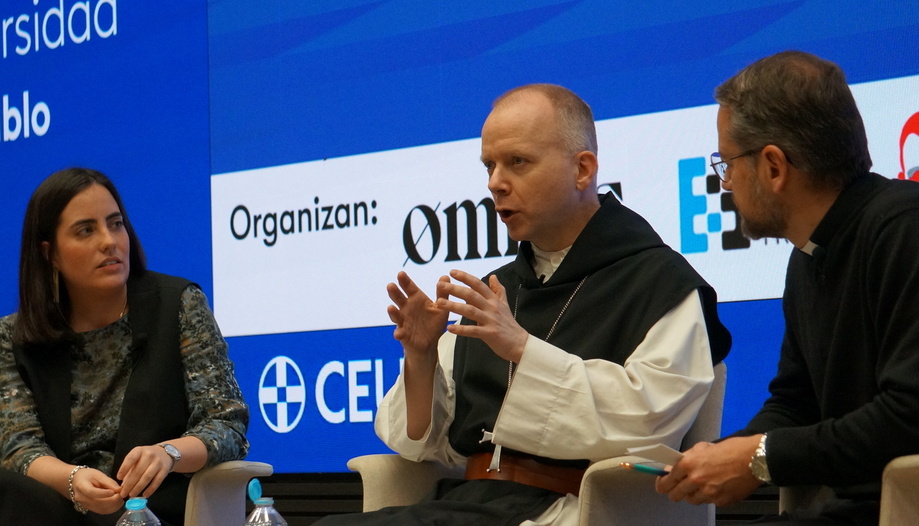
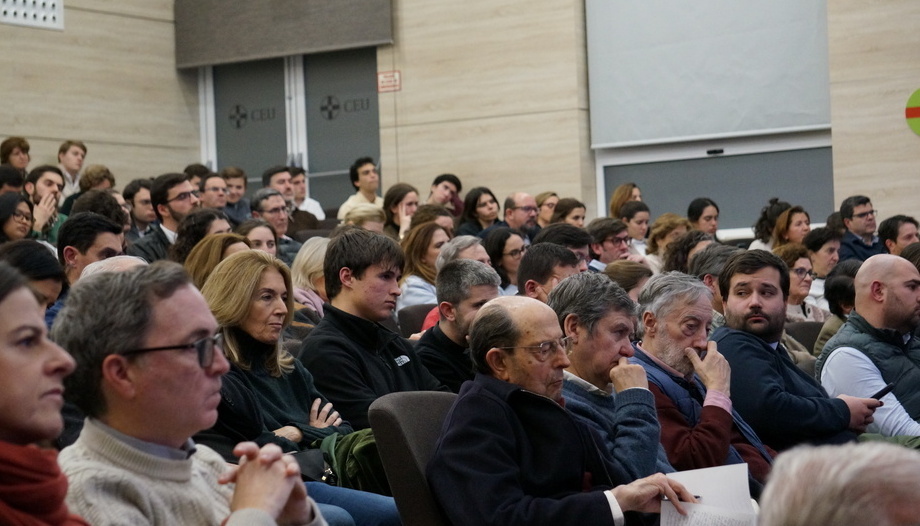
More than 250 people gathered in the Aula Magna of the CEU San Pablo University in Madrid to attend the Omnes Forum with Erik Varden. The Bishop of Trondheim and writer reflected this Friday on human suffering and its Christian meaning.
The Forum, organized by Omnes together with Ediciones Encuentro and the Ángel Herrera Oria Cultural Foundation, was also sponsored by CARF Foundation y Banco Sabadell.
Author of works such as Chastity, On Christian conversion o Wounds that heal, Varden addressed one of the most scandalous questions in contemporary faith: how can one conceive of a God who suffers?.
The reason for suffering
The Norwegian bishop stressed that the reason for human suffering does not have a simple answer. “Many leave the Church because of the scandal of suffering,” he said, adding that Christianity does not offer explanations that cancel out pain, but rather a profound reverence for its mystery. The human condition," he recalled, "is a painful condition, but not a definitive one.
In this context, Varden explained that the core of the Christian mystery is in the incarnation: God, being absolute transcendence, enters the human condition to heal it from within. “The incarnation takes place in view of redemption,” he pointed out, insisting that suffering is not the end of history.
Erik Varden reflects in a simple example the Christian's position in the face of suffering. At Crime and punishment, The brothers talk about the unjust pain and one of them ends up crying out in anger at this reality, shouting «there can be no answer to this». One of them does not try to correct his brother's anger or refute his words, but when the other stops speaking, he remains silent and fixes his gaze on the image of the cross. That is the Christian response: not an explanation that cancels out the pain, but a silent presence in the face of suffering.
Two current responses to suffering
Varden points out two tendencies in the face of suffering. On the one hand, he mentioned the “Instagram trend”, which pushes to project an ideal, invulnerable and perfect existence. On the other, he pointed to the growing inclination towards victimization and self-victimization, in which personal wounds are publicly exposed, demanding recognition and reparation. Although he acknowledged that sometimes it is necessary to show the wounds, he warned of the risk of turning them into identity: “when we say ‘my wound is me’”.
According to Varden, being caught between these two dynamics - the denial of pain and its absolutization - destroys the Christian perspective. In this sense, he invited us to reflect on the historical place of Christian symbols in public life. For centuries, he recalled, processes of teaching, justice and social life have taken place under the image of the suffering Christ. That image is honored not because of the pain itself, but because Christians know what happened on the third day: suffering does not have the last word.
The cross and your freedom
The contemporary aspiration for perfection, he added, reveals a profound truth: the human being was created for fullness and beauty. The problem arises when one tries to reach this perfection by one's own strength, which easily leads to frustration. In the face of this, Varden defended that not being self-sufficient does not imply not being free. “For freedom, Christ has set us free,” he said.
When contemplating the cross - with the nails piercing the flesh and mobility annulled - it may seem that we are before the absolute negation of freedom. However, read in faith, the cross reveals an extreme freedom: “If it is possible, let this cup pass from me, but your will be done”. For Varden, this scene shows that even when physical freedom is severely limited, a fully free inner response is still possible.
The Christian position is that the fact that we are not self-sufficient or autonomous does not mean that we are not free. For freedom, Christ has set us free. Faith teaches us that we can respond with perfect freedom even when things happen to us that restrict our physical freedom. The very idea of nails piercing flesh and a person who makes sure to take away mobility is a perverse image and at the same time read in the light of faith the cross speaks to us of extreme freedom. If it is possible, let this cup pass from me, but let your will be done. The cross teaches us that we can respond with maximum inner freedom to events that would paralyze us.
Varden talks about healing wounds
The bishop also insisted that the healing of wounds is not instantaneous. Conversion does not automatically eliminate pain or make everything end well. Some fractures, he said, will not disappear, but that does not place them beyond the reach of grace. The Christian faith does not proclaim only an omnipotent God capable of eliminating suffering, but a God who carries it with us and transforms it into a source of healing and, at times, salvation. “By his wounds we have been healed,” he recalled, stressing that Christians, as members of the Body of Christ, participate in this redemptive reality.
Redemption,“ he said, ‘is a historical fact that has already taken place, the effects of which continue to unfold in time until the end of time. In this sense, he cited the image of Christ who remains on the cross, not as an episode to be discarded, but as the certainty that all suffering can be entrusted to an omnipotent love. ’Saying, ”Lord, this is yours,“” he explained, can turn wounds into bridges of healing. "I have seen this," he added.
“We live in this world as in a valley of tears,” he concluded, “but it is a valley illuminated by the light of Christ.” For the bishop, each person is called to discover and interpret his or her own “song,” the one for which he or she was created. Although there are admirable examples of people-with or without faith-who face suffering with courage, when suffering is illuminated by Christian faith it is lived with the conviction that God is with us and that we are made to live in Him. Thus, every human experience, even the most painful, can become a path of communion with God.




 Español
  English
  Italiano