



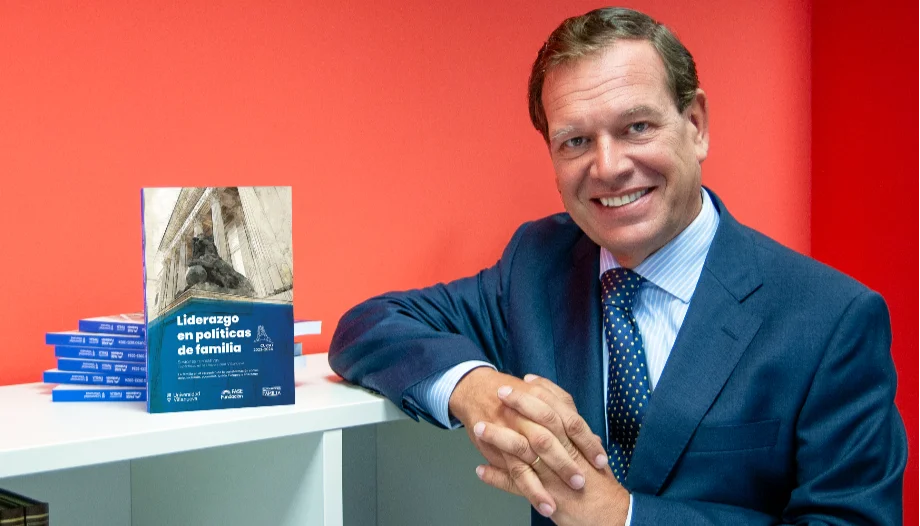
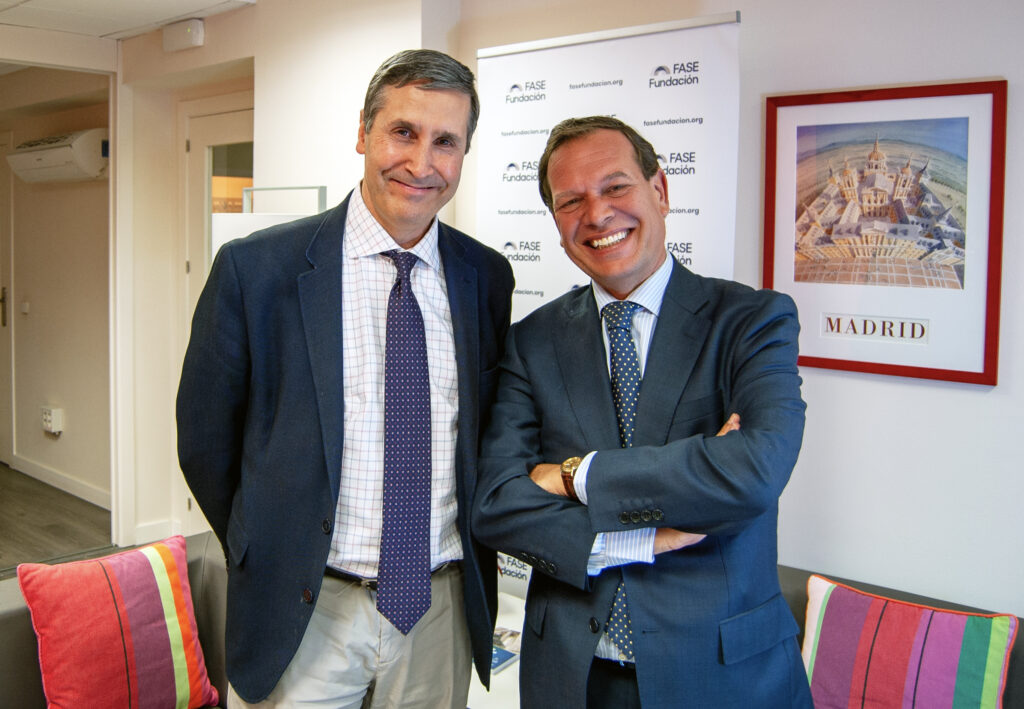
Family breakdowns do not have to be irreversible, and efforts can be made, including by institutions, to restore what has been broken. This is one of the lines of work of the FASE Foundation, which next year will celebrate half a century of operation with a focus on the family. Its general director, Alberto San Juan, welcomes Omnes at its central headquarters in Madrid, which usually hosts the foundation's sessions and conferences and, since January, its new family mediation course.
San Juan, who has extensive political experience, has held, among other positions, the post of Director General for Minors in the Community of Madrid. A sensible politician, he knows what he is talking about, as he has extensive experience in social services.
What does the foundation do?
—Our goal is to support families. And that support takes the form of conflict resolution and helping families overcome the difficulties they face. In reality, many times the difficulties families face arise because they don't know how to do things. They don't know how to deal with conflict resolution, vulnerability... FASE is there to help. Often, with some training or support, the family is able to move forward. We have a lot of experience in family issues. Next year we will celebrate our 50th anniversary.
With this milestone anniversary, fifty years, in mind, what are your plans?
—We have three specific projects. Perhaps the most innovative is to launch a course on restorative family mediation. Then there is the book we have just published, Leadership in family policies. Thirdly, a specific mental health program, I Need Therapy. One of the biggest problems that exist in families is therapy and mental health.
What does that consist of? I need therapy.?
—It is a program run by psychology and psychiatry professionals trained by Dr. Carlos Chiclana, which aims to help families through mental health therapy. We have found that, given this enormous mental health problem, there are tremendous difficulties with waiting lists. But mental health and waiting lists are a very dangerous combination because people need therapy when they need it. They need to be treated now.
What are you doing?
—On the one hand, we manage to shorten waiting times as much as possible and offer therapy that anyone can receive. Why everyone? Because it is therapy for vulnerable people.
Vulnerability does not only refer to economic reasons; it can arise from a thousand circumstances. For example, a large family with eight children, or however many, that is not poor (does not have economic vulnerability). But if that therapy cost €100, for example, they would probably give it up. It is therapy at a reduced price and applied immediately, when needed.
What are the most common problems in this area?
—It depends on age. We face very worrying challenges with young people, but above all, the problems of suicide are staggering. The data is horrifying. Approximately 10 to 15 people commit suicide every day, including many young people. It is a very preventable and very painful death due to the circumstances.
There are also problems such as anorexia, bulimia, abuse, bullying at school, and addictions (pornography, cell phones, alcoholism, gaming, etc.). There are many difficulties among young people that need to be addressed, and they are solvable.
The restorative family mediation project: what does it mean?
—We attach fundamental importance to this course. Mediation is a means of resolving conflicts within the family, and this mediation helps to bring any existing conflict to a satisfactory conclusion. For example, when a couple decides to separate, mediation helps them to bring the circle to a satisfactory close: we are going to separate amicably, in the most friendly way possible, and in the best way possible.
Specifically, restorative family mediation adds that it attempts to heal what was broken. It gets to the root of the conflict, and if there is a solution, it attempts to fix it. We believe that if it can be solved, it should be attempted.
There must be a commitment on both sides to want to resolve the issue. There will be times when it is impossible to resolve the case and the recommendation will be separation, annulment, or whatever. I am convinced that in many cases, the family can try again a second time.
This course begins on January 13.
Is there any official recognition for this course?
—Of course. We are a recognized foundation for teaching these courses. People who complete the course leave with a qualification that enables them to practice. They are professional mediators and can open a practice to provide mediation services.
What kind of people can use this family mediation service?
—Anyone who has difficulties within their family, or a problem they don't know how to solve. It's not just for divorce cases, it's for all kinds of family conflicts, from two siblings who disagree about an inheritance to a family's difficulties in caring for their elders. When a problem in a family starts to cause more trouble than necessary, that's when you can ask for mediation. An argument between husband and wife, between siblings, conflicts with the extended family, or between parents and children. It's mediation or support.
The fundamental difference is that restorative family mediation seeks to resolve the problem at its source. To restore what is broken. Mediation, on the other hand, is simply reaching an agreement to bring something to a close.
In this family mediation, with an emphasis on restoration, I believe that FASE is unique.
—We are not aware of any others, although there may be other institutions. But yes, at least we are very innovative. Since we believe that the family is the foundation of society, we fight to keep families together. Although that will not always be possible, of course.
Self-esteem often comes into play. Sometimes, when there is a conflict, you refuse to give in to a sibling or whoever it may be, but if there is mediation, someone from outside, you give in. However, that clash between two family members often festers.
Training trainers is, I believe, a unique opportunity to defend the family.
There are public institutions that also have mediators, but they do not seem to have any influence in fighting to prevent the marriage from breaking up.
—It is true that the autonomous communities have family support centers where mediation is provided. But there, they seek to settle something that the families have already agreed upon: an inheritance, for example. In this mediation, the aim is to reach an agreement to resolve a problem, but not to restore relations between family members.
Or a married couple who have already decided to separate, to finalize the divorce agreement in the best possible way. Not to try to give that marriage a second chance if both want to.
We, of course, respect people's freedom to the utmost, but we also point out that what can be saved in a marriage can be saved and that a second chance can be given.
How is a mediator trained? Psychology and law subjects?
—A little bit of everything. It's a hundred hours, with practical training in mediation. Nacho Tornel, who is a renowned mediator and one of the most authoritative figures in Spain on the subject of mediation, is our academic director.
This first course will start with a group of 25 places for mediators.
We haven't even launched it publicly yet, and we're already receiving calls from people who want to receive mediation and others who want to be trained. We're extremely excited.
It is a very interesting course for anyone who interacts with other people, because conflict resolution is part of everyday life. How can you resolve conflicts with other people? Mediation, support, and guidance in conflicts are fundamental skills that everyone should know.
Is the course in person?
—Yes, at our headquarters. It is 100% in-person, to maintain that connection and closeness with the students.
How many people can benefit from restorative mediation?
—The divorce statistics are not good. Currently, 50% of marriages in Spain end in divorce. Others say the figure is 70%. The reality is that there are approximately 100,000 marriages per year in Spain and 70,000 divorces.
It is one of the main challenges facing society. There is a lot of talk about housing, corruption, unemployment, but I think family breakdown is one of the most serious problems. In the end, what makes you happy is family life. Where you give the most love, where you receive the most love, where you are loved for who you are, where you truly feel happy, where you truly fulfill yourself is in the family. If you don't have a family, you are missing something.
If we want to build a stable society where values can be passed on and individuals can develop, we are convinced that this must start with the family.
How does FASE relate to other family counseling centers (diocesan centers, COFs, for example) throughout Spain? Are they competitors?
—They do fantastic work and accomplish a great deal of good. However, ours is a different role. It is a title recognized by the Department of Justice.
It is now mandatory to go through mediation before going to trial. So, if you go to court and say you don't want to separate, they force you to go through mediation first. This is a very positive thing.
Those who practice mediation in COFs should take courses to become certified so that they can practice in all areas of law. In fact, many lawyers are signing up for this course in order to be recognized as family mediators, because it is a prerequisite for going to a lawyer.
The family policy leadership book is another project that stems from the regular sessions organized by FASE, aimed at local politicians. What is the aim?
—We are convinced that politicians have a direct influence on society and can change things. In fact, they are the ones who make the laws, and from the town halls they can change many things, from property tax to a whole host of programs for families.
We have thoroughly diagnosed the problems facing families, and we also know that politicians are often unaware of these problems because day-to-day life is complex and because they may not be experts in social services.
Our goal is to educate politicians so that they understand the reality of families' situations. Once they are aware of the problems, we give them the tools to solve them.
What tools?
—From two perspectives. We choose a topic: Family and disability, for example. An academic gives a presentation on disability in the family, and a politician who has had good practices in disability explains it to the others.
Are the results noticeable?
—It is unusual for a politician to want to do things badly. When politicians become aware of a problem, they want to solve it. Often, however, they are either unaware of the problem or do not know how to solve it. That is why the courses we offer show politicians how these problems have been solved in different places. Good municipal practices in other municipalities.
That gives a fantastic result. Politicians have the opportunity to consult other assistants, academics, and teachers about how they do things. In politics, especially in city councils, when the mayor makes his lists of councilors, he assigns responsibilities to certain people. When you are appointed councilor for social services, in this case, it may be that you have had no experience of social services in your life and know absolutely nothing about them.
This program of politicians is to give that support to councilors or deputies in resolving the conflicts they have to study.
How many politicians, councilors, deputies, etc. have attended over the years?
—It's a well-known course, held once a month. Between 50 and 60 participants attend. It's like a light rain that gradually soaks in and shapes things. Then they ask us for information and documents. The book we've just published is a very useful tool for them.




 Español
  English
  Italiano