



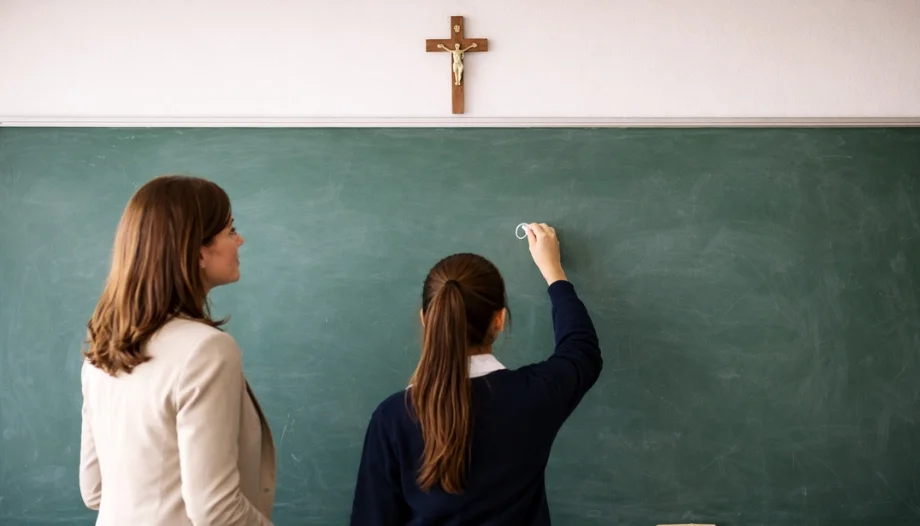
Every educational institution of the Church is born of a concrete call: a founder or foundress who, looking at reality with eyes of faith, felt the urgency of evangelizing through the school. Neither buildings nor regulations were born first: a fire was born.
This fire has a name: charism. And the charism is not an inspirational slogan or a plaque at the entrance of the school, but a living grace that must be incarnated in concrete persons, in real decisions, in a style of presence and relationship. When the charism is reduced to a text on the web, the institution begins to live on spiritual rents and to lose its transforming power.
Therefore, before talking about methodologies, digital platforms or quality indicators, a Catholic school should ask itself honestly:
- Are we still breathing the spirit in which we were founded?
- Do our decisions today allow ourselves to be challenged by the original intuition that gave life to the work?
- Or have we been sliding towards a model of a school that is correct, efficient... but indistinguishable from any other?
Keeping alive the mission received from the foundation is not nostalgia; it is creative fidelity. The school is not called to preserve a museum, but to prolong in the present the grace received, opening it to new generations. And this is only possible if those who sustain the institution -consecrated, directors, laity- live from that source and revisit it with humility.
The heart of the school: a Tabernacle, not a slogan
In many religious schools, almost without realizing it, a dangerous inversion of priorities has been taking place. We multiply projects, innovation programs, pedagogical labels, certifications, campaigns... and, at the same time, the Tabernacle is discreet, almost hidden, as if it were just another element in the landscape.
However, for a Catholic school the center cannot be other than the living Christ in the Eucharist. Everything else - projects, structures, technologies - is peripheral. Important, yes, but peripheral. The true heart of the school is the chapel, not the headmaster's office or the computer room.
An educational institution that was born in the warmth of the Eucharist becomes cold when it stops kneeling before the Tabernacle. It loses ardor when it no longer takes seriously that, in the midst of the courtyards and corridors, the Lord really dwells. Recovering this awareness changes the way we lead, teach and accompany:
- The cloister ceases to be just a work team and becomes a community that prays together.
- Important decisions are made, rather than in a boardroom, in front of the Tabernacle.
- Students learn that their school is not just a place where “things happen,” but a home where God is waiting for them.
When we replace the Tabernacle with other “centers” - marketing, innovation for innovation's sake, obsession with image - we miss the mark. We can have schools full of activity, but empty of presence. And a Catholic school without the Eucharist in the center ends up weakening its charism and losing its orientation towards the mission with capital letters: the one that remains and transforms lives.
The teaching staff: first wealth and first shared mission
In any educational institution, the main wealth is not the buildings or the programs, but the people. In a Catholic school, this is concretized in a clear fact: the faculty is the first wealth and the first place where the shared mission is played out.
For decades, many congregations assumed almost exclusively the life of their schools. Today, with fewer vocations and more lay people involved, the question is inevitable: are we making the teaching staff a true community of mission or just a team of competent professionals?
A professor can know his subject very well and, nevertheless, still not be a living part of the charism. Integrating the laity in the mission does not consist in asking them to “sign” an ideology, but in accompanying them to make it their own, to pray it, to discern it, to live it. If the charism remains in the documents of tenure and does not go down to the heart of the teachers, the chain of transmission is cut off.
For there to be a truly shared mission, it is necessary:
- Serious selection and reception processes, The program will not only evaluate competencies, but also a deep affinity with the Christian identity of the center.
- Ongoing formation in a spiritual and charismatic key, not only technical. Courses, retreats, prayerful reading of the Word, knowledge of the history of the institution.
- Personal and community accompaniment, The teachers are not “executors” of other people's projects, but co-responsible, with their own voice and discernment.
When the teaching staff becomes a living chain of transmission - from the Founder or Foundress to the students, passing through each teacher's own experience of faith - the school ceases to be a “work of the religious” and becomes, in truth, an educational community in mission.
Parents, students and teachers: a mission that is contagious
If the family is the first school and the teachers are the first wealth of the institution, the school becomes a bridge. A good bridge does not retain, it communicates. The educational mission reaches its fullness when the faith and charism that are lived at school return to the home, are incarnated in kitchen conversations, in nightly prayers, in life decisions.
How does this fruitful “back and forth” occur? Not because of specific campaigns, but because of a style:
- Parents who feel welcomed, listened to, accompanied in their struggles.
- Teachers who not only teach content, but also show a Christian way of looking at the world.
- Students who find in the school chapel a familiar place, not a strange one; a tabernacle that accompanies them from an early age and leaves an indelible mark.
When this happens, the school becomes a true “school of disciples”, where it does not manufacture clients, but forms people capable of bringing the light of the Gospel to their families, to their future jobs, to society.
In these times we see that old temptations are making a strong comeback with new packaging. One of them is to build a “self-sufficient” school, capable - in theory - of taking charge of everything: instruction, education, accompaniment, affective maturation, spiritual formation... and, along the way, blurring the real presence of parents. There is talk of “integral education” as if the school could completely replace the family. But this is a dangerous mirage.
No school, no matter how excellent, can replace the irreplaceable mission of parents. When we forget this elementary truth, educational centers become luxury orphanages: well organized, well painted, full of projects and activities, but incapable of delivering what only a home can give: roots, belonging, identity, a loving gaze.
The family is the first school of humanity, and parents are the first educators. The Magisterium has repeated this ad nauseam. When this conviction weakens, the school runs the risk of accumulating programs and “experiences” while emptying itself of what is essential: a community of life and faith in which the child knows he is loved, accompanied and called by name.
In the case of Catholic schools, this temptation is even more serious: not only is a good education at stake, but also the transmission of a charism and a mission received from God. If the living bond with families is broken, the school can continue to function externally, but it ends up becoming just another project in the educational market, without its own soul.
How to regain the lost ardor
Many management teams and religious communities perceive that, over the years, some of the original fire has cooled off. The wear and tear, the urgencies, the pressure to financially support the works... everything is taking away inner energy. The question is: is it possible to recover the ardor? The Christian answer is always yes. Not by our own strength, but by returning to the source.
Some concrete clues:
- Back to the Tabernacle together
Before reorganizing structures or designing new strategic plans, a humble gesture is necessary: to get down on one's knees. Set aside real - not symbolic - times of Eucharistic adoration for the cloister, for the management team, for the religious community. To look at the Lord and let oneself be looked at by Him. From there everything else can be rearranged.
- Reread history with gratitude
Recover letters from the Founder or Foundress, testimonies of past generations, milestones of the work. Not to settle in the past, but to listen to what God wanted to say through this history. Gratitude cures fatigue and purifies the temptation to always compare “that” with “this”.
- Honestly discerning the accessory from the essential
Not every project that sounds good is necessary. Many schools carry on their shoulders initiatives that take up time, energy and money, but contribute little to the mission. We must ask ourselves courageously: “Does this bring us closer to the heart of our educational vocation or is it just added noise? And, if it is noise, know how to let it go.
- Caring for the heart of educators
A burned-out teacher cannot ignite anyone. It is necessary to offer spiritual accompaniment, spaces of real rest, strong experiences of encounter with God. When teachers feel cared for, their ardor is rekindled and their view of their students changes.
- Making the chapel the decisive place in school life
It is not enough to “have” a chapel; it must be used. Simple and frequent celebrations, moments of silence, times of adoration with the students, available confessors... Let every child be able to say: “In my school there was a place where I knew that Jesus was waiting for me”. That memory, years later, sustains many dark nights.
Guarding the fire, not just the structure
The great danger of our educational institutions is not to run out of projects or resources, but to run out of fire. We can maintain buildings, brands, legal structures... and yet have stopped burning inside.
The good news is that the Lord does not ask for impossible heroism, but humble fidelity: to the mission received, to the foundational charism, to the real presence of Christ in the Eucharist, to the concrete families who knock at the school door every day, to those teachers who are - with all their limits - God's best tool for touching young hearts.
A school without parents is a dangerous mirage. A school without the Tabernacle at its center is also a dangerous mirage. Today's challenge is simple to formulate and demanding to live: to put Christ back at the heart of the school, to revive the charism, to take care of the educators, to accompany the families.
When that happens, students cease to be “users” of an educational system and become children who discover, little by little, that they have a Father in heaven who loves them and a Church that walks with them. And that, in the end, is the only mission worth sustaining, even if everything else changes.




 Español
  English
  Italiano