



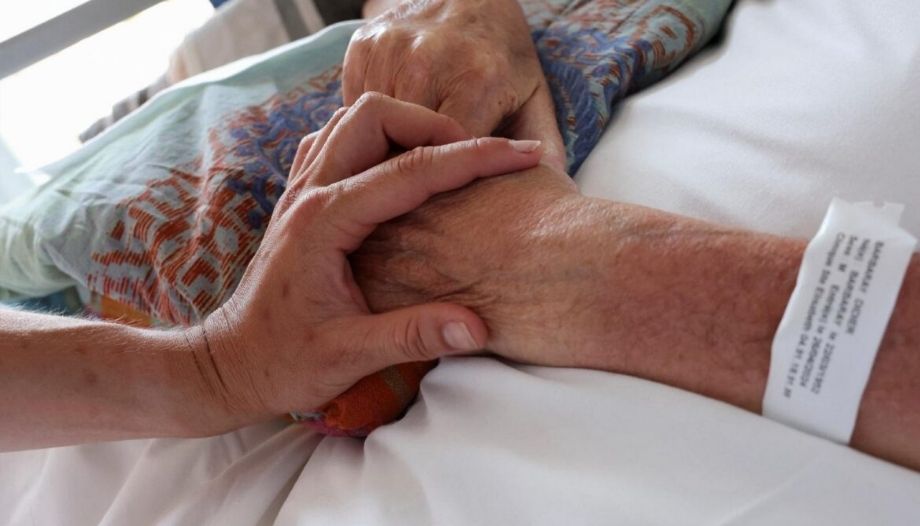
- Katarzyna Szalajko, OSV News
While Catholics in France have just held a national prayer and fasting initiative on February 20, in anticipation of the final vote on a bill that “leads our country down the path of euthanasia and assisted suicide,” and to “ask the Lord to enlighten consciences on the seriousness of the challenges posed by this proposed law,” the numbers of euthanasia procedures are rising worldwide.
The prayer and fasting initiative was organized by the French Bishops' Conference, as lawmakers prepare to a vote decisive on assisted dying legislation on February 24, although it must go back to the Senate. French prelates fear that once the bill is passed, euthanasia could become increasingly normalized, as is happening in quite a few countries.
Spain, 426 cases in 2024: 27.5 % more
In Spain, according to recently published official statistics, 426 people died in 2024 through state-approved assisted suicide or euthanasia in 2021. This represents an increase of 27,54% over the 334 deaths recorded in 2023, and nearly 48% more compared to 2022, the first full year after legalization.
Benigno Blanco, former president of the Family Forum, said social attitudes are gradually changing as euthanasia becomes routine in public health reports.
“Euthanasia has begun to become socially normalized,” Blanco told OSV News. “The numbers of euthanasia cases are published periodically as just another statistic that no longer provokes a strong reaction. We are getting used to euthanasia as just another social phenomenon, and this is how the trivialization of the legalized always begins. After this trivialization in the collective consciousness, the number of practices gradually increases”.
United Kingdom, on the verge of legalization
The United Kingdom is also on the verge of legalizing assisted suicide, with debates underway in Parliament and Catholic legislators fighting to stop an “outrageous” bill on assisted suicide.
Australia, steadily increasing
Australia, on the other hand, offers one of the clearest case studies on how assisted dying laws evolve once introduced.
Legalization in the state of Victoria with the Voluntary Assisted Dying Act was passed in 2017 and came into effect in 2019. Since then, it has spread nationally and the number of assisted dying cases has steadily increased, raising questions about how these laws transform cultural expectations and the moral identity of medicine.
In New South Wales, the second annual report of the Voluntary Assisted Dying Board shows that 2,295 people made a first-time application for VAD, while 1,028 died from the use of a VAD (Voluntary Assisted Dying) substance.
Xavier Symons: the trend towards standardization
Leading Australian bioethicist and author Xavier Symons said. the trend reflects a deeper social transformation.
“I think the growing number of ADV cases in Australia reflects both the growing public awareness of euthanasia as an option for the dying and the normalization of the choice of that option,” Xavier Symons, a professor who directs the Plunkett Centre for Ethics at Australian Catholic University and St. Vincent's Hospital in Sydney, told OSV News.
Undoubtedly, other factors have influenced the increase in VAD rates in the states, such as the availability of more professionals to provide VADs and pressure from pro-euthanasia lobbies to make euthanasia accessible in regional and remote areas. But societal attitudes are also likely to have changed in recent years.
Concern that the idea that healing is fundamental to medicine is eroding
Symons said the impact extends beyond patients' individual choices and is changing the way society views medicine itself.
“I worry that the DVA will erode the idea that healing is fundamental to medicine,” he said. “We are witnessing a replacement of the Hippocratic view of medicine-which includes the idea that a physician has a duty to seek the good of the patient-with the idea that a physician is a service provider and must help patients who wish to end their lives.”.
“Not all physicians practice euthanasia; many are conscientious objectors. But the fact that medicine now practices euthanasia affects society's perception of the medical profession.”.
Risk of expansion beyond terminal diseases
Symons warned that lawmakers in other countries debating euthanasia may underestimate how eligibility criteria may expand over time.
“The biggest risk is establishing a ‘right to die’ that could extend far beyond terminal illness, thus allowing access to euthanasia to any group that wants it,” he said. “This includes people with mental illness, people with chronic illnesses, and even people tired of life. If it is claimed that some people have the right to euthanasia, it is difficult to deny the conclusion that all people have the right to euthanasia.”.
Euthanasia, legal in several countries
Around the world, assisted dying laws have expanded steadily over the past decade.
Euthanasia - in which a physician directly administers life-ending drugs - is now legal under defined criteria in several countries around the world, including the Netherlands, Belgium, Luxembourg, Spain, Canada, Colombia, New Zealand and Australia, among others.
Complex reality
Catholic health care providers in Australia say they are navigating a complex new reality, seeking to maintain longstanding commitments to palliative care while operating within systems where assisted dying is legal.
Adrian Kerr, speaking on behalf of Catholic Health Australia, emphasized the historical roots of Catholic end-of-life care in the country.
“It was a Catholic religious order - the Sisters of Charity - that founded Australia's first palliative care service in Sydney in 1890,” he told OSV News. “That service was established to provide care to anyone who needed it. It is part of a long legacy of care involving Catholic Health Australia members, of which we are immensely proud; a reflection of the Good Samaritan commitment, responding to need, no matter who it is.”.
Kerr said Catholic facilities continue to refuse to participate in voluntary assisted dying although they remain committed to the care of all patients.
Massive campaign by French bishops: urged to focus on palliative care
Echoing a mass campaign from French bishops, urging public efforts to focus public efforts on palliative care rather than assisted dying, Adrian Kerr said that experience shows that access to quality palliative care can significantly influence patients' decisions.
“We have found that it is very rare for a person to make a definitive decision about VAD,” he said. “Some do so because their pain and symptoms are not well controlled, or because they experience some distress. We can, and do, help with these issues through holistic end-of-life care. Many patients find that this meets their needs and choose to die naturally.”.
White: legalization transforms culture
For Blanco, the Spanish Catholic advocate of dignity at the end of life, it is the legalization of euthanasia that transforms the culture even without strong initial public demand.
“When the law decriminalizing euthanasia was passed and regulated as just another health service, there was no significant social demand and, even today, there still is none,” he said of Spain.
“But social normalization has already begun, and so begins the slippery slope, which in time always leads to the progressive trivialization of what has been decriminalized.”.
He also pointed to demographic pressures on smaller families, urbanization and increasing isolation among older adults. “In this cultural and social context, it is foreseeable that euthanasia will be increasingly promoted as a reasonable solution for everyone,” Blanco said. “These are slow processes, but they are underway.”.
Impact on families left behind
Church leaders say the pastoral consequences of assisted dying are also becoming more visible, especially among families left behind when a loved one chooses euthanasia.
Monica Doumit, chancellor of the Archdiocese of Sydney, said legalization has introduced new challenges for pastoral care. “One of the unexpected challenges that has become apparent is not the pastoral care of a person seeking euthanasia or assisted suicide, but the care of the families left behind,” she told OSV News.
Distress: families who are not informed
“Some of these family members, especially if they are people of faith, did not agree with their loved one's decision to die that way, and their death provokes not only grief, but also regret that they could not have done more and even anger.”.
Doumit said families sometimes learn of decisions about assisted dying only after the process has begun or ended, which deepens the trauma. “This can be very distressing and is one of the pastoral challenges presented by this terrible legislative regime,” he said.
The Church, a compassionate care provider
Doumit affirmed that the Church sees its role as both a moral witness and a provider of compassionate care. “In every age and in the face of every challenge, the Church is called to stand up for the dignity of the human person and to defend the most vulnerable," he said.
In the case of euthanasia, those who propose to end people's lives call it ‘dying with dignity’. In the face of this, the Church must always declare that no illness or disability can ever take away a person's dignity, and that no matter how much care he or she needs, he or she remains a valued member of our community.
He added that Catholic institutions can offer a different witness through accompaniment. “We may not be able to change the law at this time, but we can care for people in a way that they never seek this option,” he said.
——————-
Katarzyna Szalajko writes for OSV News from Warsaw, Poland.
------




 Español
  English
  Italiano