



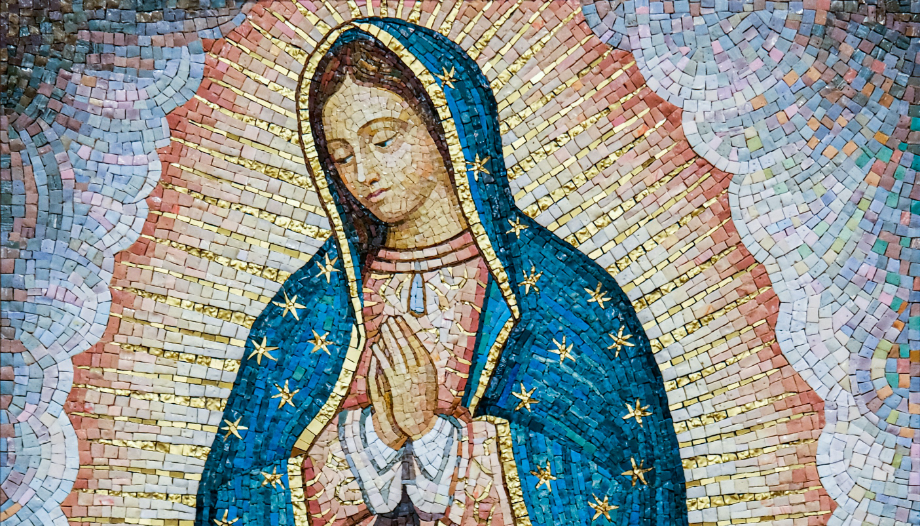
It was certain signs that convinced the bishop and the inhabitants of the new Mexico City of the authenticity of what Juan Diego was saying. Specifically, it was the cloak (tilma) of the visionary.
The cloak
To believe in the authenticity of the apparitions, Bishop Juan de Zumárraga asked Juan Diego for a sign, and during the fourth apparition, the Virgin told the seer to gather some flowers that had miraculously bloomed on Tepeyac (Castilian roses that bloomed in December in arid soil) and to take them to the bishop after placing them in his agave fiber cloak.
Juan Diego obeyed and, before the bishop and several witnesses, unfolded the cloak, on which, as the flowers appeared, the image of the Virgin Mary appeared.
What do we know about this cloak, with the image printed on it?
- It is aceropita (a term derived from Greek meaning «not hand-painted»), like the Shroud of Turin: the colors float 0.3 mm above the fiber, as if suspended.
- Scholars define it as the «Guadalupano Codex» or «Theophanic-Indigenous Codex,» because the indigenous people did not use the alphabet, but rather sacred pictograms made by the tlacuilos. The tilma is, therefore, a sacred visual text, understandable in Nahua symbolic grammar and written on cloth (but they were also «written» on amatl, paper obtained from fig or agave fiber).
- It is a simple garment, worn by peasants, rough and fragile, made of natural fabric that deteriorates in 15-20 years. But Juan Diego's has lasted almost five centuries without significant deterioration, even withstanding a bomb explosion.
- It has both Christian and indigenous symbolic characteristics.
The symbols of the code
Among the symbols immediately interpretable by the Mexicas are:
- The Nahui Ollin, a four-petaled flower in the Virgin's womb. The most sacred symbol in Nahua cosmology, it represents the one God (from whom all other divinities emanate), the origin of life and time, the center of the universe (axis mundi), the point where heaven and earth meet. For a Mexica, this flower in the Virgin's womb meant that the one God entered history in the womb of a mother. It should also be noted that flowers, in the Nahua world, are a highly symbolic object, the supreme symbol of truth and spiritual life. Offering them meant offering one's own heart.
- The stars. The tilma shows the exact map of the stars visible in the sky above Mexico City on December 12, 1531. This has a very strong meaning, which translates into the concept of tlalticpac in ilhuicac, «harmony between heaven and earth»: something that occurs in history but is confirmed by the stars, a union between the human and the divine, the celestial and the earthly.
- The maternal belt. The Virgin wears a black band across her belly, just like pregnant Mexica women, indicating that she is not a goddess, but rather carries Nahui Ollin, or the divine, the one God, in her womb. Here too, we can see the similarity between this symbol and the concept of Theotokos (mother of God) referring to Mary, a creature but mother of the Creator.
- The posture. The bent knee and the left foot forward indicate the typical position of the sacred Mexica dance, netotiliztli: a dance that is prayer, the body moving in harmony with the cosmic rhythm, like a person moving and relating to creation and creatures.
- The eyes. Visible only since the 20th century, the eyes of the Virgin of Guadalupe contain microscopic reflections of thirteen figures. The first person to notice this detail was a photographer, Alfonso Márquez, in 1929. The discovery was confirmed in 1951 by José Carlos Salinas, who identified the silhouette of Juan Diego. In 1979, thanks to digital magnification, other figures reflected in the pupils were identified, including Bishop Zumárraga, an interpreter, and a family group, with an optical effect compatible with that of a living human eye: a detail impossible to achieve with the painting techniques of the time.
- The sun and the moon. The Virgin appears clothed with the sun and standing on the dark moon. In Mexica culture, the sun and moon were very powerful deities. The fact that the Virgin is clothed with the sun and standing on the moon indicates that she has surpassed these figures: as a creature, Mother of the Creator and of mankind, not only she, but all her children «surpass» the ancient idols.
Dialogic or impositive mission
The fall of Tenochtitlán in 1521 was not only a political event, but for the Mexicas it meant the end of the Fifth Sun, that is, the end of the world: the cosmic order was collapsing, not just the empire. It was a time of uprooting and disorientation: the sacrifices had ended, but the sun continued to rise. Why? Thus, in addition to grief, there remained an openness to the sacred, to the divine, to someone who could come to their aid.
Let's consider some facts.
The Mexicas were very attached to their tradition, linked to the concept of «having roots» (only what took root in history, community, and identity was authentic—neltiliztli tlacatl, «the man who has roots»). This meant that they were willing to improve and purify their traditions, but not to eradicate or replace them.
Some Spanish missionaries, such as Bernardino de Sahagún, Alonso de Molina, and Diego Valadés, understood this well and adopted a «dialogical» model of mission: they attempted to translate the Gospel into Nahua concepts and language.
Others, however, preferred to adopt a «punitive» model, convinced (Talk of 1524) that the indigenous people had attracted divine wrath with their behavior and that, therefore, their past should be literally erased, eradicating them from their traditions.
Among them was Juan de Zumárraga, the first bishop of New Spain and Mexico City, who was precisely the one who asked Juan Diego for the sign and then believed him after seeing the cloak.
Zumárraga destroyed idols, temples, and manuscripts in an attempt to erase the Nahua spiritual heritage. However, it was precisely he, the symbol of the impositive model, who was granted the most precious sign: that theophanic-indigenous code that is the tilma with the image of the Virgin imprinted on it.
A message not «imposed from above»
Guadalupe's message, a message of reconciliation and overcoming conflicts, is therefore not only for new believers, but also for old ones. It is as if the Virgin, as a good and patient mother to all her children, revealed herself to some in order to purify their memory and their past, confirming what was already good but overcoming what was wrong, and to others not to correct them like a teacher, but to «educate» them in dialogue, proclaiming the Gospel and without imposing a cultural model.
It is significant that the Virgin does not disregard the bishop (whom she involves in everything and who is often the recipient of her messages and to whom she directs her requests), an authority of the Church and a Spaniard, and that she does not limit herself to translating the Christian message into another language, but rather reveals it using language and emotional, religious, and cultural categories that are typically Nahua. She does not speak from outside: she speaks from within the soul of Mexico, which, in fact, was giving birth.
German sociologist Hartmut Rosa argues that people change and transform not simply when they receive new ideas, but when something resonates within them, as if reality were echoing their own voice. And this experience of «resonance» occurs when there is no domination, but rather openness, emotional involvement, personal response, and mutual transformation.
Communication theorists Kent and Taylor make a similar assertion in their «theory of dialogic communication,» stating that true dialogue, as the «highest form of communication,» is based on empathy, closeness, the risk of opening up to the other, and a commitment to a lasting relationship.
And Guadalupe is this: an experience of resonance, mutual recognition, empathy.
Between 1531 and 1545, between 8 and 10 million spontaneous conversions were recorded, without coercion, but not to the «Spanish» faith, but to an inculturated Christian faith (John Paul II defined Guadalupe as «the first and most perfect example of inculturated evangelization in the history of the Church»).
Mexican anthropologist Miguel León-Portilla stated, in fact, that «in Guadalupe, it was not a new religion that was born, but a new identity: neither Spanish nor indigenous, but mestizo, Mexican.».




 Español
  English
  Italiano