



 Which Church, which priests?Convivium: Madrid priests reflect on their mission in a day marked by fraternityCarlos Chiclana: "Priests must take care of themselves in order to take care of others".
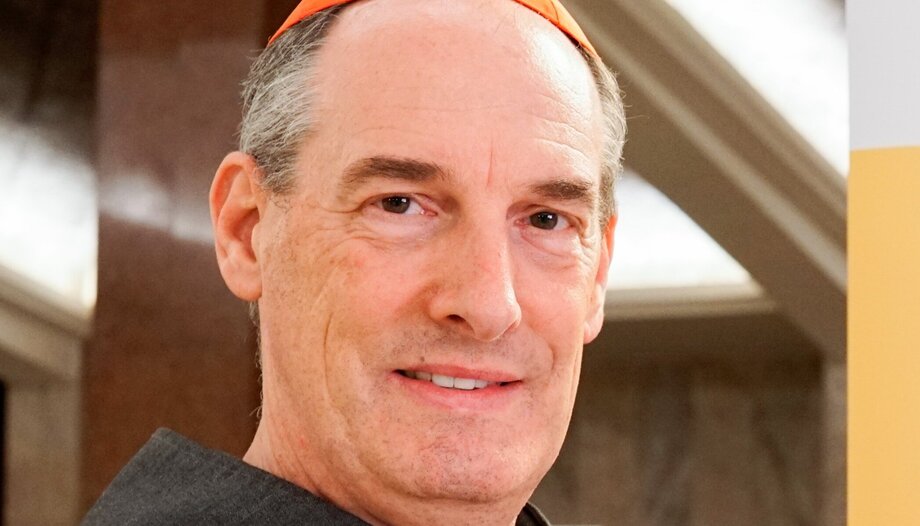
Cardinal Francisco Javier Bustillo, OFM Conv. is Bishop of Ajaccio in Corsica, a diocese that currently has some 280,000 faithful, served by some 80 priests.
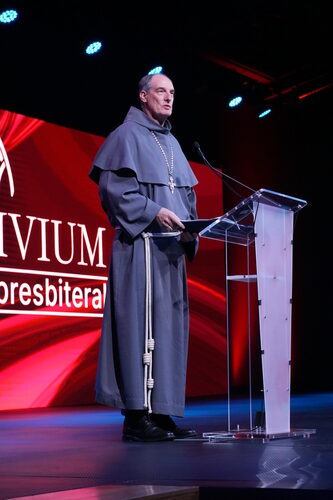
Monsignor Bustillo was the speaker at the first day of the Convivium, the presbyteral assembly convened by the Archdiocese of Madrid, which brought together for two days the priests of the diocese to reflect on its identity and mission in the current context.
In this context, Omnes was able to interview the French-Spanish cardinal on priestly identity, the care of vocations and the need to care for those who come to faith.
In such a complex society, marked by change, what are the challenges for priests today?
-The priest has to remember that he was anointed by the Holy Spirit and has to awaken creativity, audacity, to be able to give to the world the best he has. The Gospel says “you are the salt of the earth, the light of the world”. I believe that our society needs to find the joy of life and in those phases of life where we see many rather gloomy pages, it needs to find light and courage.
How to develop a demanding priestly life without ending up “burned out”?
-When I speak, especially in France, to priests, I tell them that there is a binomial that we have to take care of very carefully: health and joy. If a priest, in his ministry - which is indeed demanding and many things will be asked of us - loses his joy, or if he loses his health, he will lose his health. loses its health, loses heart and loses efficiency in its mission as well.
The priest of the 21st century, and in a city like Madrid, has to take care, with great care, of his health and joy, otherwise they will be lost. He has to work on his inner life and his humanity. If you work on your humanity and your inner life, you go further.
You have highlighted the importance of priestly fraternity. At a time when polarization is also infiltrating the Church, how do you balance the difference of each sensitivity with that fraternity?
-We see polarization today, unfortunately, in Spain, in France, in the West in general and also within the Church. It is sad that the political and ideological application of society sometimes occurs in the Church.
Our ideal is communion, it is union. Jesus said “that you may be one”, that you may be united. If we are divided in the Church, it is a problem of coherence with the witness we have to give.
When we look at the apostolic college, we find very different characters. We have Matthew and we have Simon. And Jesus calls them. Today that there are differences in the Church: that one is traditional or the other charismatic, the other modern, instead of being a problem for the church, it is a richness.
Instead of setting ourselves against each other, which is not evangelical, we have to walk with each other and celebrate that each one has his own path, each one has his own life, each one has his own journey and we are all different. And these differences are not an obstacle, but they are a good fortune and a blessing for the Church.
You come from France which, in recent years, has been making headlines with the return to faith of so many young people. How do you ensure that this return to God does not remain a spark but is life-changing?
-The first thing we see is the vacuum in French and Western society, after 60 years with the motto “Neither God nor Master”: we don't need anyone, we do what we want. There has been a lot of technological, scientific, human progress. Much emphasis has been placed on power, knowledge, doing, having, but being has been left on the periphery. That which the person is, that which the person lives. Today's young people are looking for meaning in life.
I have in my diocese, which is small, more than 303 who are going to be baptized now at Easter. This means that the young people, who are a bit virgin spiritually, are looking for an identity, they are looking for a family.
The first thing is to welcome them, to celebrate their presence. Then, we have a responsibility. We cannot simply say, how lucky we are that they all come to ask to be baptized in the Catholic Church! But we have the responsibility to welcome them, to accompany them and to guide them so that they are really part of the family of the Church and so that they can bring a little freshness.




 Español
  English
  Italiano