



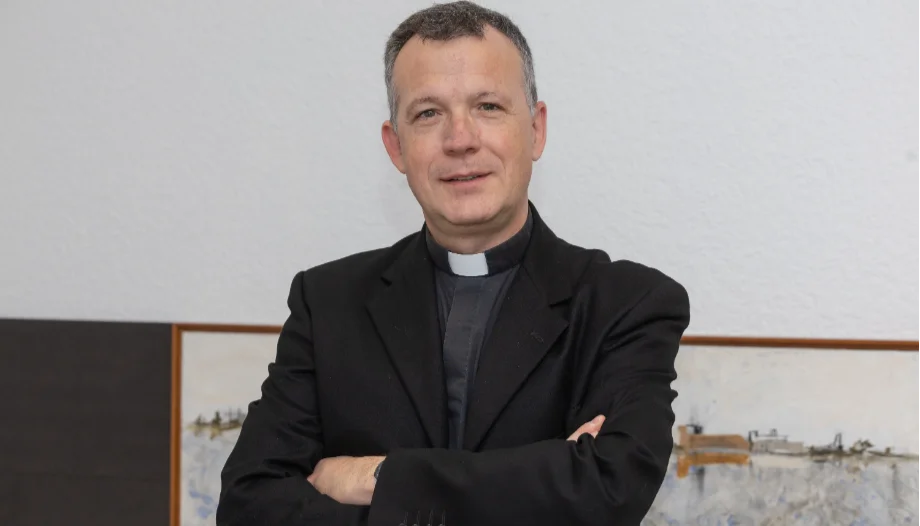
Professor Matteo Visioli is a priest of the Diocese of Parma and a professor at the Gregorian University. Between 2017 and 2022, he was Undersecretary of the Congregation for the Doctrine of the Faith. He is an expert in canon law and a leading voice in the debate on justice and penal reform in the Church. Visioli recently visited Spain to participate in the 17th International Symposium of the Martín de Azpilcueta Institute entitled “Freedom as a legal right in the Church. Hierarchical and charismatic gifts in canonical reflection.”.
We interviewed the professor to better understand how the recent reform of the Code of Canon Law seeks to protect the freedom of the faithful and punish abuses of authority. We will analyze what constitutes the crime of abuse of power and what criminal mechanisms the Church has strengthened to ensure that the exercise of authority is always a service, never oppression.
In 2021, the Church amended some canons in Book VI of the Code of Canon Law. What was the reason for this?
—The Church updates its laws to punish those who exercise authority by unjustly limiting the freedom of the faithful. Among these norms, there is one that is particularly important, a kind of “general norm” that applies to all cases of abuse of power not specifically described in other parts of the Code of Canon Law.
When is it considered that the authorities have crossed the line?
—When it goes from a prudent and reasonable use of power—what we call discretionary use—to authoritarian or arbitrary action. At that point, it ceases to be simply a misuse of power and becomes a genuine canonical offense.
Is punishment only imposed if the authority acts with malicious intent?
Here's the most striking thing: no. This canon considers not only those who deliberately abuse power to be guilty, but also those who do so through negligence. In other words, even if the person did not intend to cause harm, but their carelessness or mismanagement causes real harm to a believer or a community, they are also committing a crime.
Is that common in canon law?
—No, it's very rare. In general, for there to be a crime in canon law, the person must have acted with intent. But this is one of the few cases in which guilt or negligence is also sufficient for the authority to be held responsible.
And how is this regulated in the Code?
—With very general rules. It is a sensitive issue, and the Code deals with it with few rules, but very broad ones, precisely because it wants to cover all possible abuses of power. The problem is that such a general rule is dangerous, because ecclesiastical authority may be afraid of making mistakes. Especially when, in the face of a provision or an act of government, a question of conscience arises. For example, a superior may appoint a religious under his charge to be in charge of a monastery, but if the latter claims that this goes against his conscience, a risky and dangerous form of tension is created.
It would paralyze the actions of a legitimate government authority that could be accused of a criminal offense. Because the problem here is the transition from an administrative act—I appoint a person or order the abolition of a parish—to a criminally relevant act. This is the risk of a general rule with criminal application.
How can the concept of criminal law be reconciled with the exercise of charity in the Church?
—This “iuris puniendi,” in Latin, meaning the right to punish, may seem contradictory with regard to the Mother Church, the Merciful Church. Criminal law, in general, must be read in light of the very nature of the Church.
The purpose of penalties is explained in the Code of Canon Law: the first is the restoration of justice. Then there is the correction of the guilty party and, finally, the repair of the scandal. This also implies the repair of the damage: if I harm a person or a community, I must repair that damage.
Criminal law is not vindictive; it does not seek to punish for the sake of punishment, but rather to protect the community from potential fractures and divisions, and to help raise awareness of the wrong that has been done and to correct it. Criminal law is never perfect, but it allows for a horizon of justice that the legislator considers necessary for the good of the church, the good of the faithful, and the salvation of souls. This is the true purpose.
Is the Church evolving in its sensitivity to detect abuses of power?
—In recent years, under Pope Francis' pontificate, there have been many interventions, especially in the criminal sphere, due to emergencies that arose with allegations of abuse. These are not new events, they are old events, but awareness of these abuses is new, among other reasons because sensitivity to these issues has increased.
This is a positive thing, although it is also very painful. It is very positive because times are better today than they were then, in the sense that we now recognize problems that we did not see before. Of course, criminal law cannot be the definitive and only answer; it is just one tool among others, but the Church needs to work above all on education, prevention, and the formation of consciences.
What specific changes have been made to canon law?
—Criminal law does its part, but it cannot be relied upon to solve all problems of this kind. One of the new features of the recent Book VI of 2021, which is the book containing the Church's criminal laws, is this: it opens up the possibility of charging certain individuals, including some lay people who hold office, authority, or power in the Church. The aim is to highlight the abuse that would constitute a shift from legitimate discretion in a choice to arbitrariness that causes harm.
Lay people can do this too, and in this way they also become accountable because they hold a position, a power, an authority. And I believe this is a step forward. I am thinking, for example, of the moderators of many lay movements and associations. I am thinking of those who exercise offices in the Church. For example, under the pontificate of Pope Francis, many lay people have assumed important offices of government, and rightly so, along with these offices, they have also assumed the responsibility of ensuring that their choices are not arbitrary, but respectful of the freedom and conscience of the faithful.
How can the Church improve to prevent abuses of power and conscience?
—There are three antidotes to abuse of power. First, awareness training. Second, transparency. When an authority figure makes a decision, one antidote to prevent that decision from being abusive is to analyze the real motivations transparently. Why did I decide this?
And the third antidote is a more collegial, more synodal government, that is, the authority has the responsibility for the decision, but, in order to make a decision, it is better not to make it alone and be more exposed to the risk of abuse, but to share it with collaborators or with the community itself. Responsibility always lies with the authority; it is never collegial. However, discernment and the evaluation of cases can be collegial, thus providing greater protection against the risk of abuse.





 Español
  English
  Italiano