



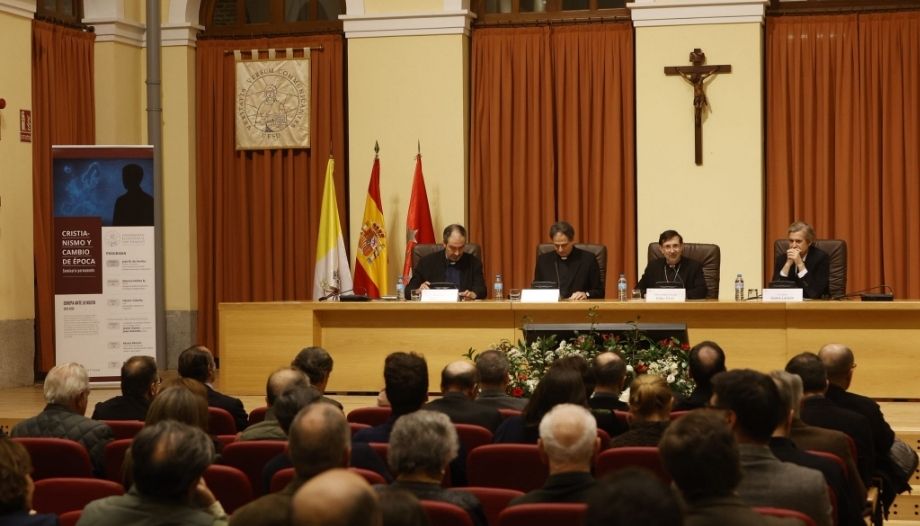
Along with numerous coincidences, the philosopher and essayist Javier Gomá, the dean of Philosophy at San Dámaso University, José Antúnez, and the Cardinal of Madrid, Archbishop José Cobo, contributed yesterday their particular views on human dignity in a conference-colloquium held at the Conciliar Seminary of Madrid under the title «Dignity, a revolutionary concept».
Indeed, “Dignity is the most revolutionary concept of the twentieth century,” Javier Gomá, director of the Juan March Foundation and of the Chair of Exemplarity at CUNED, has pointed out on several occasions. His reflection led him to write a book entitled ‘Dignity’.
Last night, as part of the permanent seminar “Christianity and epochal change”, Javier Gomá rescued some of its contents, and once again showed his provocative side, with the greatest of respect, in a dialogue format, together with José Antúnez Cid, dean of Philosophy of the center, under the presidency of Cardinal José Cobo, who intervened at the end. An event that you can see here.
“Philosophy in the last 50 years has basically become sociology.”
Dignity is everywhere, and so is exemplarity, but it has never been the object of a philosophical discourse, not a theological one, Javier Gomá stressed in his first 15 minutes. “No matter how much dignity is written in the title of a book, the content has nothing to do with it”. And referring to Kant, Gomá said: “50 percent of the books on dignity are interpretations of the 16 times Kant uses the concept of dignity in the foundations”.
“A general, universal, abstract interpretation, which puts dignity at the center of a reflection, has not existed,” the philosopher pointed out.
In his opinion, moreover, “philosophy in the last 50 years has basically become sociology, and sociology has nothing to do with reflection on dignity. There are no books on dignity, don't be fooled by the title, he added.
Dignity is one of those words that everyone feels but no one defines. Gomá proposes that “dignity is that exclusive property of the individual, by which he becomes a creditor, and the rest of humanity a debtor. The rest of humanity owes something to me, and owes something to each of you.
“The greatest crime against dignity, objectification.”
The greatest crime against dignity is to treat that which has dignity as that which has a price. That is, to treat that which cannot be replaced by something equivalent as if it were. “What is the greatest crime against dignity? Reification,” said Gomá.
Until the eighteenth century, the history of culture was cosmic. Everyone presupposed that truth is in the whole, not in this one or that one, but in the totality. Dignity primarily resided in the totality, in the generality of being, or in the supreme Being, and the other dignities were participatory.
What is new and epoch-making in the history of culture, occurring between the eighteenth and nineteenth centuries, is the emergence of subjectivity, the individual.
What is truly unique about modern dignity is that it is an individual and conflicting dignity.
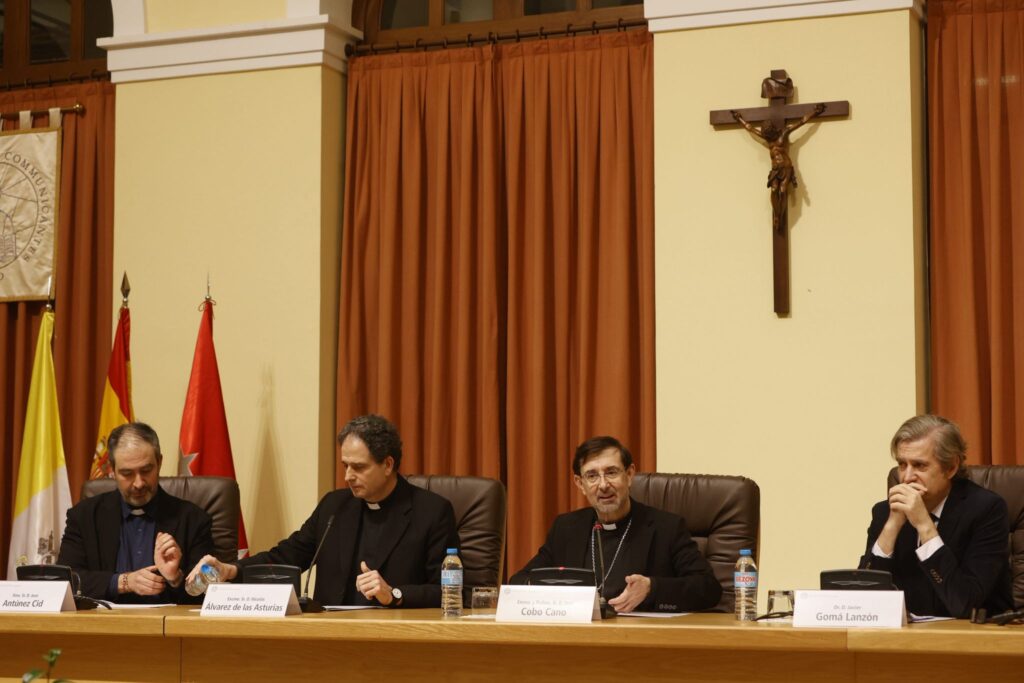
“The general interest yields to individual dignity. This is new.”
But the epoch-making modern novelty, in the opinion of the writer and philosopher, is that the following is added to this equation: “the particular interest yields to the general interest, but the general interest yields to individual dignity. This is new”.
Since the 19th century, modern dignity, the dignity of the individual is “a resistance, that which resists. It resists, for example, the despotism of the majority”. And it also resists, “this is what is new, the common good, the general interest, social progress. You cannot produce, invoke or promote the common good or social progress if it implies the trampling of individual dignity”.
“Dignity is the care of those who are in the way, e.g., the vulnerable.”. The law of the weakest
Another definition that I like very much, reflected Javier Gomá, is that “dignity is what gets in the way. What hinders rational plans, even good plans, which would go faster if there were no elements of dignity that hinder that speed. For example, caring for those who are in the way, the vulnerable, those who are good for nothing, does not help rapid progress, but it dignifies humanity and contributes to replacing the law of the strongest with the law of the weakest, which is perhaps one of the secrets of true moral progress”.
Javier Gomá pointed out that the dignity of the 20th century “is a dignity that belongs absolutely and fully to all men and women by the fact of being men and women, unrenounceable, inviolable, unique, universal”.
In his presentation, he also distinguished between ontological dignity, which we all possess as men and women, which even the most unworthy of men possess, because it is inherent to being human, and pragmatic dignity, which has to do with people's behavior.
Antunez: dignity linked to the person, social and existential
José Antúnez Cid, dean of the Faculty of Philosophy, stressed that Article 1 of the Charter of Fundamental Rights of the European Union is dignity, followed by life.
At the same time, he stressed that the discussions of the European Parliament speak to us of social dignity, that of migrants, discrimination, racism, etc., “issues that are still present in our advanced European societies”.
The dean also referred to a tradition of Christian thought and experience that, “with its shadows and its lights, defends this dignity”.
In this context, he referred to “the ecclesial reference” of Gaudium et Spes, to the document Dignitatis Humanae of the Second Vatican Council, and to the Declaration Dignitas infinita, of the Dicastery for the Doctrine of the Faith, under the pontificate of Pope Francis, “which coincides in part with some of the contributions made by Javier” (Gomá).
In this context, he referred to “two fields of effort to build this dignity, the social and the existential”.
At the end of his brief presentation, Professor Antúnez, who sees the notion of dignity linked to that of the person, asked the philosopher Javier Gomá about the fact that my life, my dignity, meets death, a subject to which the essayist had referred. From where can one draw energy, strength, illusion? What is the engine...
A provocative reflection by Gomá
The philosopher Gomá said that he was going to say something “that sounds a bit radical, but that there would be so many precautions that I would make afterwards, that I am sure everyone would agree”. “What I am going to say is going to generate contradiction,” he advanced.
“The foundations of morality depend on sentiment,” he said. “If I say now: women and men do not have the same dignity. Whites and blacks do not have equal dignity. The rich and the poor do not have equal dignity. If I say this, it is impossible for someone not to call me an imbecile. And yet, throughout history, for everybody, for the most celebrated intelligences, it was an evidence”.
Also for the great thinkers. Even Ortega. It would send shivers down your spine to read some passages of Ortega's work from the 1940”s. What has changed between what Ortega said and what we say? What has changed is that we feel differently. That other things have become evident to us. Society, beliefs, the world as a whole, is on tenterhooks depending on what is evident to the majority. Philosophy and culture are, at bottom, an administration of evidences".
“The realm of education of the heart: I do things out of conviction.”
And if it is evident to us that exemplarity, or dignity, possesses a beauty, or an excellence that recommends itself, if that is evident to us, it has an extraordinary force.
Because in addition to doing things, in the legal field, for fear of punishment, deeper is the field of education of the heart. It is when I do things not out of fear of punishment, but out of conviction.
When you ask me what is the main driving force for me, it is to create, to generate, “a sentimental education of the people, so that they see as evident things that are upright, decent, excellent, such as dignity.
“The greatest moral engine of society is disgust.”
Later, Javier Gomá said that the “greatest moral engine of society is disgust”. He must have seen faces of some surprise, because he argued: “Normally we do not have a direct intuition of values. Of decency, or of the dignity of women. But very often, moral values are so resistant to the concept, that they are perceived not through definition, but through action.
If I want to explain to my son what bravery is, I don't tell him to look it up in the dictionary, or on wikipedia, but I tell him: look son, that's brave behavior. Or better yet, look, that's cowardly behavior”.
“Where once rape or the violation of women's dignity was invisible, what suddenly happens in the 19th century? The maximum event, which produces disgust in the reader. And this disgust is mobilizing, it is generative. The novels of the nineteenth century, not the philosophy on dignity, taught a lot to feel the dignity of women, which before, however, was trampled invisibly”.
Cardinal Cobo: defense of indigenous dignity
“Dignity is a revolutionary concept, and it has always been revolutionary in every era, because it has always moved us. Pope Francis spoke of a change of era, where we have the digital continents, artificial intelligence, and so many continents ahead of us,” began Cardinal Archbishop of Madrid, Don José Cobo.
A few centuries ago, some friars ventured across the Atlantic to announce the Gospel to the ends of the earth. Among those events, a sermon delivered by Friar Antón de Montesinos in 1511, on the island that is now the Dominican Republic, stands out and is a bit of a prelude to those Indian laws.
That sermon, recounted by Bartolomé de las Casas, who was an encomendero and later defender of the indigenous people, constitutes one of the most significant moments of moral conscience, also in modern history, without speaking of dignity in itself. Because I believe that this is what our dialogue, which has begun here, is all about," said Cardinal José Cobo.
The young preacher denounced the cruelty and tyranny exercised by the colonizers against the Indians, and accused them of living in mortal sin. His words may still sound prophetic to us. By what right and justice do you hold these Indians in such cruel and horrible servitude? Are they not human beings like yourselves? Do they not have rational souls? Are you not obliged to love them as yourselves? Do you not understand? Does this leave you indifferent?”.
Root of human rights: the uniqueness of dignity
This episode in our Christian tradition reveals a fundamental conviction, argued the Cardinal of Madrid. “Even before reflection, before theology, even before law, there is life, our life. And that is our nexus of dialogue and the point of interlocution even with different cosmovisions today, which are appearing.”.
The cry of Montesinos did not arise from a theoretical lucubration, but from something very much our own. “The contemplation of wounded life and listening to the Gospel. Concrete life, and especially its vulnerability, and the Gospel of Jesus Christ, constitute two permanent schools from which springs the unconditional imperative of respect for the dignity of every person. What centuries later, we will call human rights, has here its vital and spiritual root in the uniqueness of dignity”.
The sequence is decisive. “Before law, there is life,” the cardinal added in his speech. “Before the conceptual formulation, there is moral recognition. Human dignity is not invented, nor is it granted, I believe it is recognized. And it is recognized because it is the attribute that we are seeing that comes in the human package, because it is the original gift of God”.
“A person is not worth for what he has or for what he produces, but for what he is.”
“The starting point of Christian anthropology is found, as you know, in the story of creation. God created human beings in his image, in the image of God he created them, male and female he created them. This is what we discover to be the unique dignity. The person is not worth for what he has or for what he produces, but for what he is”.
The Archbishop of Madrid recommended here the “‘Dignitas infinita’, the document of the Doctrine of the Faith, which affirms that ontological dignity belongs to every human being, beyond, he says, all circumstances, as a reality that has its roots in the very mystery of God”.
Cardinal Cobo also recalled, among other things, how philosophical reflection has also recalled the inalienable character of dignity. In contrast to the “liberal tradition,” which has reduced the concept to individual spaces, and can legitimize that “the strongest is the one who organizes coexistence,” “the Christian vision comes from the light of the Trinity,” he said.
The model of Catholicity versus the model of power and globalization that excludes”.”
And therefore offers an understanding beyond the isolated individual. “It is of the ontologically relational person, we are dialogue by the fact of recognizing ourselves as persons. And we launch ourselves with human dignity to make a contribution that I think is very good in our world.”.
In this line, the cardinal offered “a reflection to build and to live in this new time. Of course, there are two models. I would say that there is a model for building this new world. “One is that of the imperium, that of power, which ends up saying who are the good and the bad, thus always discarding many. It is a political, economic, or media globalization, which also influences a lot, which generates exclusion and weakens the sometimes deepest bonds of the human being”.
But there is another, and “it is a way that we Christians also understand because it has much to do with Catholicity and the Eucharist. Understanding human dignity from the universality that unites without erasing differences”.
It is the logic of encounter, he said in his concluding remarks, “where each culture can contribute its richness and where we all recognize ourselves as children of God and brothers and sisters. We know, from our experience of the Eucharist, how to articulate unity and diversity, above all based on human dignity and intercultural dialogue”.




 Español
  English
  Italiano