



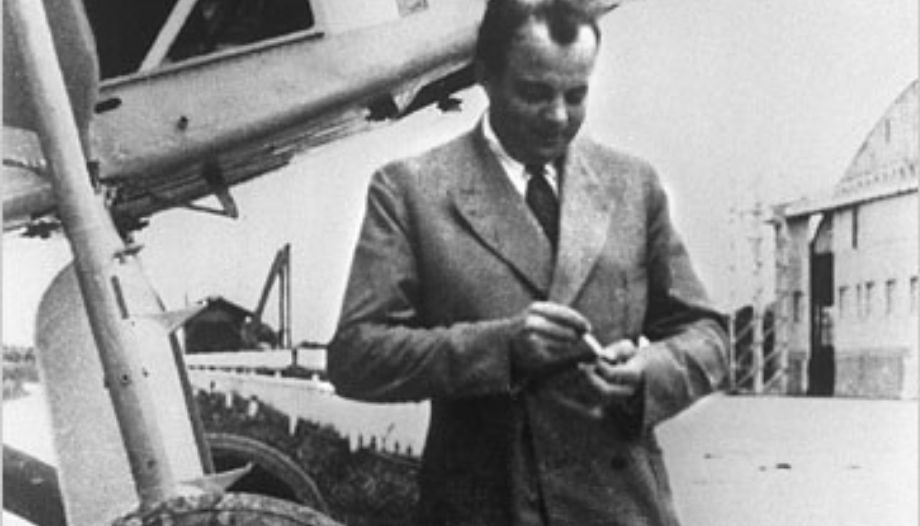
Olivier d'Agay, great-nephew of Antoine de Saint-Exupéry, who disappeared in 1944 while piloting an Allied aircraft in World War II, said in an interview in June this year that his great-uncle would have mixed feelings.
On the one hand, joy, upon seeing the success of his Little Prince of Asteroid B-612. But on the other, sadness, “because humanity did not advance” (‘La Crónica de hoy’).
We do not know if the writer and pilot's mother, Marie Boyer de Fonscolombe, would be sad. But it is very true that Marie was much more than the aviator's mother, according to his biographers, who highlight her resilience and deep faith.
Strength in the face of the death of her children
Because Marie de Saint-Exupéry bore with fortitude the death of her husband Jean, who died suddenly in 1904, and of three of her five children (Francois at age 15, from rheumatic fever (1917); Marie-Madeleine, in 1926, from tuberculosis; and the poet pilot, Antoine, in 1944).
These losses had a profound impact on his life, but he survived them with persevering faith and intense dedication to others until his death in 1972.
Ideals, culture, and faith
Marie Boyer de Fonscolombe She was born into a family of ancient French nobility deeply marked by ideals, culture, and faith, which strongly influenced her upbringing and values. She received part of her education from the Sisters of the Sacred Heart in Lyon.
The biographies by Stacy Schiff and Persane-Nastorg, cited at the end, and the family works collected by Olivier d'Agay, show that Marie raised her children—particularly Antoine—in an environment that was unusual for its time: a combination of moral rigor and great inner freedom.
A very young widow at 28, with five children to care for, she did not opt for a rigid or authoritarian upbringing. On the contrary, she encouraged imagination, artistic sensitivity, and personal reflection.
Faithfulness to the call
She instilled in her son Antoine a constant conviction: life only has meaning when it is lived as a calling, not as a comfort. This advice was not formulated as theory, but as example. Marie insisted on the importance of fidelity to one's conscience, even when it involved risk or misunderstanding. This attitude is at the root of the sense of duty that Antoine showed as a pilot and writer, and which runs through works such as ‘Wind, Sand and Stars’.
Biographies note that Marie never discouraged her son's difficult decisions—not even his dangerous vocation as a pilot—even though they caused her fear. Her constant advice was not “avoid danger,” but “be faithful to what you are called to do.”.
At this point, Schiff emphasizes that Antoine found in his mother a figure of unconditional support, capable of sustaining without possessing, and guiding without dominating.
A life of quiet, deep, and hopeful faith
One of the most striking features of Marie de Saint-Exupéry is the discretion of her faith. She was not a woman of religious discourse or spiritual prominence. However, all biographies agree that her life was sustained by a firm Christian faith, inherited from her family and assumed in a personal and mature way.
This faith was manifested above all in her hope, tested by extreme circumstances. Marie outlived her husband and three of her children, as we have seen, coping with the disappearance of Antoine in his plane in Corsica during World War II.
Instead of retreating into bitterness, his response was a persistent trust in God and in the ultimate meaning of life, even when that meaning was not visible.

The biography Marie de Saint-Exupéry, l’étoile du Petit Prince describes her spirituality as a faith marked by pain. It is not a naive religiosity, but a hard-won, silent hope, sustained by prayer and the conviction that death does not have the last word. This certainty was decisive for her inner balance and her ability to continue giving herself to others.
In the vision that transmitted For Antoine, faith does not appear as a closed system of answers, but rather as an orientation toward the light, even in the middle of the night. This attitude helps us understand The Little Prince, where hope is not imposed, but rather proposed as a quest.
Service to others in the world wars
If there is one point on which all sources clearly agree, it is that Marie lived her faith through service. Her spirituality was eminently practical.
During World War I, she trained and worked as a nurse, caring for wounded soldiers in military hospitals. It was a sustained, demanding, and physically demanding commitment.
After the war, and especially after the death of her daughter Marie-Madeleine, she intensified her dedication to others. She collaborated with aid organizations, the Red Cross, and local initiatives to help the sick and vulnerable. During World War II, now elderly, she once again became involved in caring for and supporting civilians affected by the conflict.
Biographies emphasize that this service was not an escape from personal suffering, but a conscious response to it. Marie seemed convinced that pain can only be transformed when it is shared and directed toward the good of others.
This logic had a profound effect on Antoine, who in his writings emphasizes brotherhood, responsibility, and the value of sacrifice for something that transcends us.
Below are some quotes from Marie de Saint-Exupéry, with formulations from familiar sources.
“Faith does not consist in having no nights, but in walking toward the light.”
In a letter addressed to one of her children, Marie expressed her faith not as an easy certainty, but as a persevering quest, in terms that biographies summarize as follows: “Faith does not consist in having no nights, but in walking toward the light even when you cannot see it.” The idea is reflected in biographies.
“We have not lost those we love; they have gone before us.
In a summary very close to the original text, also from familiar sources, after the death of one of her children, Marie wrote words that express her Christian hope: “We have not lost those we love; they have gone before us.” And this hope led her to an even greater dedication to the service of others.
On God and Interiority
According to explanations from family testimonies collected by Olivier d'Agay, Marie insisted to Antoine that a relationship with God is not imposed from outside, but is discovered in the depths of one's innermost being. Every human being carries within them something that transcends them; that is where God waits, she said. Antoine would say in The Little Prince: ‘What is essential is invisible to the eye.’.
These ideas are drawn from biographies such as Marie de Saint-Exupéry, l’étoile du Petit Prince, by Michèle Persane-Nastorg, Éditions du Triomphe, Paris, 2023; the aforementioned Olivier d'Agay, Stacy Schiff's ‘Saint-Exupéry: A Biography’, which offers in-depth family context, and literary and non-literary articles in digital format (Aleteia) or in academic journals in particular.




 Español
  English
  Italiano