




Marta Ripollés, CEO of Fundación Tacumi, has a degree in law and is the mother of three children, the eldest of whom has Down syndrome. This explains why Ripollés has been working in the third sector for more than 15 years, and has worked in foundations that support people with intellectual disabilities and those at risk of severe exclusion.
In an interview with Omnes, this mother, a specialist, shows a personal conviction and a conviction of the Tacumi Foundation. “All children have the right to learn together and all parents have the right to choose the model of education they want for their children, regardless of each child's abilities.”.
Tacumi seeks the full integration of children and young people with intellectual disabilities into the educational (and professional) environment. This is their bet: together and together” in the classrooms of regular schools, because they form “better students ... and better people”. Here is the conversation with Marta Ripollés.
What is the objective of Fundación Tacumi?
- With the slogan ‘Juntos y Revueltos’ (Together and Scrambled), the Foundation has been supporting the school inclusion of children and young people with intellectual disabilities and other specific educational needs for 15 years through the program “Aulas itinerantes” (Itinerant Classrooms).
And what does ‘Aulas itinerantes’ consist of?
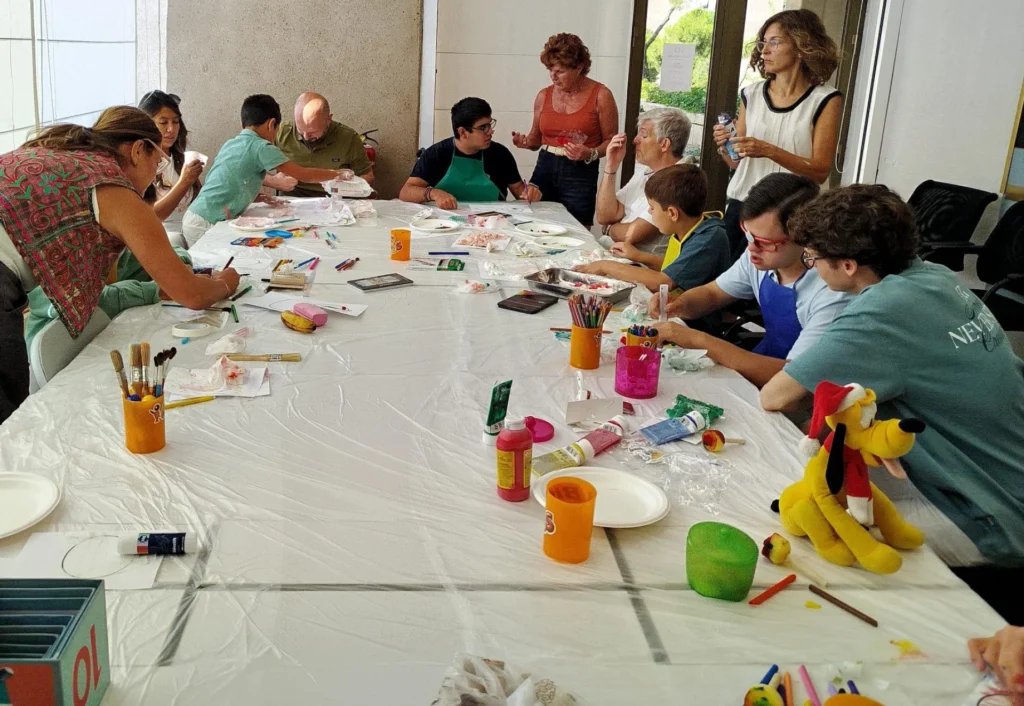
- ‘Aulas itinerantes’ is a program in which specialized professionals enter the classrooms of regular schools to support students who need it most, helping them to progress alongside their peers, adapting materials, supporting teachers and creating inclusive environments.
Tell us what lies at the bottom...
- For the past 15 years, at Fundación Tacumi we have worked in Madrid for a conviction as simple as it is powerful: all children have the right to learn together and all parents have the right to choose the model of education they want for their children, regardless of the abilities of each one.
It is perhaps interesting to note that the Tacumi Foundation was born more than 15 years ago thanks to the Talita Foundation in Barcelona. Some parents of children with intellectual disabilities were interested in what Talita was doing in Barcelona and implemented the same model in Madrid.
How many schools are they in?
- Today we are in 12 schools in the Community of Madrid, supporting 35 students in the classroom, but with a much greater multiplier effect: changing the culture of these schools, raising awareness among classmates, families and teachers.
When a child with a disability enters a regular classroom, he or she is not only in the classroom, but also in the classroom.
learning math or language. He is learning - and also teaching - something much more important: that we all have a place. That differences do not separate us... but enrich us.
How does this inclusion, or integration, of students with disabilities work? What are the consequences?
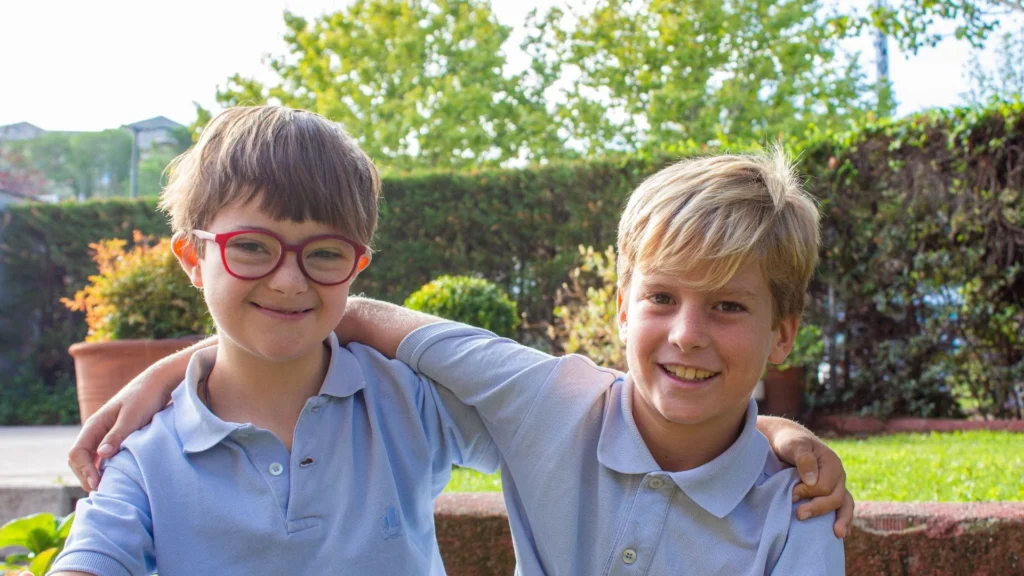
- Inclusion doesn't just change the life of the child receiving support. It changes the lives of everyone around them. Peers discover that empathy is not taught in a book. It is learned by living together. They learn that helping, waiting, listening, valuing... are also forms of intelligence.
Inclusion is not just a right. It is an opportunity. An opportunity to build more humane schools, where every child - with or without disabilities - feels that he or she belongs. Because when everyone learns together, they not only become better students...they become better people.
What does ‘inclusion’ mean to you?
- From what I have been telling you, when we talk about inclusion, we are not just talking about them. We talk about us. About the society we want to build. Of a future where every child, without exception, knows that his or her presence matters. That is why we need to be known, so that we can continue to grow. We want to reach more schools and more families so that no child is left without the opportunity to grow, advance and learn with their peers.
Can you briefly describe the mechanics of the support you provide?
- When a family, or a school, contacts us because they have a student with an intellectual disability or any specific educational need, support, that makes that lack of support makes them be excluded in the classroom, we intervene.
What we do is to provide support in certain sessions throughout the week -we are not there all day, because that would not be inclusion, but something else-. What we do is an initial assessment by our coordinator, and we determine between 4 and 8, maybe more, sessions per week, in language, mathematics, history, physics, in which the child, the student, needs some support.
Because the student is from the school, we are an occasional support, and what we do is to favor that inclusion. If we were there all day long it would not be inclusion, it would be something else, it would not even be special education.
What we try to do is that through this weekly punctual support, establish guidelines, both for the teachers, who are with the student all day long, because the student is from the center, and follow up with the guidance departments, that is to say, we set objectives for that student.
The educator, the person who intervenes in the classroom, is ours, a person hired by the Foundation, but the resource is paid by the families, the center pays nothing.
From which centers do you call them, or to which centers do you most often contact them?
- Mainly, we need to reach private schools. For example, we have an agreement with Fomento, and we are in many Fomento schools. There are many families who need it. It is true that we are a small foundation, but we are eager to continue growing, especially in Madrid. A lot of families call us. With children, with specific needs, who do not know what to do. As a result of the interview with Voz Pópuli, at the beginning of December, many families contacted us.
I have a daughter with Down syndrome who will now be 24 years old. I didn't know that integration existed in my time. My daughter Maria went to a special education school, and she has been happy, and I have been happy in special education. But now that I see the advantages of inclusion -I've been at the Foundation for a few years now-, especially up to a certain age, and up to secondary school, for example, I take a lot of advantage of it. Not only for the benefit of the child who has that need, but also for the benefit of the environment, of his peers, of awareness, how they change their outlook. This is, as they say, win-win, in the end it's a win-win situation. The person with a disability and the environment. How it changes the look, the empathy, the teamwork...
Let's finish: Do children with disabilities have the right to be in regular education, or should they be referred to special education? What does the law say?
- If a family wants their child to go to a regular school, the child has the right to be in that school. What happens? Unfortunately, when a child with an intellectual disability or with a behavioral problem, etc., comes to them, the centers do not have the means to provide support. But not because of their own fault, but because they do not provide them with those means, or because they do not have adequately trained staff.
What usually happens is that the centers invite those families to go to special education. But in fact, the law says that the child has the right to be in that school. And the center will have to provide the supports that the child needs. The reality is that there are no means for those supports, and the centers are overflowing. That is why Tacumi was born. Because to many families who opted for regular education, the centers told them, great, I'll take it, but I don't have the means, you put them there.
And the last one, tell me for a moment about the cost.
- It is true that it is a resource that is not cheap. We attend and make an initial assessment without any commitment, and we give you an estimate. And then there is the service check, which is very important. Families that have been granted the Dependency Law have an economic subsidy, which you can apply to domestic help, or you can apply it to a training service. And the families that have the service check, as they call it, pay part of the fee with what the public administration gives them through the Dependency Law.
These aids do a lot, says Marta Ripollés in conclusion. We do not ask her for data, but she gives them. “To me, for example, they give me 300 euros a month, and the training of my daughter Maria is 600 euros. Well, that's half. In the end, whoever has a need, looks for the means to be able to solve that need”.




 Español
  English
  Italiano