



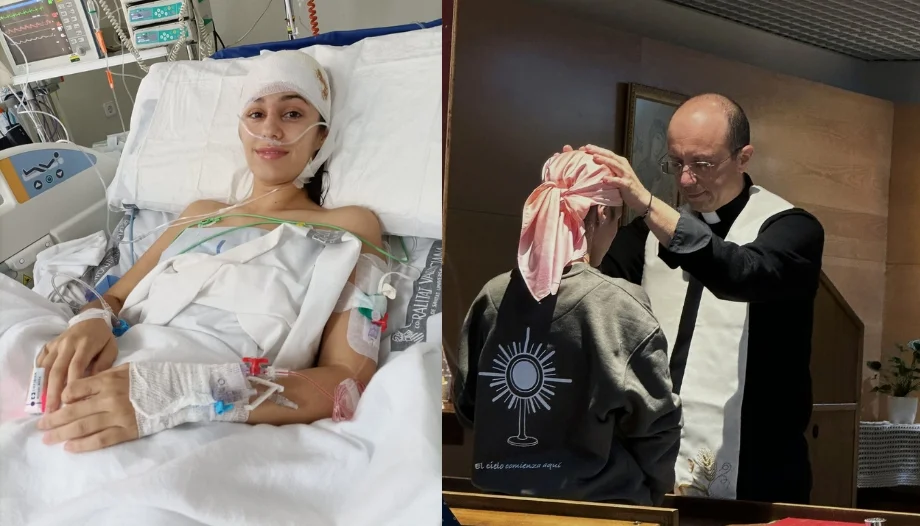
For years, Nerea Castellanos (Alicante, 1995) lived with a tumor the size of a tennis ball without knowing it. What began in April 2023 as headaches, vomiting and vision problems - initially attributed to migraines and a cervical contracture - ended in a life-changing diagnosis: a grade 3 astrocytoma in the right frontal lobe of the brain. Despite two surgeries, radiotherapy and chemotherapy, Nerea says she shared her testimony at Instagram, Among other things, because I wanted to remember all that.
From the beginning she had a certainty that never left her: «I knew she was going to be cured». Indeed, in just nine months, on January 25, 2024, she received the good news: «there is no disease». The first thing she did was to pray before the tabernacle of the San Juan University Hospital. Today she looks back on all that and testifies to the faith that sustained her and the meaning of her suffering.
In this interview, Nerea tells us how she coped with her cancer. We can glimpse her optimism in small everyday gestures, such as the decision to dress up and dress in cheerful colors every time she went to the oncology department, a simple but firm way of facing an environment marked by sadness and suffering.
When you were told you had a brain tumor, what was the first shock like? What role did faith play?
He has had the whole role. As soon as I was told about it, I thought «what should I do now». Maybe without being aware of it, the Holy Spirit and the Lord were in me, because at no time was I worried.
People told me that my attitude was not normal. Now I am even more aware that this peace was a gift that the Lord gave me at that moment, and I have always been very positive and very cheerful. In fact, I was like the one who had to console everyone because I knew I was going to be cured.
Why did you decide to share your testimony in networks?
I was living so many things that I didn't want to forget anything: anecdotes from the hospital, my siblings coming from abroad to see me, deep conversations with my family... I made a second private Instagram account as a diary to keep everything there, but I never uploaded anything. I felt it didn't make sense to separate a “nice Instagram” from the real thing.
Deep down, the only thing that held me back was the fear that it would seem that I was looking for pity or attention. In the end I thought: «this is my reality, I want to keep it for myself and also share it in case someone else finds it useful or feels identified. And if it bothers anyone, they can always stop following me».
In fact, when I was diagnosed with the tumor I read the book by Elena Huelva, the girl who died of cancer. Her testimony helped me a lot, because I felt that, in a way, I was talking to her. No matter how much I talked to my friends or other people, it was not the same. She was describing trials, feelings and moments that I was also going through, and I felt very identified. Even if I couldn't talk directly to her, she was very much with me. So I thought that maybe I could also help someone by telling my story, especially because brain cancer, as was my case, is very scary, and it doesn't always have to end badly.
Have you seen fruits after sharing your testimony?
Yes, there have been some very special cases. One of them is a father I am very fond of. He contacted me because his one-year-old daughter had the same tumor as me. In fact, worse. And it had come to his attention when I told him that the only thing that gave me peace was to offer suffering. He wanted to understand this better.
She felt guilty, she thought her daughter's illness was a punishment from God and we talked about it. I finally got to meet them in person when they came to Alicante for treatment. I spent time with the child, playing with her, and it was a gift. To this day we still write to each other.
What was it for you to offer that suffering?
What I get the most out of everything that has happened to me is the offering of suffering. For me it was a revelation.
One day, after telling me that they had removed practically all the tumor, I had my mind set on going home. But, at the last minute, they told me that they had to give me an injection in my stomach. It may seem silly, but I had a panic attack: I felt that I could not go on any longer, that I had no strength for anything else. And to top it off, they explained that I would have to take it every day for at least fifteen days.
The next day I woke up in anguish, waiting for the moment when someone would come through the door to prick me. I cried, tried to distract myself with music or drawing, but nothing calmed me. Until something did click inside me and I thought: “I'm going to offer it”.
It was instantaneous. Suddenly the suffering made sense, it gave me peace. I understood that it was not in vain, that I could offer it for someone, for the Lord. And that changed everything.
Before the first operation, you were told that you could come out lifeless. How did you face the possibility of dying?
At that time I was alone with my father and we started talking about it. I said, “Dad, if I die, I'm not going to know. I'm not going to suffer, I'm going to be asleep.” Also, I explained to him that if I died, I would have reached the goal, the best place I can be, I would have reached heaven with the Lord and that I would be better off than here.
He understood what I was saying, even if it hurt. I knew they would suffer because of the human attachment we have, but for me it was a very real peace. I wasn't playing hard to get: I really felt it. Now I think it was the Holy Spirit sustaining me, because, if not, it cannot be explained.
Have you seen how this illness has strengthened your relationship with God?
Yes, now I am more aware of the trust I had in Him and the grace He gave me. I see His presence in my life and I am more grateful.
A few months before all this, I was already very strong in my faith. In fact, a friend even told me that it seemed that the Lord was preparing me for that moment. I am not overflowing with faith by any stretch of the imagination, but even then I felt very strong.
Other aspects were also strengthened, such as my relationship with my guardian angel. Before the operation, a priest suggested to my father that I talk a lot with my angel and the guardian angels in the operating room, and I did. Since then I am much more aware of him and talk to him many times a day.
What place has Our Lady occupied in this process?
I slept every night in the hospital with my rosary rolled up in my hand. After all, she is my mother, literally.
Every day my earth mother slept with me and held my hand; she almost always stayed with me. On the day of the operation, however, I had to spend the night in resuscitation and I could not go in there.
That night I really felt that Our Lady was with me, as if she was holding my hand. I couldn't see well or use my cell phone, but I managed to put on music and spent the whole night listening to Am I not here, who am your mother? of Athens and Quiet by Luis Po. I didn't sleep at all, but those songs sustained me, especially the one about the Virgin, which says something like: “I am here, I am your mother, don't be afraid”.
After receiving the news that there is no illness, what do you feel God is asking of you?
I'm still figuring that out. But I felt very clear that I wanted to do something that would really help, both at work and personally. I had a lot of uncertainty, but also the conviction that the Lord had saved me because he had a plan for me. I kept asking him, “Lord, what do you want from me?.
Eventually he gave me the job where I am now, in a foundation for people with mental health problems, where I am very happy. There I also met my partner, whom I will marry next year, and I live it as a gift from God.
I feel that He has saved me for this plan and that I will continue to discover more things, but it is clear to me that I cannot stop talking about Him and trying to help and be His instrument.




 Español
  English
  Italiano