



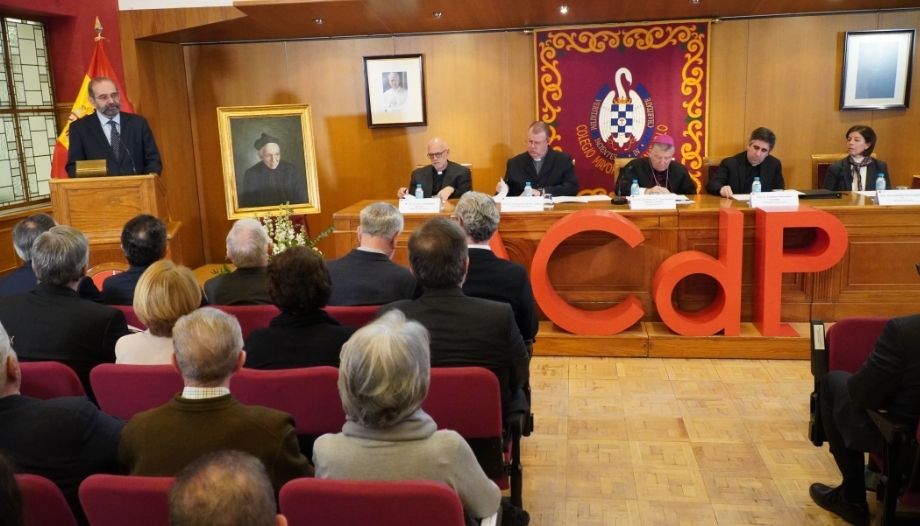
The ceremony marked the official beginning of the process for the recognition of the sainthood of Father Ángel Ayala S.J. (Ciudad Real, 1867 - Madrid, 1960), founder of the Catholic Association of Propagandists (ACdP). A man who preached to show the faith in the public sphere, «from the rooftops», to be witnesses of Christ.
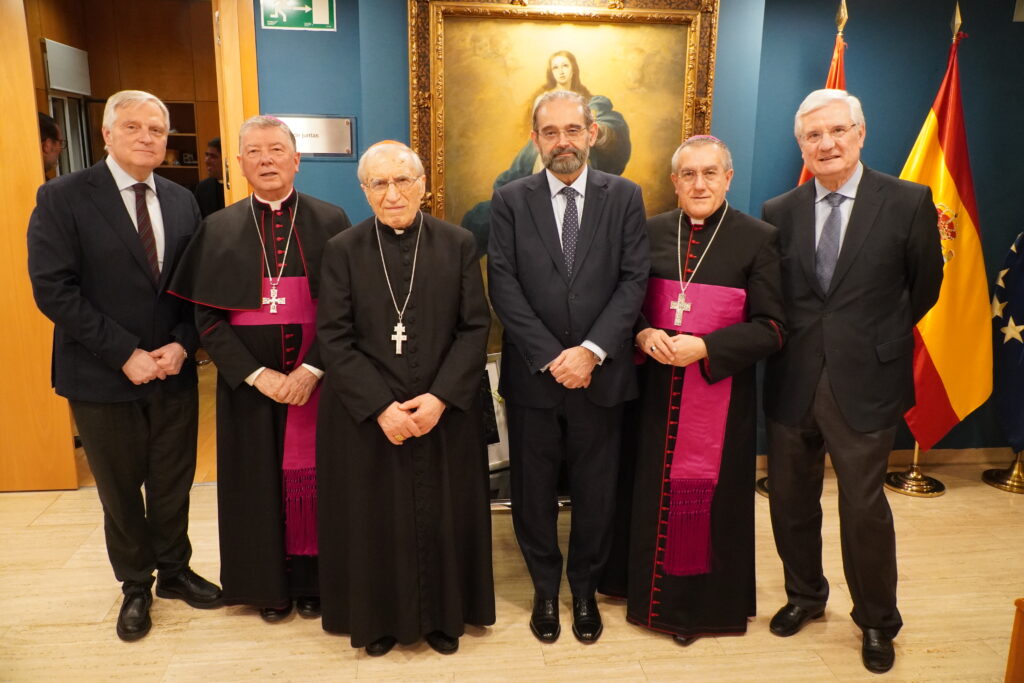
The event was presided over by Bishop Juan Antonio Martínez Camino, auxiliary bishop of Madrid, with the assistance of the Nuncio of His Holiness, Bishop Piero Pioppo, Cardinal Antonio M. Rouco Varela, Archbishop Emeritus of Madrid, the president of the ACdP, Alfonso Bullón de Mendoza, and the mayor of Ciudad Real, Francisco Cañizares, among other civil and ecclesiastical authorities, members of the ACdP and numerous members of the faithful.
“His apostolate has certainly been fruitful,” said Monsignor Martínez Camino, who added that “the Church takes seriously the possibility of Father Ayala being a living witness of the Gospel.” For his part, the president of the ACdP, Alfonso Bullón de Mendoza, underlined the fame of sanctity that accompanies the memory of the Father Ayala.
The Postulator of the Cause of Fr. Ayala, S.J., and National Secretary for the Causes of Canonization of the ACdP, Pablo Sánchez Garrido, PhD from the Faculty of Political Science and Sociology of the Complutense University, and professor of Moral and Political Philosophy at the CEU San Pablo University in Madrid, told Omnes that his example “constitutes a singular and very important contribution to the Church. We spoke with him.
Can you briefly describe some of the features of Fr, S.J., founder of the Catholic Association of Propagandists (ACdP)? You have Ayala brought the joy of faith to public life.
- In fact, although as a young man he had a certain reputation as a serious and demanding person, Father Ayala gradually softened his character by dint of virtue and grace until he became an old man who welcomed lay people and religious with a smile to direct them spiritually, especially those called to be leaders in public life, whether they were workers, ministers or religious. He also boasted of being “an old man with a sense of humor” as he titled one of his last books:
“Thoughts on life by an old man with a sense of humor”. He therefore developed an apostolate of joy, which led to his facet as a pedagogue, and to his facet as a spiritual formator of leaders.
Tell us about your firsta time
- His first stage is also of enormous interest, since it is his stage as founder of apostolic and educational works. This is the period in which he founded the Catholic Association of Propagandists, to form young Christian leaders called to awaken the sleepy Spanish Catholic people, from which the great Ángel Herrera Oria, now in the process of beatification, also emerged. He also founded and directed the prestigious Catholic Institute of Arts and Industries, which today is ICAI-ICADE; the Minor Seminary of Ciudad Real, or various works of social and worker apostolate, inspired by the Social Doctrine of the Church. Nor should we forget that he was one of the founders and initial promoters of the acquisition of the newspaper El Debate, years before Ángel Herrera took over its management.
In other works he was not the main founder, but he played a very important role, as in the Confederation of Catholic Students, in the CEU, or in the founding of the Missionary Company of the Sacred Heart of Jesus.
Diocesan phase and Roman phase
Now the opening of his Cause of beatification and canonization has taken place. Can you explain this diocesan phase, and the one that will follow, that of the study of his heroic virtues?
- The processes of canonization for virtues have two phases: diocesan and Roman. The diocesan phase is usually opened in the place where the Servant of God died and requires that the Servant of God have a reputation for sanctity, as well as the faithful who recommend themselves to his intercession. This phase is rather a kind of procedural instruction, conducted by the episcopal delegate and by the postulator, where all the testimonies are collected, before an ecclesiastical tribunal, as well as all the documents, certificates, writings (published and unpublished), etc., by a historical commission. The theological censors in turn analyze the writings in the light of the ecclesial Magisterium.
Once all the documentation and testimonies have been compiled and duly classified, the diocesan process is closed and sent to the Dicastery for the Causes of Saints in Rome to open the Roman phase.
In this, a Roman postulator, in collaboration with the directive figure of the relator, prepares a “positio”, a kind of doctoral thesis that exposes and justifies the entire life of the Servant of God, focusing on his natural and supernatural virtues, in heroic degree, and his fame of sanctity. This document, once completed, is presented to the Roman commissions (historians, theologians, bishops and cardinals) until finally the Holy Father signs the decree of heroic virtues and the Servant of God is declared venerable, although this does not mean that he can still be publicly venerated.
But all this being important, what is decisive is the process of a miracle, necessary to be declared blessed, or of a second miracle, to be declared a saint. As is well known, the miracle process, which also has a diocesan and Roman phase, is a very rigorous process that requires the existence of a miracle clearly attributable to the intercession of the Servant of God and that this miracle be certified by a commission of medical experts who have to verify the extraordinary and scientifically inexplicable nature of the healing and then enters the theological evaluation of the fact as miraculous, by other commissions, prior to the final declaration of the Holy Father as blessed, or as a saint.
Angel Ayala and Cardinal Ángel Ayala are sometimes confused. Herrera Oria, whose Cause is also open. Explain it, if you would be so kind. The president of the ACdP, Alfonso Bullón de Mendoza, has underlined the fame of sanctity that accompanies the memory of Father Ayala.
- Well, it is true that sometimes there is some confusion between the two “angels” (Herrera and Ayala) perhaps explainable because there was always a great identification between the two, since Father Ayala trusted Angel Herrera from the beginning, whom he selected from the Marian congregations of “Los Luises”, along with other companions, and put him at the head of the Catholic Association of Propagandists, or later at the head of El Debate, as I said before. But Father Ayala knew how to create works and then withdraw to the background, he was very subsidiary and was not at all clerical, or clericalist. In this he was ahead of the Council in the Council's vindication of the role of the laity in the apostolate and in a certain way in being the vanguard of the Church in society. Before, there was an idea that the apostolate or the ecclesial action of the laity was rather an extension of the action, or of “the hand”, of the Hierarchy, according to the theory of the “longa manus”. Father Ayala, on the other hand, entrusted this great work of public apostolate to a group of young lay people whom he formed especially for it and launched them into public life with great confidence and freedom.
“Let's see what God wants from us.”
But returning to the confusion of “angels”, it should be clarified that the founder of the ACdP was Father Ayala, in 1908, with that phrase: “Let's see what God wants from us”. Then it is true that circumstances withdrew him from the front line because, like other saints, he suffered calumny, in this case under the false accusation of fundamentalism, and was removed from Madrid to Ciudad Real. This put all the responsibility of the newly founded ACdP on the young Ángel Herrera, who had to assume an unusual protagonism for apostolic associations of the time, making him a protagonist of the Spanish Church, even in his stage as a layman, prior to the priesthood.
It could be said that their lives have parallels...
- Yes, both ended up as priests, although Ángel Herrera would later become a bishop and cardinal. But each has his own character and brings us his own model of holiness, if I may use the expression. As a matter of fact, I believe that in both cases there was a proven reputation for holiness, which led to the initiation of the respective processes: that of Ángel Herrera around 1996 and that of Ángel Ayala around 2020, with previous steps since 2008, when the ACdP created the Secretariat of Causes of Canonization. It is true that the Cause of Father Ayala could have been initiated earlier, but the means and the necessary institutional determination to do so are not always available.
The event highlighted his promotion of apostolic initiatives, such as ACdP and How do you value Father Ayala's contribution to the Church? His educational footprint, for example, and others.
- Indeed, his work as a great pedagogue was enormous, and there are his biography, his educational foundations and his books to prove it. However, I want to focus on something else if we talk about his contribution to the Church, since there have been many great Catholic pedagogues before and after him. However, I believe that Father Ayala's contribution to the Church is very important and that it has something special, since holiness is one thing, and I trust that it has reached many people -even some of them known to us, as probably our grandparents-; but canonizable holiness is another thing.
In order for the Church to place someone as a model, it is not enough to be convinced of his holiness; it is necessary that this Servant of God has pointed out, from his openness to grace, a way to live the faith, that he has contributed something new to the People of God, or that he has made the ordinary of the Christian life in an extraordinary way, in such a way that he deserves to be recognized as a model, as a “canon”.
In my opinion, as a postulator, devotee and specialist in the life of Father Ayala, and stressing that we must wait for the judgment of the Church to speak properly of his sanctity, I believe that this is true of him, since Father Ayala shows us, together with his then young disciple, the Servant of God Angel Herrera, a way of bringing the faith to public life, at a time when the faith was being cornered in the private sphere, in application of the statist dogma (liberal), the Servant of God Ángel Herrera, a way of bringing the faith to public life, at a time when the faith was being cornered in the private sphere, in application of the statist (liberal or socialist) dogma of separation between the public and the private.
This is not a trivial matter since the Christian faith is called to reach all corners of society, including all social realities and structures.
Bringing faith into public life is a hallmark of the company. Continue...
- What I have just said does not mean to propose an undesirable clericalism, nor a confessionalism, but to fulfill the mission of being “salt”, “light” and “leaven” of society, bringing the faith to all temporal realities, which is not exhausted in the private, but the faith must also permeate with courage or evangelical “parresia” the public sphere, according to the Gospel mandate to proclaim the faith from the housetops, for as Jesus says: “what you have spoken in the ear in the rooms, shall be proclaimed from the housetops” .
Mention some of these “rooftops” to proclaim the faith.
- Today these “rooftops” for proclaiming the faith are undoubtedly the mass media, as Father Ayala saw when he promoted the newspaper El Debate, but they are also the chairs, political commitment, entrepreneurial initiative, social action, etc. It is a matter of being a witness of Christ also in these temporal realities and of not swallowing the worldly and theologically false dogma that faith is a private matter.
Moreover, Spain is precisely a place where faith has been lived openly and publicly in a natural way, even in the life of leisure and devotion, as shown by our traditions of Holy Week, or our Corpus Christi, or our great writers and artists of the Golden Age, who took faith to its highest social and cultural expression.
Father Ayala showed a way for the laity to live their life in the Church and in society, a kind of what I have called the “Pauline option” or the “Pauline model” for those who feel this special call to public life, but which in a broad sense applies to every Catholic, especially if he or she is a lay person.
A path that today is not only not outdated, but is more necessary than ever, even if it must always find new forms of expression, new roofs, to continue to proclaim to all the salvation of the Gospel, without hiding the light under the bushel.




 Español
  English
  Italiano