



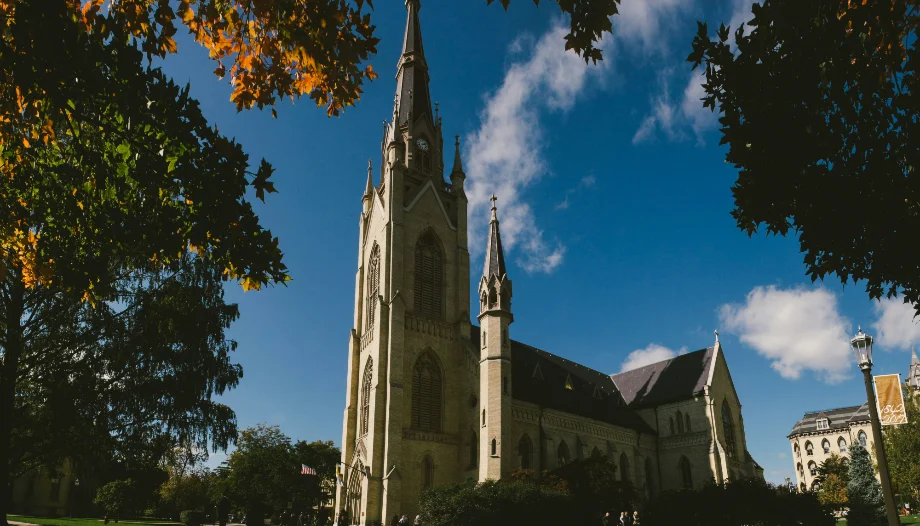
The Catholic identity of educational institutions is back at the center of the debate following the departure of sociologist Christian Smith from the University of Notre Dame. This is not a marginal voice. Smith, a professor for twenty years at the US university, held the Kenan Chair, garnered $15 million in external funding, directed top doctoral dissertations and was, in his words, “an enthusiastic advocate for the Catholic mission of the university.”.
Smith has explained the reasons for his departure and the decline of his university in a long article published in First Things, where he regrets leaving the university for not being true to his principles, when at 65 years of age “almost any professor in a similar situation would continue working five, ten or fifteen years more.”.
1. True Catholic teachers
For Smith, the core of a university is not in its religious aesthetics or marketing, «but in its intellectual life.” And there, he argues, is “precisely where Notre Dame, to a large extent, fails to be Catholic.”.
The official mission statement is clear: “The University requires of all its scholars [...] respect for the goals of Notre Dame and a willingness to participate in the dialogue that gives it life and character.” Moreover, there is “a special obligation and opportunity [...] to deepen the religious dimensions of all human learning.” The problem, however, is that “these fine words are not consistently and rigorously put into practice.”.
One of the most delicate points is the faculty. Former President John Jenkins stated, “We must have a majority of Catholic faculty and scholars.” The goal was to have “dedicated and committed Catholics predominate in number among the faculty”.
Smith charges that, in practice, this criterion is met “through a ‘check the box’ approach, whereby a candidate who was baptized Catholic but now despises Catholicism is considered Catholic.” A Catholic educational institution will maintain its identity only if the majority of its workers are truly Catholic, formed in the tradition and willing to uphold it intellectually.
2. Confronting inconsistencies with ideology
Another serious element is the lack of institutional courage. Smith speaks of “a lack of vision and courage among leaders” and of a leadership “terrified at the prospect of conflict”. When tensions arise over identity and mission, the reaction is to avoid the problem. “Instead of confidently promoting the stated Catholic mission [...], leaders [...] speak with enthusiasm and then shrink back.”.
Not to fight against employees or managers who “actively resist and [...] subvert” the mission is, in the long run, devastating. And if those who denounce public inconsistencies are met with silence or evasions - as happened with his book on Catholic higher education, to which there was “resounding silence” - “it will end badly”.
Obviously, this does not detract from the fact that there may be non-believing professors or professors of other religions who can collaborate positively with the aims of the university, the problem that he denounces refers to those who openly hold anti-Catholic positions.
3. The danger of looking for the world's applause.
Smith identifies a third corrosive factor: “the yearning for general acceptance.” The university “desperately yearns to belong” to the club of large secular institutions. But “only one factor makes Notre Dame suspect: Catholicism.” Hence the temptation to minimize it.
Jenkins“ own question resonates as a reproach: ”If we fear being different from the world, how can we make a difference in it?" Seeking the world's applause, acceptance and political correctness is not the way for an institution that claims to have a specific mission.
4. Q1 publications and neglect of mentoring
The ambition to become a major research university accelerates the problem. The dean's priority was for the faculty to “publish in prestigious journals”. The logic of hyperspecialization ends up displacing the intellectual integration proper to a Catholic mission.
The result is “niches of mission-oriented activities” instead of real integration. Moreover, research and bureaucratic pressure reduces the shared intellectual life: “We are expelling technicians with PhDs, not intellectuals with a solid background”. Focusing exclusively on publications in academic impact journals means neglecting personal mentoring, which is decisive for the integral development of students.
5. Marketing and appearance: “Appearing instead of being”.”
Smith also denounces the hypertrophy of marketing. The university lives more and more in “a world of neat appearances”. The symbolic example is the bookstore turned merchandising store. In contrast to North Carolina's motto, “Esse Quam Videri” (“To be rather than to appear”), he observes that today the opposite imperative prevails: “To appear rather than to be”.
Beware of making marketing and image a permanent distraction: when the brand supplants the mission, identity is diluted.
6. Intellectual formation and Social Doctrine
One of the most eloquent episodes recounted by Christian Smith is that of a brilliant senior finance student - a committed Catholic concerned about environmental issues - who confessed to him that she had not heard of the Social Doctrine of the Church as applied to economics for four years.
For Smith, this is a “mind-boggling oversight”: training future business leaders at a Catholic university without seriously introducing them to the Catholic social tradition is a structural contradiction.
A warning that challenges Spain
Notre Dame is not an isolated case. In Spain, too, there are many schools and some formally Catholic universities whose identity has become tenuous, with little effective transmission of the faith to students and families.
The warning is clear: if there is no real majority of committed teachers, if internal inconsistencies are not addressed, if external applause is sought and mission is replaced by rankings and marketing, Catholic identity becomes a mere label. And, as Smith implicitly concludes with his exit, a label does not sustain an institution.




 Español
  English
  Italiano