



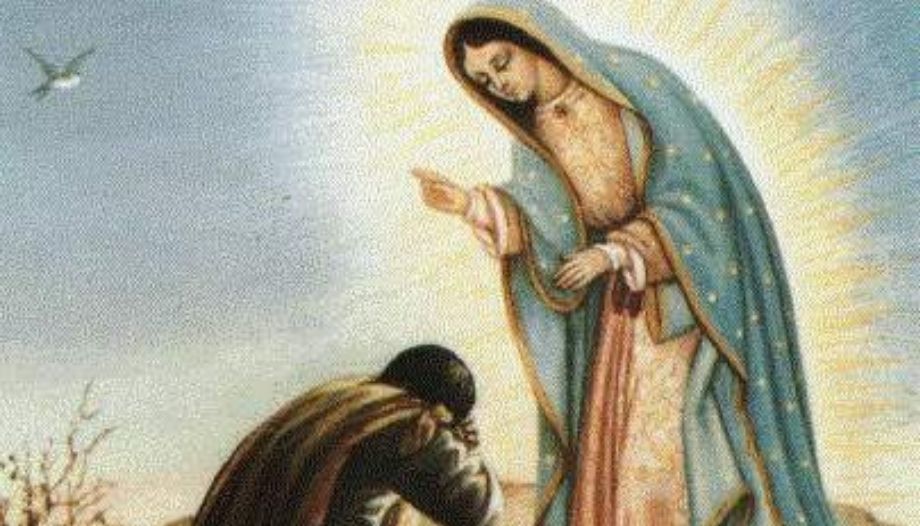
After his baptism, he was named Juan Diego, but his original name was Cuauhtlatoatzin, which in Aztec means “he who speaks like an eagle.” He was an indigenous peasant who traveled from his village to Mexico City on Saturdays, the day that Spanish missionaries devoted to catechesis.
Juan Diego, 57, was walking across a rocky field at dawn on December 9, 1531, according to the vatican saints' calendar. When he reached the foot of Tepeyac Hill, he was drawn to the song of a bird he had never heard before. Then silence, and a sweet voice calling him: «Juantzin, Juan Diegotzin.».
The man climbs to the top of the hill and finds himself facing a young woman in a dress that shines like the sun. He kneels and listens as she introduces herself: ‘I am the ever-Virgin Mary, the Mother of the true and only God.’.
The bishop asks for a sign
The Lady entrusts Juan Diego with a task: to inform the bishop of what has happened to her so that a Marian temple can be built at the foot of the hill. The archbishop of Mexico, Fray Juan Zumárraga, does not believe him. In the afternoon, the Lady invites Juan Diego to try again the next day.
This time, the bishop asks a few more questions about the apparition, but he remains skeptical and asks for a sign. The farmer reports the request to the Lady, who promises to give him a sign the following day.
The peasant learns that his sick uncle is dying, and he goes out to find a priest. On the morning of the 12th, Juan Diego, at Tepeyac, changes his route to avoid meeting the Lady.
But the Virgin Mary stands before him and asks him why he is in such a hurry. The peasant throws himself to the ground and asks for forgiveness. The Lady reassures him. His uncle is already cured, she says, and invites Juan Diego to climb the hill to pick flowers to take to the bishop, some “roses of Castile.” Something impossible in the middle of December.
The Indian gathers them up and wraps them in his tilma, the coarse cloth cloak he wears, and sets off for Mexico City. Juan Diego recounts the events to the bishop and unrolls his cloak in front of those present.
The image of the Virgin is reproduced on the cloak.
At that very moment, the image of the Virgin, the icon venerated everywhere, appeared on the cloak. The bishop went to the site of the apparitions, began the work, and on December 26, the first chapel was ready next to the hill.
San Juan Diego, a widower for several years, asked to live in a small house near the chapel. For another 17 years, until 1548, he continued to be the guardian of Our Lady, the dark-skinned Virgin. You can find a more complete biography here.
The Shrine of Tepeyac, whose heart is the sacred image of the Virgin Mary of Guadalupe, has been a constant destination for pilgrims since the 16th century, not only from the Mexican nation but of the entire American continent, explains the Shrine.



 Español
  English
  Italiano