



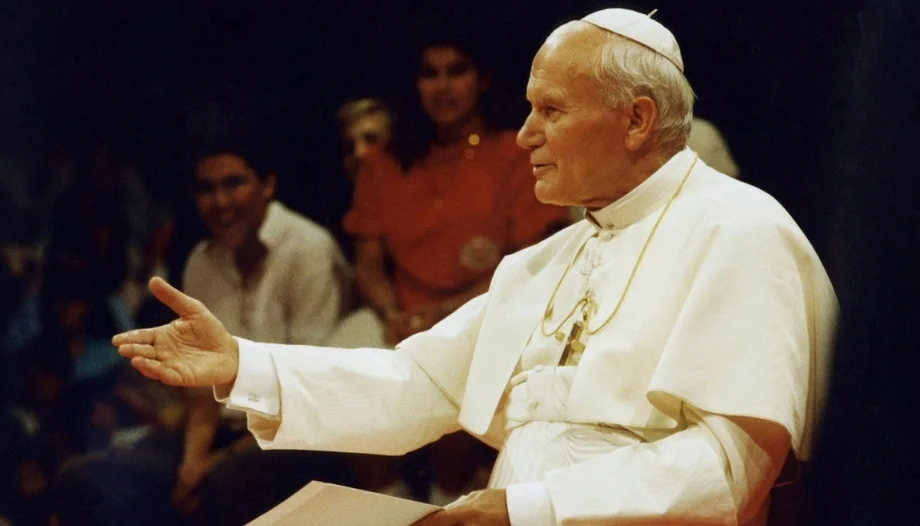
 Radiating Humanity in the World: John Paul II and CultureSt. John Paul II and the search for truth, goodness and beautyBeauty as revelation of the mystery: St. John Paul II and Art
In its desire to be present in the world and carry out its mission of evangelizing all peoples, the Church has paid particular attention to the media, especially since the mid-20th century. Within this vast body of teaching, the pontificate of St. John Paul II was especially prolific and intense, not only in terms of the number of texts or references, but also in terms of media attention, a phenomenon unparalleled until that moment in the history of the Church. This is demonstrated by the regular meetings he held with media and entertainment professionals from the beginning of his mission at the head of the See of Peter until the end, as evidenced by the gathering in Rome of journalists from around the world on the occasion of the Jubilee of 2000.
Similarly, his decision to appoint a renowned journalist as spokesperson and entrust him with the professionalization of the Vatican's institutional communications was surprising. On the other hand, his messages on the occasion of World Communications Day and his speeches to the members of the Pontifical Council for Social Communications stand out. All this vast corpus magisterial has also been the subject of various studies and compilations. In this article, we aim to highlight the most fundamental ideas.
A media-savvy Pope
It is clear to everyone that Saint John Paul II possessed exceptional qualities as a “media personality,” thanks to his theatrical background, his broad culture, his interest in contemporary world affairs, and his constant attention—a true pastoral concern—to ordinary people (young people, workers, fathers, and mothers). All of this facilitated his “connection” with media professionals, which translated into mutual closeness, respect, and admiration. As one of them put it:
“An athlete and actor, his body is a means of expression and communication. A valuable instrument at the service of his mission (...). This is one of the secrets of Wojtyła's media phenomenon. His charisma lies in his transparency. He has a personal charm that is expressed in the way he looks, smiles, and moves. An attitude so warm that it is irresistibly seductive.” Even some of his less favorable biographers, such as Berstein and Politi, acknowledge that “John Paul II was the first pope to understand the television age, the first to master the medium, to handle a microphone, the first pope who was accustomed to improvising, who was not afraid to perform in public.”.
Behind this closeness and familiarity lies a deep conviction about the role that the Church must play in contemporary society, where Christians are called to be protagonists in the battle for the soul of the world, which is being fought above all in the “new Areopagus,” among which the media stands out. This is what this holy Pope specifically pointed out: “The first Areopagus of modern times is the world of communication, which is unifying humanity and transforming it—as they say—into a ‘global village’.
Social media has become so important that for many it is the main source of information and education, guidance and inspiration for individual, family, and social behavior. The younger generations, in particular, are growing up in a world conditioned by these media. Perhaps this forum has been somewhat neglected: other instruments for evangelization and Christian formation are generally given priority, while social media are left to the initiative of individuals or small groups, and are included in pastoral planning only at a secondary level. It seems clear that St. John Paul II was well aware of this deficit and of the need to address it from the very beginning of his time at the helm of Peter's Barque. Hence his initiative to professionalize the Sala Stampa and create a new culture of institutional relations with the media.
Gifts from God
In line with what the Church has been saying for the last half-century, Pope Wojtyła emphasizes the positive nature of the media, seeing them as gifts from God that should be used for good: “The media,” he says, "are the ticket of admission for every man and woman to the modern marketplace, where opinions are publicly expressed, ideas are exchanged, news circulates, and information of all kinds is transmitted and received. For all these gifts, we give thanks to God..." The confirmation of this reality does not respond solely to the desire to reaffirm previous teaching; rather, it is the fruit of his own personal conviction and pastoral experience.
At the same time, in line with the Magisterium, he emphasizes the instrumental nature of these gifts, which as such can be used in the service of man and society or against them. “The Church's relationship with the media is complex and requires constant reflection,” he explains. "On the one hand, the Church sees the media as having endless potential, not only for the dissemination of information, the creation and communication of art and culture, recreation and the improvement of the human spirit, but also for the growth and strengthening of the kingdom of God. At the same time, it is painfully aware of the damage that can be inflicted on individuals and society by the misuse of these instruments." These words summarize the other main aspects that he develops in his teaching and which we will discuss below.
Agents of socialization and acculturation
It is significant that in one of his first messages on the occasion of World Communications Day (1980), Saint John Paul II referred to the influential power of the media “in the process of socialization of young people, facilitating a vision of man, the world, and relationships with others that often differs profoundly from that which the family tries to transmit.”.
That same year, speaking before UNESCO, he stated: “Since these media are ‘social’ media, they cannot be used to dominate others, either by political powers or by financial powers that impose their agenda and their model. They must become the means of expression of the society that uses them and that also ensures their existence. They must take into account the real needs of this society. (...) They must take into account the good of humanity and its dignity. They cannot be subject to the criteria of interest, sensationalism, or immediate success, but rather, taking into account ethical requirements, they must serve to build a ‘more humane’ life.”.
In fact, not only does “communication generate culture,” but “culture is transmitted through communication,” as he also points out. This is the basis for the crucial issue underlying the case of the media, which is their power of social and cultural influence; or, in other words, their role as agents of socialization and acculturation. “This is a phenomenon of vast proportions,” he continues, "sustained by powerful social media campaigns that tend to propose lifestyles, social and economic projects and, ultimately, a general vision of reality that internally erodes distinct cultural organizations and noble civilizations. Due to their outstanding scientific and technical nature, Western cultural models are fascinating and attractive, but unfortunately, and with increasing evidence, they show a progressive humanistic, spiritual, and moral impoverishment.".
Thus, the content transmitted by the media—whether informative or purely entertaining—is never innocuous. It reflects a particular anthropological and sociological vision. The communicative process itself is the basis for the creation of culture, of a way of seeing and understanding what surrounds us, and very particularly, man himself. The Holy Father emphasizes this in the following way:
“The human person and the human community are the end and measure of the use of social communication media; communication should be carried out from person to person, with a view to their integral development.” “Because the mass media always respond to a certain conception of man, whether they deal with current events, address cultural issues, or are used for artistic expression or entertainment; and they are evaluated according to how accurate and complete this conception is.
Undoubtedly, this influential power carries with it a serious moral responsibility, as Pope Wojtyła himself emphasizes: “We know that the media exert a great influence on the formation of consciences and, consequently, on the moral sphere. Therefore, we must first pay attention to the fact that the media help people to form their consciences and moral attitudes in a way that not only respects God's law, but also defends human nature, which is the bearer of an innate and inalienable dignity that must be respected in all circumstances.” “Thus, with regard to content, we must always appeal to the sense of responsibility of communicators and to the critical sense of those who receive the communication.”.
Service to truth and the common good
From what has been said so far, it is clear that there is a close and necessary link between communication and truth and, therefore, between communication and the common good. This is an aspect that St. John Paul II wanted to emphasize from the beginning of his pontificate: communication as a service to truth and the common good. Already in a meeting with media professionals in Mexico (1979), just a few months after being elected Pope, he called them “seekers of truth” and exhorted them: “Serve above all the truth, that which builds, that which improves and dignifies man.”.
And that same year, speaking to communications professionals at the UN, he confided: “You are true servants of the truth; you are its tireless transmitters, disseminators, defenders. You are dedicated transmitters, promoting unity among all nations by enabling all peoples to share the truth. (...) Be faithful to the truth and its transmission, because the truth endures; the truth will not disappear. The truth will not pass away or change. And I say to you (...) that service to the truth, service to humanity through the truth, is one of the most valuable things of your best years, of your subtle talents and of your most strenuous dedication. As transmitters of the truth, you are instruments of understanding among people and of peace among nations.”.
Seekers, transmitters, disseminators, defenders, servants... It is difficult to find a longer string of adjectives to describe the duty of communication professionals to the truth. In this regard, another speech given in 1982 to representatives of the media in Madrid is equally relevant. In it, he emphasized: “I have uttered a well-considered word: service. Because, in effect, with your work you serve and must serve the cause of man in his integrity: in his body, in his spirit, in his need for honest recreation, for cultural and religious nourishment, for correct moral criteria for his individual and social life.” And with strong emphasis, he asserted: “The search for the unyielding truth requires constant effort, it requires placing oneself at the appropriate level of knowledge and critical selection. It is not easy, we know that well. (...) If complete and total objectivity is difficult, the struggle to find the truth, the decision to propose the truth, the practice of not manipulating the truth, the attitude of being incorruptible in the face of the truth, are not difficult.”.
It is, in essence, a diaconia, as St. John Paul II himself explains in the encyclical Faith and ReasonAmong the various services that the Church must offer humanity, there is one for which it is responsible in a very particular way: the diaconate of truth. This is a diaconate in which the media and other cultural agents also participate. Thus, we can affirm that “if the media are used well, they can help us to know the truth and free us from ignorance, prejudice, isolation, and the violation of human dignity that occurs when the media are manipulated for the purpose of controlling and limiting human thought.”.
This insistence on defending the truth remained unchanged until the end of his pontificate. It is revealing that he referred to it again during the Jubilee for Journalists in 2000: “In this great journey of humanity, the truth of the human person, created in the image of God and destined for eternal communion with him, is also manifested; and the truth is revealed, which is the foundation of all ethics and which you are also called to observe in your profession (...): you are called to consecrate your professionalism to the service of the moral and spiritual good of individuals and the human community.”.
A profession with a vocational background
In light of the above, it is easy to understand the high esteem in which St. John Paul II held communication professionals. That is why he described this profession as a “vocation that is so relevant and beautiful,” benefiting from the “nobility of the task” they undertake; “a service of incalculable importance,” “a task that is in a certain sense ‘sacred.’” For this very reason, he refers to them not only as “servants of the truth” but even as “dispensers and administrators of immense spiritual power.” He concludes: “There is no doubt that mass media Today, they are one of the great forces shaping the world, and in this field a growing number of well-gifted and highly trained people are called to find their own work and the possibility of exercising their own vocation. The Church thinks of them with attentive and respectful affection, and prays for them. Few professions require as much energy, dedication, integrity, and responsibility as this one, and at the same time, few professions have such an impact on the destiny of humanity.
The world of media has undergone exponential growth in recent decades. However, these words can continue to inspire new generations of professionals in this sector. After all, technology evolves, the world changes, but human nature remains the same.
Priest. Doctor in Audiovisual Communication and Moral Theology. Professor of the Core Curriculum Institute of the University of Navarra.




 Español
  English
  Italiano