



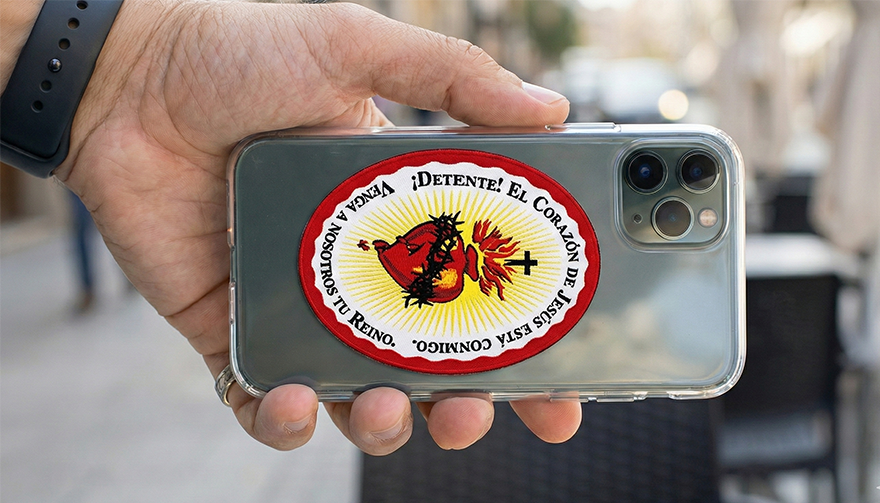
Among the signs of Christian devotion, the «detente» occupies a special place. Today many young people use it as a simple symbol but full of trust and love for the Sacred Heart of Jesus. However, behind this small emblem there is a rich history, marked by apparitions, saints, epidemics and wars.
What is the detente?
The “detente” is a small emblem that was formerly worn sewn to the chest (today it is fashionable to wear it on a cell phone case), usually with the image of the Sacred Heart of Jesus. Its name comes from the expression "detente", a supplication addressed to evil, to the devil and to all danger, invoking the protection of Christ. It is a sign of love for the Heart of Jesus and of trust in his protection against the lurks of the evil one.
It is also known as the “Little Scapular of the Sacred Heart”, although it is not a scapular in the strict sense. It requires no special ceremony or blessing for its use: it is enough to wear it with faith.
The origin of the devotion: St. Margaret Mary Alacoque
Devotion to the Sacred Heart of Jesus was born in the 17th century, from the apparitions of Jesus Christ to St. Margaret Mary Alacoque, a Visitation nun.
On December 27, 1673, while praying before the Blessed Sacrament, she received her first revelation. In this mystical experience, the Lord showed her his ardent Heart of love for humanity, wounded by the ingratitude of men, and entrusted her with the mission of making this devotion known.
In later revelations, Jesus showed her his Heart surrounded by thorns and crowned by the cross, symbol of his sacrificial love and the pain caused by sin. He expressed to her his desire to be loved, to rescue souls from the power of evil and to shower abundant graces on those who would venerate his Heart, especially by wearing his image in homes or on the breast as a sign of love and protection. She herself wore them under her habit and encouraged her novices to do the same.
In the third revelation, during the feast of Corpus Christi in 1674, Christ asked her for concrete practices of reparation: frequent communion, devotion on First Fridays and the Holy Hour on the night of Thursday to Friday, uniting herself to his agony in Gethsemane. Thus devotion to the Sacred Heart was clearly established as a way of love, reparation and total trust in Christ.
Detente and the Marseilles plague
The use of the detente became extraordinarily widespread during the Marseilles plague of 1720. In that context, this emblem was known as “Safeguard”. It consisted of a piece of white cloth with the Sacred Heart embroidered on it and the legend: «O Heart of Jesus, abyss of love and mercy, in you I trust».
The form closest to the present-day pendant was promoted by the Venerable Anne Madeleine Rémuzat, who, forewarned of the disaster that the plague would cause, promoted with her sisters the making and distribution of thousands of these emblems throughout the city and its surroundings. Soon after, according to the chronicles, the epidemic ceased, strengthening the popular devotion to the Sacred Heart.
Blessed Bernardo de Hoyos and the “I will reign in Spain”.”
In Spain, the great apostle of the Sacred Heart was Blessed Bernardo de Hoyos (1711-1735). At the age of 21, while copying excerpts from the book «De cultu Sacratissimi Cordis Iesu», he came to know this devotion that transformed his life. He himself reported having felt a deep love and a certainty of being loved.
Like St. Margaret, while praying before the Blessed Sacrament, she received words from Jesus Himself, who entrusted her with the mission of extending this devotion in Spain. In the face of difficulties, Christ consoled her with a promise that would mark the spiritual history of the country: «I will reign in Spain, and with more veneration than in many other parts».
“Stop bullet”: faith in wartime
From France, the custom of sewing the detente on the clothing of sons, husbands or brothers going to war spread rapidly. They trusted in the protection of the Sacred Heart on the battlefield.
In the 19th century, the Carlist troops in Spain wore scapulars with the inscription: «Stop bullet, the Heart of Jesus is with me», and in many cases they added «I will reign in Spain» or even a part of the Our Father: «Thy Kingdom come».
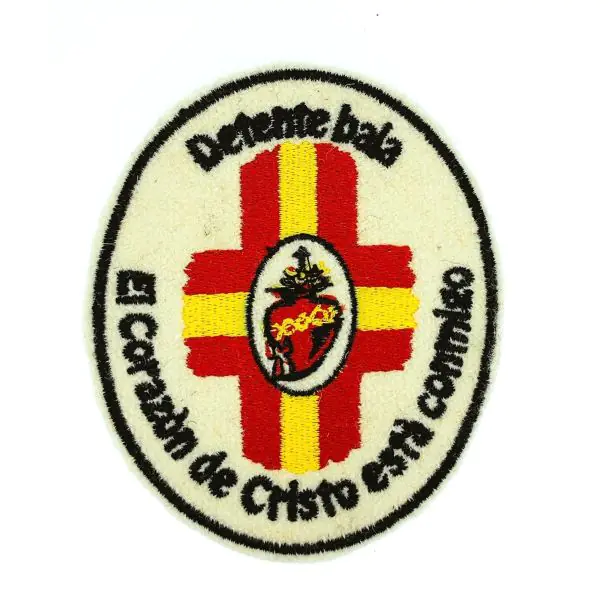
During the civil wars of the 19th century and later in the Spanish Civil War (1936-1939), the detente became popular among requetés, legionaries and some Falangists. The devotion also crossed the Atlantic: the Mexican Cristeros wore it during their uprising against the government of Plutarco Elias Calles, with the inscription: «Stop, evil enemy, the Heart of Jesus is with me».
Persecution and fidelity
At the time of the French Revolution, these emblems were considered symbols of fanaticism and hostility to the regime. Even during the trial of Marie Antoinette, the possession of an image of the Sacred Heart with the inscription: «Sacred Heart of Jesus, have mercy on us» was used as evidence against her.
Far from disappearing, the detente was strengthened as a sign of spiritual resistance and Christian fidelity.
Indulgence granted by Pius IX
In 1872, Pope Pius IX granted an indulgence of 100 days, once a day, to all the faithful who wore the scapular and prayed an Our Father, a Hail Mary and a Glory Be. In a subsequent brief, he clarified that, since it was not a scapular in the strict sense, it did not require a blessing or specific inscription: it was enough to wear it around the neck.
The Pope himself composed a beautiful prayer to the Sacred Heart, inviting us to unite our hearts to Christ's in adoration, reparation and love:
«Open to me your Sacred Heart, O Lord Jesus! Show me its charms, unite me to Him forever. May all the movements and beats of my heart, even during sleep, be a testimony to you of my love and tell you unceasingly: Yes, Lord Jesus, I adore you; accept the little good that I practice; do me the mercy of making reparation for the evil committed; so that I may praise you in time and bless you throughout eternity. Amen.
A living sign today
Today, the detente remains a simple but powerful sign. For many young people it is a concrete way of bringing Christ to the center of daily life, a reminder that the Heart of Jesus is near, loves, protects and accompanies them in the face of the temptation of the evil one.
Thus, the Detente has become a sign of fidelity to the Most Sacred Heart of Jesus Christ: an insignia that ennobles, a defense in our battles and a shield that reminds us that this Heart, which loved mankind so much, continues to reign.




 Español
  English
  Italiano