




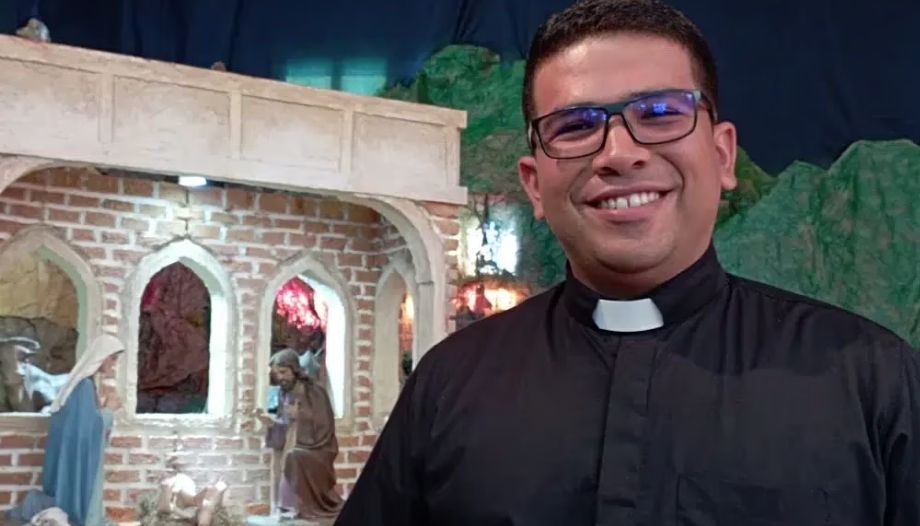
This is the opinion of the Venezuelan priest Gustavo José Perozo Pérez, ordained in 2020 and incardinated in the diocese of Carora, in statements to the CARF Foundation: “Hope perseveres in the hearts of most Venezuelans”. At present, Gustavo José Perozo is studying for a degree of Canon Law in the ecclesiastical faculties of the University of Navarra.
The priest grew up in an environment of faith in his native country, but his vocation did not arise in childhood. It was later, in his youth, when, through catechesis, his work as an altar boy, the parish, the closeness of some religious and the witness of the parish priest, when he began to consider his call to the priesthood. “All this awakened in me the search for something more,” he said.
And in 2012, at the age of 19, he left his university studies in Geography and History and entered the seminary. Eight years later he was ordained a priest. Today he assures that “Venezuela needs well-trained canonists, and it needs them urgently”.
Training for mission
After being sent by his bishop to the Ecclesiastical Faculties of the University of Navarra, the young Father Gustavo considers that “Canon Law contributes a lot to the mission of the Church, it is at its service. From this perspective, its contribution to the pastoral action of the Church in Venezuela is evident, and at the same time, the need for specialists in Canon Law in all branches, who can favor this service”.
“To build a society founded on justice, truth, liberty and fraternity, and thus emerge from the grave crisis that has afflicted the country for many years,” encouraged Pope Leo XIV in his Speech to the Diplomatic Corps in January, referring to Venezuela and other countries. And “Canon Law can contribute not only within the Church but also in the current complex socio-political situation,” the Venezuelan priest stressed to the Diplomatic Corps in January. CARF.
Commitment of the Church in Venezuela
In a context of restriction of human rights and freedoms as denounced by Leo XIV, the action of the Church is not passive, but “remains present and committed, trying to enlighten every reality with criteria and initiatives centered on the Gospel”, adds the priest Gustavo José Perozo.
In his opinion, the most visible action is social work, especially through Caritas, with soup kitchens, medicine banks, nutrition programs, medical care and job training.
However, the Church's commitment goes beyond this: “In the midst of all the reality experienced and suffered, in each place and in different ways, the presence of the Church has been adapting to the needs, evangelizing and offering a response to each need that has arisen; all this, the fruit of a committed listening and a shared effort,” he told the CARF Foundation.
Service profile: “a diakonia”.”
“This service also has a profoundly social and political value thanks to the many pastoral agents who, with their dedication, availability, sensitivity, generosity and prayer, in a spirit of communion and charity, and from the Church's own institutions, are the hands and feet that bring, give, lift, carry and make possible, in short, that this service can be a sign of comfort and hope”.
In this way, he concludes: “the role of the Church transcends the intra-ecclesial sphere and becomes a true diakonia to the Venezuelan society”. That is to say, a service carried out with dedication and love.
Church that suffers with its people, but is hopeful
The Church in Venezuela is not an elite, it suffers the same reality as the rest of the citizens, and faces threats, limitations and consequences derived from the country's situation.
Gustavo José Perozo acknowledges that the prevailing feeling today is uncertainty, both inside and outside. But there is something that has not been lost: “Hope perseveres in the hearts of most Venezuelans”.
“The road to the restoration of democratic institutions will be long,” he says, "but it is not impossible.
Awakening of faith
His analysis also takes a positive approach. Far from a massive abandonment of the faith, in many communities one can perceive “a new ardor, a reconfiguration of the experience of faith,” even in the midst of hard difficulties.
“There are many young people who participate in retreats, movements and various charismatic experiences that bring them closer to the Church and then lead them to processes of accompaniment, maturation, commitment and apostolate,” adds the Venezuelan priest.




 Español
  English
  Italiano