



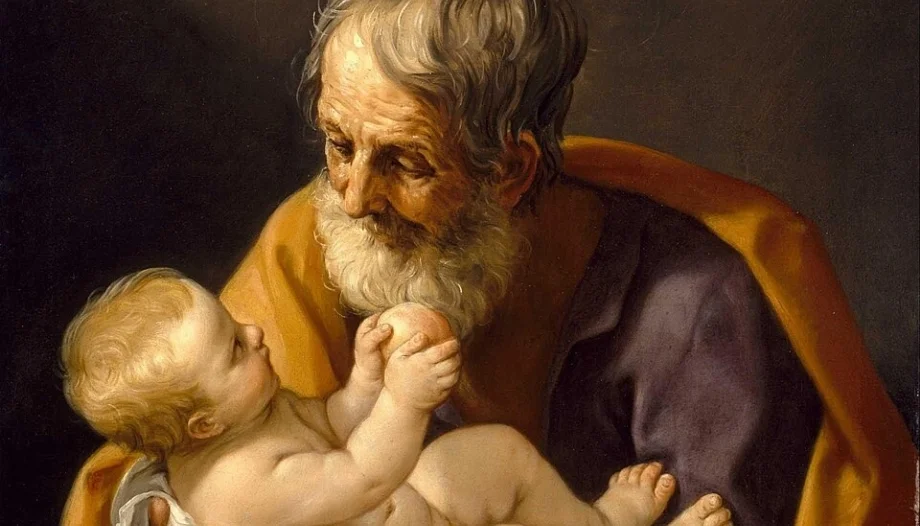
We live in difficult times: broken families, crises of fatherhood, fear of the future, job uncertainty, spiritual fatigue. And yet, during Advent, the liturgy quietly presents us with the figure of a man of whom we have not a single word: Saint Joseph.
The Church has not hesitated to present Saint Joseph to us as Patron of the Universal Church since 1870, and recently the Popes have returned to it time and again, emphasizing its humble, strong, and creative fatherhood.
There is something very striking about this season of Advent: we put lights on the streets, make plans, think about gifts... but the Gospel presents us, almost without fanfare, with a man who seems to go unnoticed: Saint Joseph.
In a world where it seems that only those who make noise exist, José is the patron saint of all those who sustain life from the sidelines: parents who do not appear on any posters, grandparents who act as a safety net, anonymous workers, religious sisters in small communities, lay people who serve in humble parishes... all those who, if they fail, everything falls apart, but who almost never appear in the picture.
This article is about him. And, above all, about us with him.
Saint Joseph, a man who listens in the night
The Gospel defines him with a single word: “righteous” (Mt 1:19). That is, a man who lives in the presence of God, who takes His will seriously, even if he does not fully understand it.
We do not have a single word of his. Nothing. And yet God entrusts him with his own Son and the Virgin Mary. And that already dismantles many of our ideas about “success” today, about influence and prominence.
Furthermore, there is a beautiful detail in the life of Saint Joseph: the great decisions of his life come at night, in dreams. At night he learns that he must take Mary in. At night he is told to flee to Egypt. At night he knows when to return.
There are no speeches, no grand arguments, no dramatic dialogues. There is silence, listening, and obedience. In a time like ours, saturated with noise, opinions, and perpetual discussions, the figure of Joseph is uncomfortable because he brings us back to the essential: before deciding, we must listen.
When life gets complicated, we fill ourselves with noise: messages, calls, opinions, social media, “consultations” everywhere... José, on the other hand, enters in silence. He listens. He discerns. And then he acts.
The Church Fathers insisted that Joseph's true greatness lies not in the flesh, but in faith: he is a father because he trusts God, because he places himself totally at the service of the divine plan in favor of Jesus and Mary. Tradition reminds us that his “yes” is no less radical than that of the Virgin: he too accepts, without fully understanding, a path that disrupts his human plans.
In a culture that confuses freedom with constant improvisation, Joseph teaches us a different kind of freedom: the freedom to obey God when His plans contradict our own.
Parenthood without appropriation: caring without possessing
One of the most striking features that the Church sees in Joseph is his way of exercising fatherhood: firm but not domineering; present but not intrusive; responsible but without appropriating either Jesus or Mary.
José is both an uncomfortable and luminous mirror.
God entrusts Jesus and Mary to him, but he does not place himself at the center. He cares for, protects, decides, works... but never takes ownership. He knows that this Child is not “his” project. He could have felt himself in the background, but he chooses to be a guardian, not an owner.
The Popes have described Joseph as a “father in the shadows”: the shadow is not darkness, it is the discreet presence that allows another to be the center.
In times of rampant narcissism, of “egos” inflated by selfies and likes, the figure of Saint Joseph, a man who disappears so that Christ may shine, is profoundly countercultural.
This has enormous power today:
- For parents: Joseph reminds you that children are not a “personal project,” but a mystery entrusted to you. They are not an extension of your own ego, but people called to a vocation that will often exceed your expectations.
- For those who exercise authority in the Church: superiors, parish priests, bishops, lay people on mission. Spiritual fatherhood or motherhood is never domination over consciences, but service so that the freedom of God's children may mature in others. The abuses of power and conscience that so hurt the Church today arise, at their core, from forgetting Joseph's style: to guard without possessing.
- For any form of Christian leadership: Joseph shows an authority that is not self-assertive, but rather protective, supportive, and, when the time comes, knows when to step aside.
Because abuses of power, conscience, and even spiritual abuses that have caused so much damage arise from precisely the opposite: from people who take ownership of other people's souls, stories, and decisions. They want to be owners where they have only been asked to be custodians.
Saint Joseph, on the other hand, is the image of one who supports without crushing, who guides without manipulating, who leads without chaining. That takes a lot of humility. And a lot of faith.
St. Augustine said that St. Joseph is a father “more through charity than through flesh.” He is a father because he loves by setting free, because his authority resembles that of God: an authority that does not crush, but lifts up.
Creative courage: not just holding on, but making a move
Sometimes we imagine holiness as resignedly enduring whatever comes our way. But that's not it. Look at Joseph: when the angel tells him to flee to Egypt because Herod is looking for the Child, he gets up in the night, takes the Child and his Mother, and leaves. No drama, no delays, no speeches. He acts.
Recent Church tradition has called this “creative courage”: knowing how to seek new paths when things go wrong, without losing trust in God.
Isn't that exactly what we often lack?
- Marriages that are going through a crisis, but are not giving up: they seek help, change habits, and start over.
- Young people who do not remain stuck in complaining about the lack of work, but who try to educate themselves, become entrepreneurs, and leave their comfort zone.
- Christian communities that, instead of lamenting that fewer people attend Mass, ask themselves how to reach out, how to create spaces for listening, how to accompany others better.
José does not simply suffer the circumstances. He faces them. He gets through them. He trusts, yes, but he also uses his head and his hands. That balance would do us a lot of good: pray more, yes; but also get up more, speak more clearly, take more action.
The workshop in Nazareth and our work today
There is a scene that the Gospel does not recount, but which the Christian imagination has meditated on for centuries: Jesus in the workshop with Joseph, learning the trade. The Son of God, with a gouge in his hand, raising sawdust, listening to his earthly father explain how to adjust a beam.
Isn't that a beautiful scandal? God Himself made Man learning to work with another man.
That silent scene dignifies the work of millions of people: the cleaner, the night nurse, the mother who never stops at home, the teacher who gives his all in class, the call center operator, the priest who spends the afternoon listening to people in his office, the nun who cares for the elderly.
Not every job will be brilliant, dreamlike, or stable. Sometimes it will be precarious, poorly paid, routine. But Joseph reminds us of something very liberating: the value of your work does not depend on the applause you receive, but on the love with which you do it and to whom you offer it.
Perhaps this Advent we could look at our own work—whatever it may be—as that little workshop in Nazareth where everyday life is sanctified.
Saint John Paul II emphasized that Joseph reveals the dignity of human work as participation in the work of the Creator and as service to family life.
In a world where so many feel “discarded” professionally—people over 50, young people without opportunities, people with invisible jobs—José becomes a patron, an example, and a companion on the journey.
A fragile Church in the arms of a father
The Church declared Saint Joseph Patron of the Universal Church. This is not a decorative title. It is a way of saying that today's Church is very much like the Child Jesus in his arms: fragile, threatened, in need of protection, and at the same time the bearer of something immense that is not hers, but God's.
We are living in times of painful wounds in the Church: scandals, abuse, disillusionment, mistrust. Sometimes we feel like distancing ourselves, or living our faith “in private” so as not to complicate things.
But Joseph does not abandon the Child when the situation becomes complicated. He does not turn away when Herod appears, when dangers arise, when nights of flight begin. It is precisely then that his mission is at stake.
Caring for the Church today—each from our own place—is very Josephine: defending what is essential, protecting the weakest, not getting involved in power games, not relativizing evil, but also not losing hope. It is not closing our eyes to wounds, but putting our shoulder to the wheel to heal them.
And here it may be worth saying something clearly: the Church will emerge from this crisis, above all, thanks to the silent holiness of many anonymous “Josephs.” Of religious women who live their dedication faithfully. Of lay people who do their jobs well and educate their children well. Of priests who serve without making a fuss. Of married couples who forgive each other seventy times seven times.
Living like Joseph during this Advent season
What does it mean, in practice, to live this Advent “with Saint Joseph”?
- Allowing God into my plans
Like Joseph, God also “interrupts” our plans: an illness, an unexpected change, a crisis in marriage, a professional failure. Advent is a time to ask ourselves sincerely: Am I willing to let God change my plans, or do I just want Him to bless the ones I've already made?
- Exercising authority as a service
Parents, educators, church leaders, team leaders: we all need to learn from Joseph's example. More presence and less control; more listening and less imposing; more example and less moralizing.
- Reconciling with my own history
The birth of Jesus does not take place in a perfect setting: there are censuses, displacements, precariousness, a manger as a crib. God does not wait for life to be “in order” to make himself present. Saint Joseph helps us to look at our biography—with its wounds, limitations, and sins—not as an obstacle, but as a place where God wants to be born.
- Revaluing hidden work
That report that no one appreciates, those hours in the kitchen, accompanying a sick person, that quiet study, that shift at the hospital, that sleepless night with a child... These are the workshop of Nazareth today. Lived with God, they sustain the world.
A saint for those who don't appear in the photo
In a society where visibility is confused with importance, during this Advent season the Church presents us with a saint who reminds us of something very simple and very liberating: you don't have to be in the picture to be at the heart of the story of salvation.
Perhaps what is most relevant about Saint Joseph today is precisely this: he is the saint of those who hold up the world without anyone noticing.
Those who get up early to go to work reluctantly, but go anyway.
Those who endure an illness without complaining all day long.
Those who give their all for their children, their students, their elderly.
Those who have been hurt by the Church, but continue to love her and pray for her.
Those who, with their sins and weaknesses, say every day: “Lord, here I am; I don't understand everything, but I trust.”.
This Advent, as we look at the nativity scene, we can focus a little more on that figure who almost always remains in the background, with his staff in his hand, watching silently. He doesn't need to speak. His entire life is already a word.
And perhaps our prayer could be as simple as this:
Saint Joseph, teach me to be where God wants me, even if no one sees me, even if I don't appear in the photo, without noise, without fear, and without wanting to be the center of attention.




 Español
  English
  Italiano