



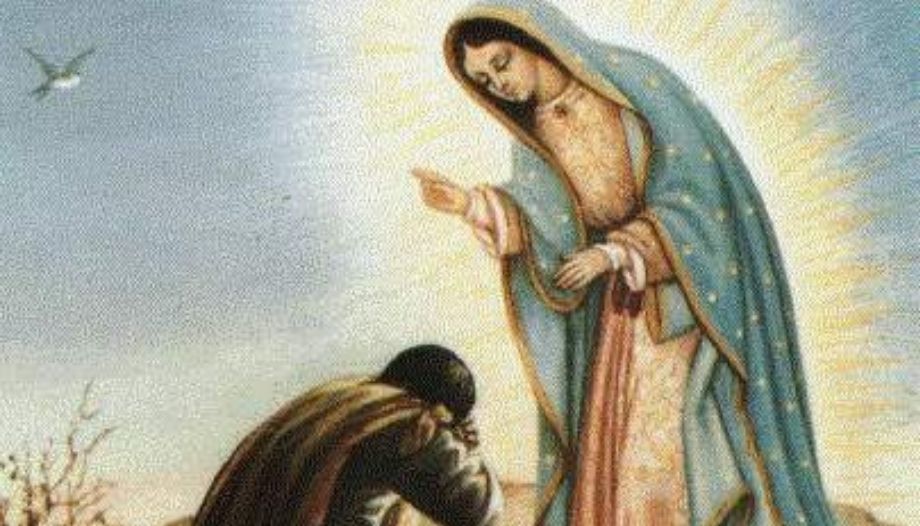
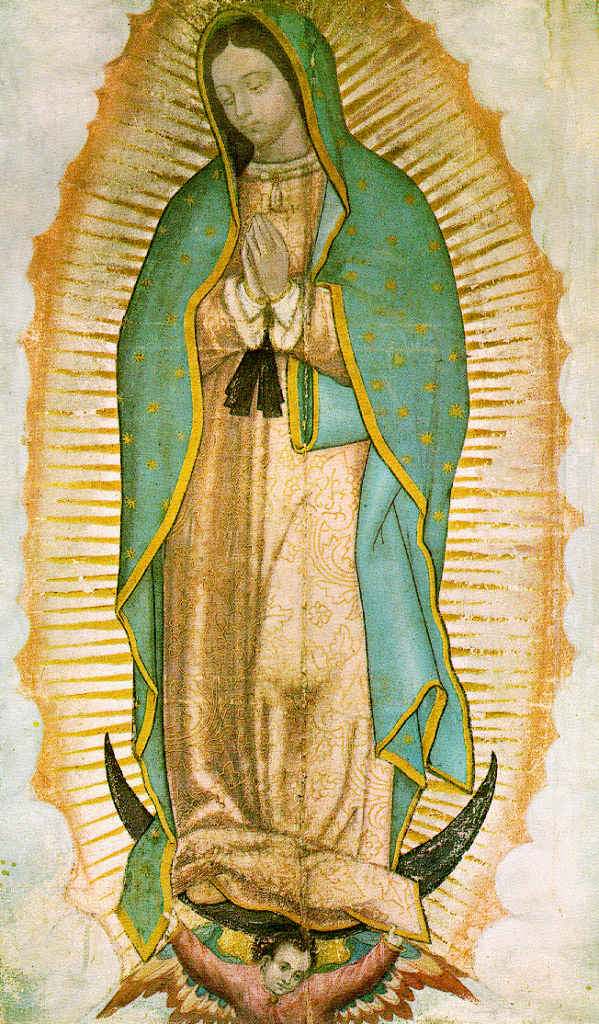
The Virgin Mary appeared on several occasions to the Indian Juan Diego Cuauhtlatoatzin on the hill of Tepeyac, today Mexico City. In one of her visits to the Franciscan bishop Fray Juan de Zumárraga, Our Lady left her image printed on the tilma de ayate, a thin fiber cloth, of the Indian Juan Diego.
There are numerous facts, at least nine, that experts have concluded as scientifically inexplicable, when analyzing the ayate or tilma of the indigenous Juan Diego, with the printed image of Our Lady. These conclusions concern the tilma itself and, above all, the eyes of Our Lady.
These facts are mentioned below, as explained by Dr. Andres Brito in a documented exposition contained in a video of Nazareth TV, which you can see below. Due to its length, 1h.14’ 53”, a synthesis is included.
Brief history
Before providing a summary, please see a brief synopsis of the well-known historical facts recalled by Dr. Andres Brito in the video.
According to the guadalupana tradition, In December 1531, the Virgin Mary appeared several times to the indigenous Juan Diego Cuauhtlatoatzin on the hill of Tepeyac. In these apparitions, the Virgin asked him to go to the bishop Fray Juan de Zumárraga to request the construction of a temple in that place, and to transmit his message of love. The bishop asked for a sign as proof of the authenticity of the message.
In the next apparition, our Blessed Mother Mary of Guadalupe instructed Juan Diego to cut roses of Castile that miraculously bloomed in Tepeyac -something impossible in that time, December, and place- and to take them to the bishop wrapped in his tilma.
When he unfolded it before Fray Juan de Zumárraga, the flowers fell and the image of the Virgin Mary was printed in a prodigious way in the tilma Juan Diego, revealing his face and figure. Faced with this sign, the bishop believed and ordered the construction of the requested temple, giving rise to the deep devotion guadalupana in Mexico, in all America, and in the world.
9 conclusions in the light of science
“It gives the impression that the tilma is indestructible,” says the speaker. And that is where the first conclusions come from. In fact, he says, “the following is scientifically inexplicable”:
1. “That the ayate (the cloth, the tilma itself), has survived for 480 years., of which 116 were without any protection whatsoever.
2. “That the image has not deteriorated at all.”.
3. “That it resisted contact with nitric acid in 1795.”.
4. “That it remained intact after the explosive detonation of 1921.”. He survived a dynamite bombing that year.
5. “That the codices present in the tilma are a codex addressed to the Mesoamerican Indians of the 16th century. St. John Paul II called it “a perfect inculturation”.
“No known pigments”
6. “That there are no known pigments or the procedure by which the image was “impressed” onto a canvas on which there are no brushstrokes.
Dr. Richard Kuhn, Nobel laureate in chemistry, stated in 1938 that “no such pigments are known in nature on this planet. The pigments in the image are neither of animal origin, nor of vegetable origin, nor of mineral origin, nor of synthetic origin”.
Ophthalmologists
7. “That the eyes respond to the characteristics of a living human cornea.”.
8. “That there are 13 human figures in the corneal reflections only visible with contemporary technology, which excludes any possibility of chance or fraud.”.
Dr. Enrique Graue, ophthalmologist, rector of the Autonomous University of Mexico, “an authority on the subject, discovers that the eyes of the Virgin of Guadalupe reflect light exactly as a living human eye would (...) which is impossible in a painting made by a human hand”.
Since 1950, a score of well-known ophthalmologists have studied the eyes of the Virgin Mary in the tilma, and have confirmed their observations, says researcher Dr. Brito.
Dr. Rafael Torija, ophthalmologist, pointed out that the images appear reflected in both eyes, and that they “respect the Samson-Burkinje optical proportions” (in a living eye up to three images of what is in front of it can be reflected due to the curved surfaces of the cornea and crystalline lens). “It's not pareidolia, they are real images,” he adds.
Dr. José Aste Tonsmann: thirteen figures in the Virgin's eyes
“Where the incredulous definitely throw in the towel,” the speaker points out in the video (53’), is with Dr. José Aste Tonsmann, an engineer specializing in Computer Science at Cornell University, also a professor at the Universidad Iberoamericana de México, who died in 2024.
Dr. Tonsmann is the one who discovered thirteen tiny, almost microscopic figures in the eyes. To do this, he needed a computer to produce “one-mm-square grids in the corneas. 1,600 grids of 15 x 15 microns. to enlarge the image 2,500 times. And to capture two hundred shades of gray, as opposed to the 30 that the human eye captures” (57′ et seq.).
“Thirteen 8 mm figures, among them that of Fray Juan de Zumárraga, that of Fray Juan González, the interpreter who was at his side, that of the Indian Juan Diego himself unfolding the tilma, which can also be seen, that of a seated Indian...”.
The images are published in Dr. Tonsmann's book, the same figures in the right eye and in the left eye, respecting the Samson-Burkinje laws, and a family group, to complete the thirteen figures”.
9. (Also unexplained): “That the stars of the mantle show with mathematical precision the constellations visible on December 12, 1531”. This and other aspects can be consulted in the video.
St. Juan Diego Cuauhtlatoatzin, indigenous seer of the Virgin Mary of Guadalupe, was canonized by St. John Paul II on July 31, 2002 in the Basilica of Guadalupe in Mexico City.





 Español
  English
  Italiano