



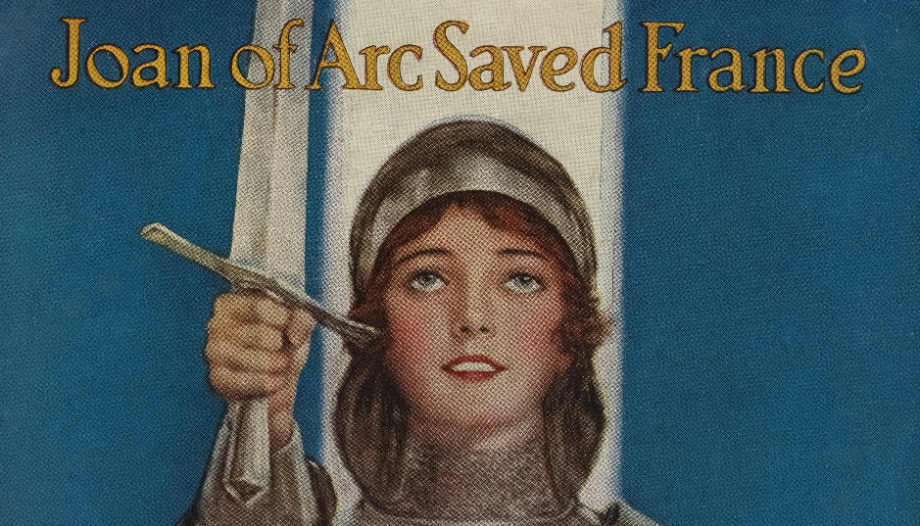
Joan of Arc (1412-1431), attractive and complex historical figure. The girl who heard voices; the young woman who led the French army in the name of God to change the course of the Hundred Years' War; the girl who preferred to dress in boys' clothes; the woman who died at the stake accused of witchcraft and heresy; the one who, centuries later, would be proclaimed a model of sainthood by the same Church that had condemned her. A determined, spiritual and mystical woman; charismatic military leader, emblem and standard; multifaceted, controversial and largely unknown. Object of multiple stereotypes - the madwoman, the heroine, the witch, the feminist, the saint. Archetype of the free woman and freedom of conscience.
Defiant and timeless icon. True to herself, to her voices, to her conscience, to God. Consistent and courageous, strong and in love, with a sharp and ironic sense of humor. She did what she understood God was asking of her, and at the same time, what she felt like doing. Existentially obedient and free.
To understand the complexity of Joan of Arc in all its depth requires to situate her historically and to get rid of the prejudices of today's perspective. The first thing to do is to recall some essential facts. Joan of Arc lived between 1412 and 1431. She died at the stake at the age of nineteen, after having led - at only seventeen - the French army of the Armagnac side.
In 1429 she played a decisive role in the liberation of Orleans and the coronation in Reims of the legitimate heir to the throne, the future Charles VII of France, which was a key strategic turning point in the Hundred Years' War. But... why did Joan go to war? Why did she end up dying at the stake? And what about the voices she supposedly listened to? To answer these questions it is essential to attend to the political, war and ecclesiastical context of the time.
The Hundred Years' War
The Hundred Years' War, which took place between 1337 and 1453, was a confrontation mainly between England and France, although it was marked by a profound internal war. It had numerous antecedents: territorial motives, dynastic tensions and conflicts over succession rights. In short, England seized French territories, while a civil war raged in France.
We are especially interested in the decades before Joan of Arc. Charles VI of France was incapacitated by madness: he suffered from a severe uncharacterized psychosis, which highlighted a belief - delirium - that his body was made of glass. The rivalry between the Dukes of Burgundy and Orleans led to open civil war. In this context, Henry V of England won a crushing victory at the Battle of Azincourt (1415).
The situation was complicated by the Anglo-Burgundian alliance after the assassination, in 1419, of Duke John of Burgundy. Part of France, under Burgundian influence, signed with Henry V the Treaty of Troyes in 1420, disinheriting the dauphin Charles - son of Charles VI - who had the support of the Armagnac faction (Orleans).
Joan of Arc came into play in this scenario. In 1429 she led the liberation of Orleans and accompanied the dauphin Charles to his coronation in Reims, delegitimizing the Treaty of Troyes and giving a decisive turn to the war. Joan would be imprisoned in 1430 and executed at the stake in 1431. Years later, in 1435, the Treaty of Arras dissolved the Anglo-Burgundian alliance and allowed the reunification of France. Eventually, the war swung in favor of the French kingdom, which expelled the English from the continent and ended the conflict in 1453.
Joan of Arc was key in this turn of the war, and she did so not simply «in the name of God» but «by God's command».
The Church, the Popes and the Western Schism
To understand Joan we must also understand the situation of the Church and, in particular, of the papacy. In the 15th century, all European Christianity was Catholic; neither the Lutheran separation (1517) nor the Anglican schism (Henry VIII, 1538) had yet taken place. Therefore, the war between France and England was a conflict between Catholic Christian kingdoms, not a religious war like those that would follow in Europe during the 16th and 17th centuries.
Despite the fact that they were fighting among the faithful of the same creed, God did take sides; no one doubted that. The English interpreted that God had pronounced himself in favor of England with the resounding victory of Henry V at Azincourt, while Joan of Arc understood that God was taking the side of France, when she felt that he was calling her to war to liberate Orleans, unify France and defend it against England.
This was, in fact, the reason why Joan was executed at the stake: the Church in the English zone considered that Joan's voices could not be from heaven and, consequently, could only be from the evil one. Once the war was over, the Church reviewed the trial, recognized the outrage and restored her from the accusation of heresy. Centuries later, at the beginning of the 20th century, she was beatified and canonized.
It is also interesting in relation to the papacy. The Church was immersed in the so-called Western Schism - we are still within Catholicism - also known as the Schism of Avignon. It took place between 1378 and 1417, that is, superimposed on the Hundred Years' War and prior to the entry into action of Joan of Arc. During these decades there were two popes, one in Rome and the other in Avignon. There were even three popes from shortly before Joan's birth: in 1409 the Council of Pisa was convened to resolve the conflict between Rome and Avignon, but neither of the two popes showed up. As a result, both were deposed and a third was elected.
Some details of the complexity of the situation: there was a pope in Rome -the first one was Urban- and another one in Avignon -the first one was Clement-. The pope of Avignon moved at a certain moment to Peniscola, known as Pope Luna. The third in discord, as a result of the Council of Pisa, was Alexander V, who settled in Bologna; his pontificate lasted less than a year and he was succeeded by John XXIII. For his part, Gregory XII (of Rome) convened the Council of Constance in 1414 and resigned the papacy; the third popes were annulled, Martin V was elected in Rome, while Pope Luna (Benedict XIII) continued in Peñíscola until his death in 1423, at the age of 94.
This crisis of the papacy had direct repercussions on the war between England and France: England supported mainly the pope of Rome, while France supported the pope of Avignon.
A note: the Western schism - with popes in Rome and Avignon - should not be confused with the previous period of the papacy in Avignon, when there was only one pope displaced for security reasons, and which ended with the return to Rome, thanks in part to St. Catherine of Siena.
When Joan of Arc was born in 1412, the schism was in its final years, with three popes; and when she took action in 1429, only the pontiff of Rome remained, although the memory of more than a century of popes and antipopes in Avignon was still very present. Thus, in France there was little talk of Rome as they faced the English, who had supported the Roman pope throughout the war.
Voices, psychopathology and mysticism.
Let us return to another of the initial questions: what about the voices Joan of Arc heard? Mad, witch or saint? It might seem that the only pertinent question is whether Joan was psychologically ill or balanced and, from a faith perspective, whether those voices were the fruit of a disorder or truly came from God. However, the problem is more complex.
Firstly, because a person can be mentally healthy and still “hear voices” that are not of divine origin. And, secondly, because within a believing worldview the voices are not reduced to a simple alternative between God or pathology: the Christian tradition has always contemplated the possibility of interior experiences that do not come from God, but have an evil origin. These were precisely the dominant interpretative categories in the 15th century, and they are the coordinates from which to understand Joan of Arc.
Voices. Perception is a complex phenomenon, intimately linked to imagination and thought. We do not perceive reality directly: hearing, like seeing, is a process mediated by nervous pathways and by filtering and selection mechanisms influenced by emotional state, desires, memory and experience. In addition to perceiving, we imagine. Imagination also generates images and voices, both in dreams and in wakefulness, and is equally conditioned by our inner history.
On the other hand, there are different types of thinking, or thinking can take different forms. Some think abstractly, others by means of images; some think “speaking”, and in some people thought can take the form of voices. Desires and fears can also take the form of inner images and words. All this belongs to the ordinary workings of the human mind.
Consciousness - the interiority, the “heart”, the reflective experience of one's desires, impulses and intuitions - is an amazing space. We feel that we are masters of our thoughts and desires, and yet they exceed us.
We tend to understand agency-the authorship of our acts-as something strictly internal, but perhaps it can also have an external origin. And if God wanted to make himself present... would it not be logical that he would do so through our own psychological and cognitive processes? Is it not reasonable to think that he would do so through a thought, an impulse of the conscience or an inner voice? And the same experience could be lived as a voice coming from outside or as something so intimate that it is confused with one's own will.
The experience of hearing voices must be read in individual, historical and cultural terms. In certain contexts - and the Middle Ages is one of them - these experiences were more normalized and integrated into the frameworks of shared beliefs. Moreover, in the fifteenth century, the main question was to discern whether the voices came from heaven or from hell; there was therefore only the alternative between understanding Joan as a mystic or as a demoniac woman.
All this challenges our usual references of normality and madness. On the one hand, we cannot judge medieval experiences with modern categories; on the other hand, we cannot give up critically reviewing whether the categories in force today really help us to understand reality in depth or whether, on the contrary, they impoverish and simplify it. Suggestibility -which today we know to be greater in certain populations and times- had a particular force at that time. But suggestibility neither invalidates experience nor explains it by itself.
The boundary between psychology and spirituality, far from being clear-cut, is complex and requires careful discernment. It is not a matter of distinguishing between black and white, but of recognizing grays and overlapping planes. Understanding the voices of Joan of Arc requires, therefore, avoiding reductionism and assuming that the interaction between psychic experience, personal conscience and religious experience is necessarily articulated.
Joan and the war
Joan of Arc's genuine simplicity contrasts with the horror of the war in which she is involved and which she leads. She impels the army to combat and to terrible deaths; nevertheless, it does not seem that she fought hand to hand nor that she killed anyone. He claims mercy for the English survivors, provides them with the sacraments and demands virtue for his own army. Without this apparent contradiction, Joan of Arc cannot be understood either.
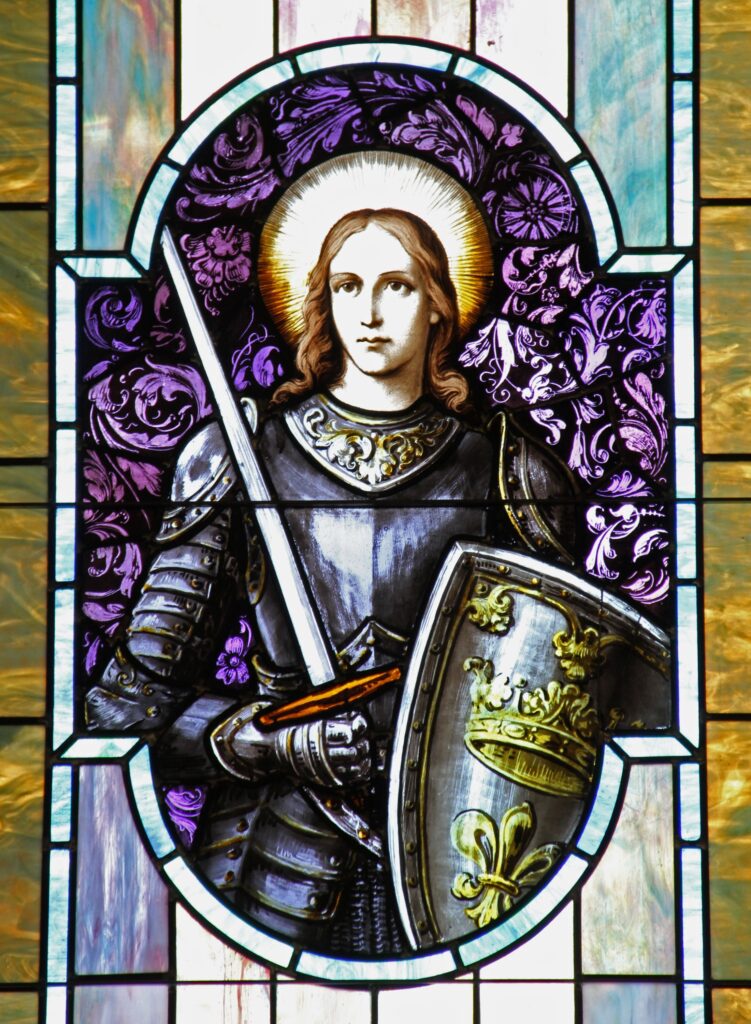
Joan goes to war hand in hand with her voices, angels and saints. She wields a weapon for its symbolic value, a sword with the inscription “Ieshus Maria”. But she almost always carried a white and golden banner, with an image of Christ with two angels, and a field of lilies or fleur-de-lis, emblematic symbol of France. Although he did not use force, he did not lack courage: he inspired hope and instilled ardor.
It cannot be said that she was a great strategist: she attacked, she attacked, she advanced a lot in a short period of time, and she was mistaken militarily or she let herself be badly advised. But, in a short time, she did what had not been done and surely would not have been done. Confidence and faith, determination and courage.
It is somewhat ironic that, centuries later, the British Winston Churchill -military and statesman, bold and daring- praised Joan of Arc and confessed his admiration for her, probably because of her courage.
At certain moments of wars - or for certain types of war - certain personality profiles are decisive, with drive and leadership capacity, as could have been Churchill or Patton. Or Joan of Arc, with her impulse to launch herself again and again, even knowing -because the voices told her so- that she would be wounded.
Joan of Arc lived and died in a context of war. In other times, war was the norm; today, unfortunately, it is no exception. In any case, life always contains a combat dimension: energy is needed to maintain or restore order and avoid chaos.
This happens in biological systems as well as in psychological dynamism and social relationships. The search for good implies struggle in the face of darkness. This is another reason why the warrior Joan will always be an immortal figure, in the same way as the Iliad, archetypal tale of war.
The courage that Juana showed in the war is undoubtedly related to her fidelity to the voices and to her conscience, which would sustain her even in the face of trial and death.
Trial, martyrdom and spiritual legacy
Joan of Arc can undoubtedly be considered a martyr. She dies for her conscience and for the truth, faithful to herself to the end, faithful to God. She was subjected to an unjust trial, to an absurd and manipulated interrogation, as happened to Jesus Christ and, a century later, to Thomas More, also in England. Benedict XVI underlines the parallelism of Joan with Jesus Christ: «After the years of hidden life and interior maturation follows the brief but intense two-year period of her public life: a year of action and a year of passion.
Joan was a woman of deep prayer, who dialogued with God with trust and confidence. God spoke to her, and she communicated with Him: intimately, and also through voices - of saints and the archangel St. Michael, as she herself explained - perceiving them as God's help and presence. She was nourished by divine grace through the sacraments, especially confession and the Eucharist. And she longed for them.
At the trial, they tried to manipulate her, to take advantage of her devotion and sacramental piety. She dressed as a man because she wanted to, out of practical sense - military - and to protect herself from possible sexual aggression, although she also explained that the voices had suggested it to her. In short, she did it because she felt like it. Of course, she was willing to dress as a woman if she was allowed to hear mass and receive communion: first things first. But it was all part of the deception.
Through days of pressure and deception, in a state of exhaustion and confusion, they try to get Joan to sign a retraction of the heresy of which they accuse her, and they succeed -in that way-. Mark Twain says in his portrait: «The crime was concluded. She had signed... what? She did not know, but the others did. She had signed a confession of witchcraft, of dealing with demons, of perjury, of blasphemy against God and against angels; of being cruel and bloodthirsty, of promoting sedition, of being perverse, a servant of Satan, and the acceptance of dressing as a woman...».
As soon as he regains his lucidity, he recants his recantation, even knowing what it means: death at the stake. And, paradoxes of history -resquicios of mercy and incoherence-, he is granted to receive the sacraments before dying: confession and communion. He dies saying before a crucifix: «Jesus, Jesus, Jesus».
Juana's voice today
Joan of Arc was a transgressor in her time, she broke the mold and today she also breaks with “the expected”, challenging our explanatory models. Joan of Arc heard voices, Joan of Arc is a voice, Joan of Arc is many voices. Her voice resonates in diversity and freedom, in fidelity to her conscience, in deep faith and love. Her voice is courage and leadership; her voice is spiritual depth and relationship with God; her voice is martyrdom and coherence to the end; her voice is timeless: it is still relevant today.
Psychiatrist. University of Navarra Clinic




 Español
  English
  Italiano