



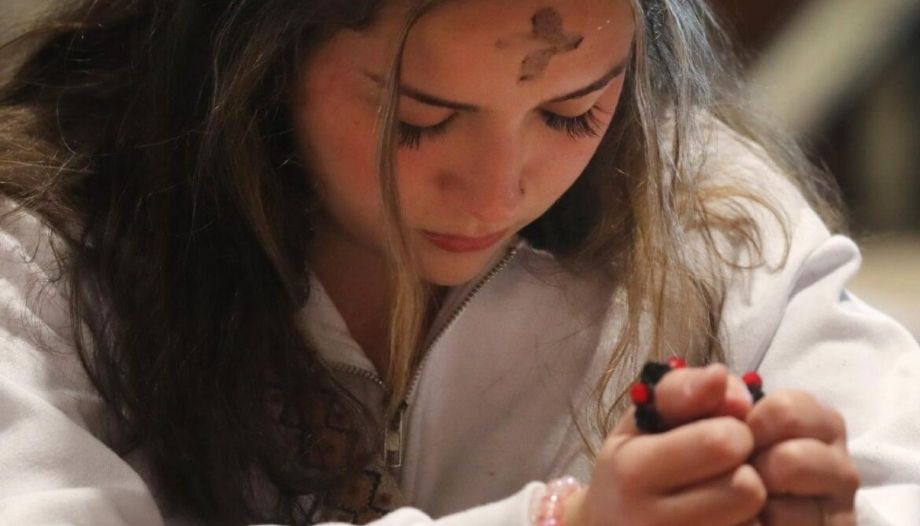
- Kimberley Heatherington, OSV News
It is a common experience for those attending the Ash Wednesday Mass. The pews are filled with many attendees, many of whom are unfamiliar to regular parishioners.
Who are all these people and why are they there?
They want their ashes.
Tracking Mass attendance between 2019 and 2024, Georgetown University's Center for Applied Research in the Apostolate, which conducts social scientific studies for and about the Catholic Church, reported that Ash Wednesday continues to compete with Easter and Christmas for the most attended Masses each year.
In fact, attendance at the 2024 Ash Wednesday Mass exceeded attendance at the 2023 Christmas Mass. Why do so many people make an extra effort to go to church on Ash Wednesday, the first of the 40 days of Lent when it is not a holy day of obligation and they are not obliged to receive the ashes?
Identity marker: we are Catholic
“One of the things without a doubt is that, for many people, it's a very clear identity marker that they are Roman Catholic,” said Jesuit Father Bruce Morrill, professor of theology and chair of Roman Catholic Studies at Vanderbilt University in Nashville, Tenn.
“I've often seen younger people - even before this era of younger, more conservative Catholics - very excited about this, saying, ‘This is our public declaration that we are Catholic,’” he said.
But, he noted, other Christian denominations also distribute ashes, so the soot stain on the forehead seen on Ash Wednesday may belong to an Episcopalian or a Lutheran.
Reflection on death and sin
But for everyone, the ashes include an invitation to reflect on mortality and sin.
“I think the two things, death and sin, have a strong overlap,” Father Morrill said. While people may rush for his ashes - with their unmistakable outward sign of inner penitence - he hasn't noticed a similar stampede into the confessional.
However, “even in an age when people do not go to the sacrament of penance as often as they did in the early 20th century, this symbol touches us deeply about our sin,” he said. “It is a symbolic ritual action that speaks to them.”.
Ash Wednesday as a way of looking towards Easter
Mixed with the monotony of contemplating “the Four Last Things”, the Four Last Realities (death, judgment, heaven and hell), there is an anticipatory look towards a change of season and, with it, renewal.
“Ash Wednesday is a way of anticipating Easter,” Father Morrill said. “And here in the northern hemisphere, that also means anticipating spring.”.
The ashes are made from the palms blessed on Palm Sunday of the previous year, and the tradition of placing them on the penitents dates back to the 11th century.
Blessing and imposition of ashes
As stated in the Directory on Popular Piety and Liturgy, published by the Vatican's Dicastery for Divine Worship and the Discipline of the Sacraments, “the imposition of ashes is a survival of an ancient rite according to which converted sinners underwent canonical penance. The act of putting on ashes symbolizes frailty and mortality, and the need to be redeemed by God's mercy.”.
But it is not, the directory continues, a gesture to be taken lightly.
“Far from being a merely external act, the Church has preserved the use of ashes to symbolize that attitude of interior penance to which all the baptized are called during Lent,” he says.
“The faithful who come to receive the ashes should be helped to perceive the inner meaning implicit in this act, which disposes them to conversion and a renewed paschal commitment.”.
Speaker, retreat leader and author Liz Kelly also emphasized the connection between ritual and relationship.
Deep desire for a relationship with God
“Ingrained in the human heart is a deep desire for a relationship with God, a recognition that disciplines such as Ash Wednesday nurture and protect,” said Kelly, who directs women's formation at the Institute. Word on Fire., and that in March she expects to publish her next book, “Anchored by Hope: Meditations to Soothe the Anxious Soul,” with The Word Among Us Press.
“We were created for order, and whether our lives are orderly or disorderly, we all suffer some disorder and long for the order that infuses us with Divine Order,” he said. “Ash Wednesday responds to this deep desire for order, for reordering, an order that leads to new life, prosperity and peace.”.
To be cleaned
At Kelly Parish in Minnesota, ashes are sprinkled over the top of the head, not imposed on the forehead, which provides a somewhat different penitential experience.
The ash slides through your hair: it stings, it makes it dirty, it irritates, it spreads and stains everything it touches. You almost forget it's there until it's time to brush your hair or go to sleep, or you scratch your head, and then, there it is: this black, irritating stain,» he said.
“The ash also has a corrosive texture; it is not easily removed by hands or by rubbing,” he added. “It takes water to remove it completely.”.
This provides an opportunity for further reflection, he said.
“And isn't that like sin? We need mediation to remove it,” he said. «Don't we desire precisely what reconciliation produces: to be cleansed of this irritating, corrosive stain?»
The attractiveness of the materiality of ashes
Kelly continued, “This is part of the great genius of the Church: She understands that we need sacramentals, we need to use these things in and on the body as a means to bring about inner transformation and understanding.”.
Timothy O'Malley, who teaches at the University of Notre Dame in Indiana, agreed.
“Religious practice requires the body, and it's just a very trite kind of spirituality that forgets that and tries to think of it simply as a kind of intellectual phenomenon,” said O'Malley, professor of theology, academic director of Notre Dame's Center for Liturgy and associate director of research at the McGrath Institute for Church Life at Notre Dame.
O'Malley added that sprinkling ashes on the head is a common practice around the world, although rare in the United States.
The materiality of ashes seems to attract people, and self-discipline is a natural attraction in a society focused on self-improvement, especially when combined with a realistic awareness that life has proverbial ups and downs.
Fasting is necessary. Penance
“I think people just need those moments in their lives,” O'Malley said. “There's a recognition that existence can't be completely festive. Fasting is necessary, and this is kind of a gateway to the Church's fast.”.
That realization, he explained, can be intriguing to those who do not belong to any particular denomination. He said he has a friend who lives in New Orleans and, although he does not attend Mass, he often stops drinking alcohol during the Lent due to the Catholic culture of the city.
And while it is to be hoped that future penitents will actually find their way inside the walls of a church this Feb. 18, O'Malley noted that on New York City street corners, ashes are often handed out as people exit the subway.
“I've always thought that there is a desire on the part of the human being, for a certain space of silence and contemplation, a kind of penitential day,” he said. “It's fascinating.”.




 Español
  English
  Italiano