



 Are priesthood and diaconate for women?"We women have been looked at with short-range lights.""The woman's womb is the altar where God enters the world."
In recent decades, the role of women in the Church has been the subject of increasingly visible debate. Many people wonder if women might one day be able to receive the sacrament of Holy Orders. However, the Catholic Church maintains that this is not a question of “rights” or “discrimination,” but rather of the very nature of the priestly ministry as instituted by Jesus Christ. Why does the Church maintain this teaching? What biblical, theological, and symbolic reasons are behind the priesthood being reserved for men, and how does this relate to the specific mission of women in the Church?
Back in the 1970s, when some Christian communities began to raise the possibility of ordaining women, Paul VI publicly recalled that for the Catholic Church it is “not admissible” to confer the ministerial priesthood on women. And it is not, he affirmed, for fundamental reasons:
- The example of Christ, who chose only men as apostles.
- The constant practice of the Church, which has faithfully imitated Christ in this choice.
- The living Magisterium, which consistently teaches that this exclusion is in harmony with God's plan for his Church.
To further clarify this issue, Paul VI commissioned the Congregation for the Doctrine of the Faith to issue the declaration «Inter Insigniores,» which expounded and deepened the foundations of this doctrine, concluding thus: «the true reason is that Christ, in giving the Church its fundamental constitution, its theological anthropology, always followed by the Tradition of the Church itself, has established it thus.».
Saint John Paul II, in his apostolic letter Ordinatio Sacerdotalis, emphasizes that Christ chose his Apostles in a completely free and sovereign manner. He did not allow himself to be influenced by socio-cultural conditioning. In the Gospels, we see Jesus acting with great freedom and dignifying the vocation of women, but even so, he reserved the apostolic mission for men. Later, the Apostles themselves passed on this same practice when they chose their successors and collaborators in the ministry.
The role of women in the Church
Saint John Paul II highlights the essential role of women in the Church in his apostolic letter: «The fact that Mary Most Holy, Mother of God and Mother of the Church, did not receive the mission proper to the Apostles or the ministerial priesthood clearly shows that the non-admission of women to priestly ordination cannot mean a lesser dignity or discrimination against them, but rather the faithful observance of a provision that must be attributed to the wisdom of the Lord of the universe.» He adds that the role of women is crucial today, both for the renewal and humanization of society and for believers to rediscover «the true face of the Church.».
Pope Francis reaffirmed this position, emphasizing that “it is a theological problem” but that it is not a matter of deprivation but rather a different role where there is still much to explore, and he acknowledged that women must be given more space in the Church in other areas.
Furthermore, the Declaration Inter Insigniores recalls that the hierarchical structure of the Church is entirely ordered to the holiness of the faithful: «the only superior charism to be desired is charity (cf. 1 Cor 12-13). The greatest in the Kingdom of Heaven are not the ministers, but the saints.
Christ the Bridegroom, the Church the Bride
From St. John Paul II's Theology of the Body, one can offer another argument. In a world where it does not matter whether the body is male or female, the Church asserts the importance of its meaning. John Paul II spoke of the Eucharist as the sacrament of spouses because it is the sacrament in which the spouses par excellence, that is, Christ and the Church, give themselves to each other. And they give themselves, he said, in the same way that spouses do in marriage: in their female or male bodies.
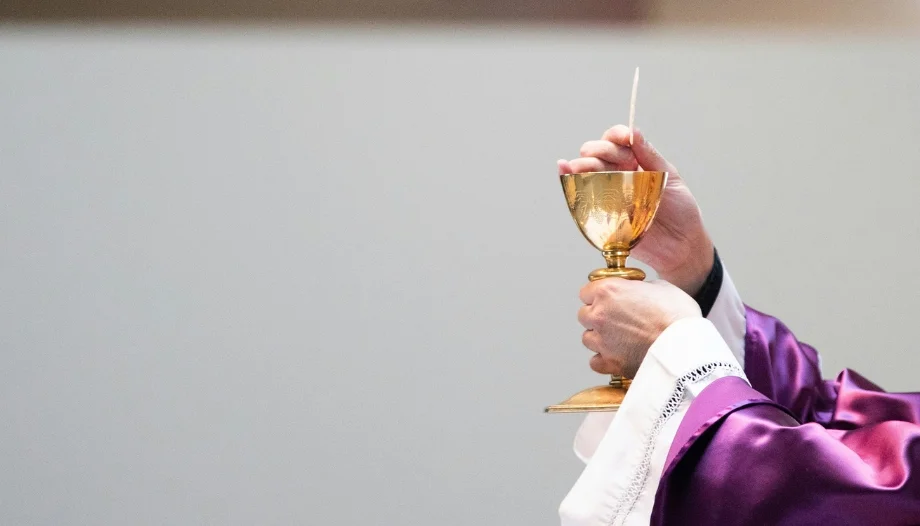
Men and women do not give themselves in the same way. This is expressed in the conjugal act: the husband gives himself by leaving himself and going toward his wife, and the wife gives herself by welcoming her husband into herself. This same language is embodied in the history of salvation. Thus, when the priest takes the form to consecrate it and says, «Take and eat... this is my body which will be given up for you,» it is Our Lord saying these words to the Church. A woman could not pronounce them because she simply does not give herself in this way, but rather by welcoming the gift of her husband into herself: by eating His Body.



 Español
  English
  Italiano