



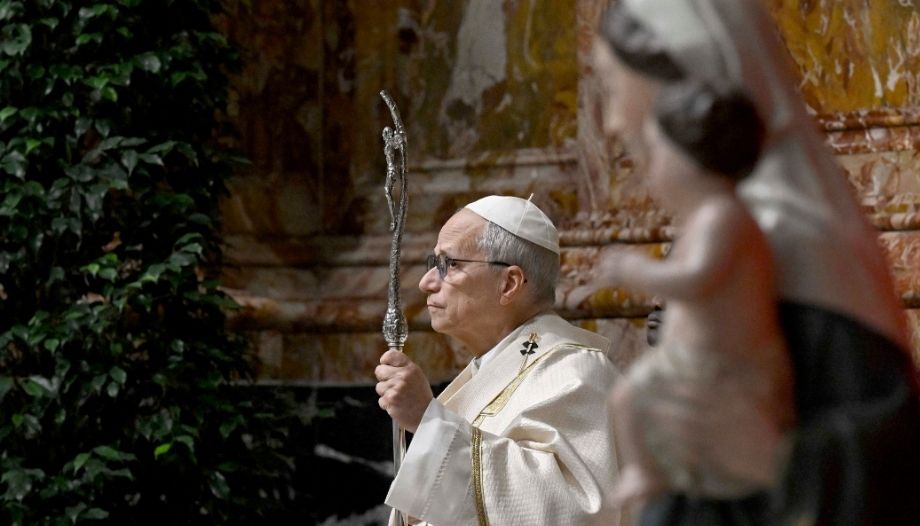
The restriction and “short-circuiting” of human rights in the world, the violation of fundamental freedoms, especially freedom of expression and religious freedom, with conscientious objection, the defense of human life and the family, with the rejection of the “so-called right to safe abortion”, surrogate motherhood and euthanasia, have been core aspects of the wide-ranging Speech of Pope Leo XIV to the Diplomatic Corps accredited to the Holy See, which are summarized here.
Force-based diplomacy
Along with this, the Pontiff denounced that “diplomacy that promotes dialogue and seeks consensus among all parties is being replaced by a diplomacy based on force, whether by individuals or by groups of allies.”.
“War is back in fashion and war enthusiasm is spreading,” he noted at the beginning of his speech. “The principle established after World War II, which forbade countries to use force to violate each other's borders, has been broken.”.
“Peace remains a difficult but possible good.”
In the Pope's view, “peace is no longer sought as a gift and as a desirable good in itself (...). Instead, it is sought through arms as a condition for asserting one's dominion. This seriously compromises the rule of law, which is the basis of all peaceful civil coexistence”, and he stressed the importance of respecting “international humanitarian law”.
However, after analyzing some of the best-known conflicts shaking the world, such as those in Ukraine, Israel and Palestine in the Middle East, Haiti, the African Great Lakes region, Myanmar, or Venezuela, the Pope concluded by pointing out that “despite the tragic situation before our eyes, peace remains a difficult but possible good”.
As St. Augustine reminds us, he stressed, “our supreme good consists in peace, because it is the very goal of the city of God, to which we aspire, even unconsciously, and of which we can enjoy a foretaste even in the earthly city”.
Venezuela: seeking peaceful political solutions
Referring to Venezuela, Leo XIV renewed his “vehement appeal for peaceful political solutions to the present situation, bearing in mind the common good of peoples and not the defense of partisan interests. This is especially valid for Venezuela after recent events”.
I renew my appeal, he said, “to respect the will of the Venezuelan people and to work for the protection of the human and civil rights of all and for the construction of a future of stability and harmony, finding inspiration in the example of two of their children, whom I had the joy of canonizing last October, José Gregorio Hernández and Sister Carmen Rendiles”.
In this way, “it will be possible to build a society based on justice, truth, freedom and fraternity, and thus overcome the serious crisis that has afflicted the country for many years”.
Drug trafficking, a scourge for humanity
“Among the causes of this crisis is undoubtedly drug trafficking, which is a scourge for humanity and requires the joint commitment of all countries to eradicate it and prevent millions of young people around the world from becoming victims of drug use,” the Pope said.
“Alongside these efforts, there must be greater investment in human development, education and the creation of employment opportunities for people who, in many cases, are unknowingly drawn into the world of drugs.”.
Other central themes of his speech: fundamental rights and freedoms
As mentioned above, the profound criticism of threats to human rights and the defense of fundamental rights such as religious freedom and life have been central to his discourse.
“We are witnessing a real “short-circuiting” of human rights,” the Pope diagnosed. “The right to freedom of expression, freedom of conscience, religious freedom and even the right to life are being restricted in the name of other so-called new rights, with the result that the very framework of human rights is losing its vitality and leaving room for force and oppression. This happens when every right becomes self-referential and, especially, when it becomes disconnected from reality, nature and truth.”.
Conscientious objection is not rebellion
In his reflection to the Diplomatic Corps, the Pope sharply criticized the restriction of fundamental human rights, “beginning with freedom of conscience. In this sense, conscientious objection allows people to refuse legal or professional obligations that conflict with moral, ethical or religious principles deeply rooted in their personal lives.”.
Conscientious objection is not rebellion, but an act of fidelity to oneself, he said. “At this moment in history, freedom of conscience seems to be increasingly questioned by states, even by those who claim to base themselves on democracy and human rights.”.
A truly free society does not impose uniformity, but protects the diversity of consciences, preventing authoritarian tendencies and promoting an ethical dialogue that enriches the social fabric, he stressed.
Restricted religious freedom: an appeal to nations
Similarly, religious freedom risks being restricted, he said later. As Benedict XVI recalled, this is “the first of all human rights, because it expresses the most fundamental reality of the person”.
The most recent data show that violations of religious freedom are increasing and that 64 % of the world's population suffer serious violations of this right. “In calling for full respect for the religious freedom and worship of Christians, the Holy See calls for the same for all other religious communities.”.
In this section, the Pope did not want to overlook that “the persecution of Christians continues to be one of the most widespread human rights crises today, affecting more than 380 million believers around the world.”.
Discrimination against Christians
At the same time, the Pope did not forget “a subtle form of religious discrimination against Christians, which is spreading even in countries where they are a majority, such as in Europe or America.
There, they are sometimes restricted in their ability to proclaim the truths of the Gospel for political or ideological reasons, especially when they defend the dignity of the weakest, the unborn, refugees and migrants, or promote the family.”.
Defense of the family
An important part of the Pope's speech focused on the family. From a Christian perspective, human beings are created in the image and likeness of God, who, “in calling them into existence out of love, called them at the same time to love,” he recalled, quoting St. John Paul II.
“This vocation is manifested in a privileged and unique way within the family. It is in this context that we learn to love and develop the capacity to serve life, thus contributing to the development of society and the mission of the Church. Despite its importance, the institution of the family today faces two crucial challenges,” the Holy Father noted.
Its fundamental social role is underestimated
On the one hand, there is a worrying trend in the international system to neglect and underestimate their fundamental social role, leading to their progressive institutional marginalization. On the other hand, we cannot ignore the growing and painful reality of fragile, broken and suffering families, affected by internal difficulties and disturbing phenomena such as domestic violence.
The vocation to love and to life, which is manifested in an important way in the exclusive and indissoluble union between a woman and a man, implies, according to Pope Leo XIV, “a fundamental ethical imperative for families to be able to fully welcome and care for unborn life. This is increasingly a priority, especially in those countries that are experiencing a dramatic decline in the birth rate.”.
“Life, a priceless gift”.”
“Life, in fact, is a priceless gift that develops within a committed relationship based on mutual self-giving and service. In the light of this profound vision of life as a gift to be cherished, and of the family as its responsible guardian,” “we categorically reject any practice that denies or exploits the origin of life and its development,” the Pope said.
“Among them is abortion, which interrupts a growing life and refuses to welcome the gift of life. In this regard, the Holy See expresses its deep concern about projects aimed at financing cross-border mobility for the purpose of accessing the so-called “right to safe abortion”.".
It also “considers it deplorable that public resources are allocated to suppress life, instead of investing them in supporting mothers and families. The main objective must remain the protection of all unborn children and the effective and concrete support to all women so that they can welcome life”.
Surrogacy: the dignity of both parties is violated.
Similarly, there is the practice of surrogacy. “By turning gestation into a negotiable service, it violates the dignity of both the child, who is reduced to a “product,” and the mother, by exploiting her body and the generative process and altering the original relational vocation of the family.”.
Euthanasia: false compassion
Similar considerations also apply to the sick and to the elderly and lonely, who sometimes find it difficult to find a reason to go on living. “Civil society and States also have a responsibility to respond concretely to situations of vulnerability, offering solutions to human suffering, such as palliative care, and promoting policies of genuine solidarity, rather than encouraging false forms of compassion such as euthanasia.”.
A similar reflection can be applied to so many young people who face numerous difficulties, including drug addiction. A joint effort by all is needed to eradicate this scourge of humanity and the drug trafficking that feeds it, the Pope reiterated, in order to prevent millions of young people around the world from falling victim to drug abuse.
Reaffirming the protection of the right to life
In conclusion, Leo XIV said: “It is necessary to reaffirm forcefully that the protection of the right to life constitutes the indispensable foundation of every other human right. A society is healthy and developed only when it protects the sacredness of human life and actively strives to promote it”.
Supporting signs of hope for peace
After recalling signs of courageous hope for peace in our time (the Dayton Accords that ended the bloody war in Bosnia and Herzegovina, or the joint declaration of peace between Armenia and Azerbaijan), and the need to constantly support them, the Pope recalled the celebration in October of the eighth centenary of the death of St. Francis of Assisi, «a man of peace and dialogue, universally recognized even by those who do not belong to the Catholic Church».
“A humble heart and artisan of peace is what I wish for each of us and for all the inhabitants of our countries at the beginning of this new year,” he concluded.




 Español
  English
  Italiano