



ARTISTIC COMMENTARY
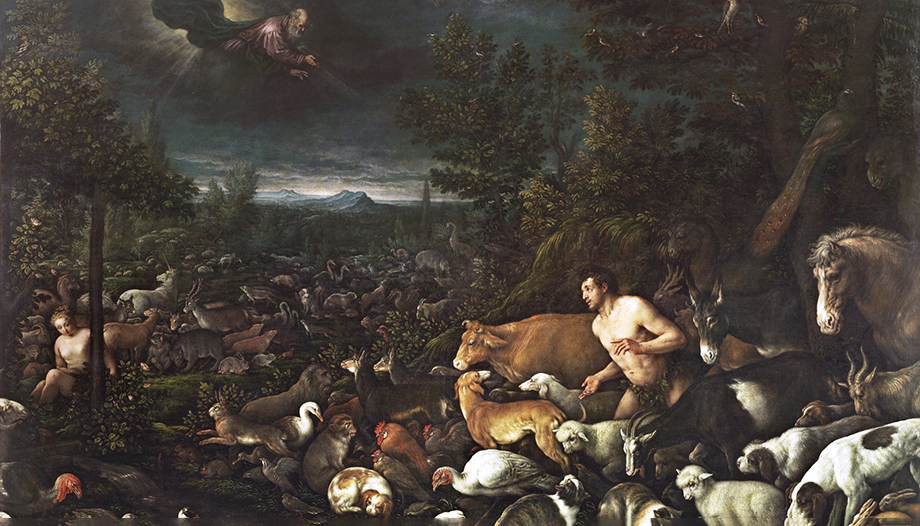
The play captures the moment in salvation history after the fall of Adam and Eve, when God confronts Adam about his actions. The scene appears in Genesis 3:9-11. Although many works of art have focused on the fall of Adam and Eve or their expulsion from paradise, depictions of God rebuking Adam are rare. Earlier we examined the depiction of Adam and Eve chosen by Dürer as an excuse to showcase his artistic mastery in depicting the human body. In contrast, the scale of this oil painting, which deals with the moment after the fall, (191 x 287 cm) is used to represent Eden as an Arcadian landscape full of animals.
The composition places the three central figures-God, Adam and Eve-within a triangular structure. God occupies the apex of this triangle, although the biblical text suggests that He was walking in the garden. His elevated position reinforces His omnipotence and authority over all creation. Adam and Eve, on the other hand, are placed on either side of the base of the triangle. This physical arrangement reflects their separation from God after the fall, a visual representation of the breach caused by original sin.
Eva, sitting under a tree on the left side, partially hides behind a rose bush. Her gaze is fixed on the stream flowing beneath her feet, her face full of guilt. She avoids looking at God, and her body language reflects her inner torment. Around him are mythical creatures such as unicorns, and exotic animals such as the dromedary. In the 16th century, it was common for painters to use animal stencils in their works, as artists were unlikely to have seen many of these animals in person. Eve's disconnection from the conversation between God and Adam highlights her passive role at this point in the narrative.
Adam, on the other hand, is standing on the right side, looking directly at God. His left hand points toward Eve, accusing her of offering him the forbidden fruit, while his right hand seems to offer an excuse on his own behalf. This interaction captures the essence of the dialogue between Adam and God. The animals surrounding Adam are painted in greater detail than those surrounding Eve, especially the domestic animals such as the cats and the small dog. A white lamb, placed in the foreground near Adam's feet, symbolically prefigures Jesus Christ as the “Lamb of God,” who would later sacrifice himself to redeem humanity from the sin that began in Eden.
Eden after the fall
The canvas is filled with a wide variety of creatures, symbolic of God's generosity in creation. The contrast between the multitude of animals in the lower half of the composition and the relative emptiness in the upper half adds another layer of meaning. The empty sky and space around God in the upper half signify his separation from the earthly realm emphasizing the distance between humanity and the divine after the fall. God's outstretched hand seems to ask Adam: “Wasn't all this enough?” The cool tones of the overall composition evoke a sense of loss and broken confidence. Unlike Bosch's warm and vibrant depictions of Eden, the Bassano's palette suggests a world still lush and abundant, but now tainted by disobedience.
Although God is depicted here as rebuking Adam, the Bible presents him as a more fatherly figure. This tension between judgment and paternal love is reflected in the composition. God is above and beyond creation, but still involved in its narrative. God rebuking Adam offers a unique interpretation of an underrepresented moment in the biblical story of Adam and Eve.
The painting is part of the Spanish Royal Collection, although it is unclear who originally commissioned it. We know that the painting was in the possession of Prince Philibert of Savoy, who later gave it as a gift to Philip IV of Spain. Philip IV's father, Philip III, had acquired several works by Bassano during his visit to Venice in 1582. This canvas, therefore, not only represents a significant theological moment, but is also a testimony to the artistic and cultural exchanges between the courts of Europe in the late Renaissance.
CATECHETICAL COMMENTARY
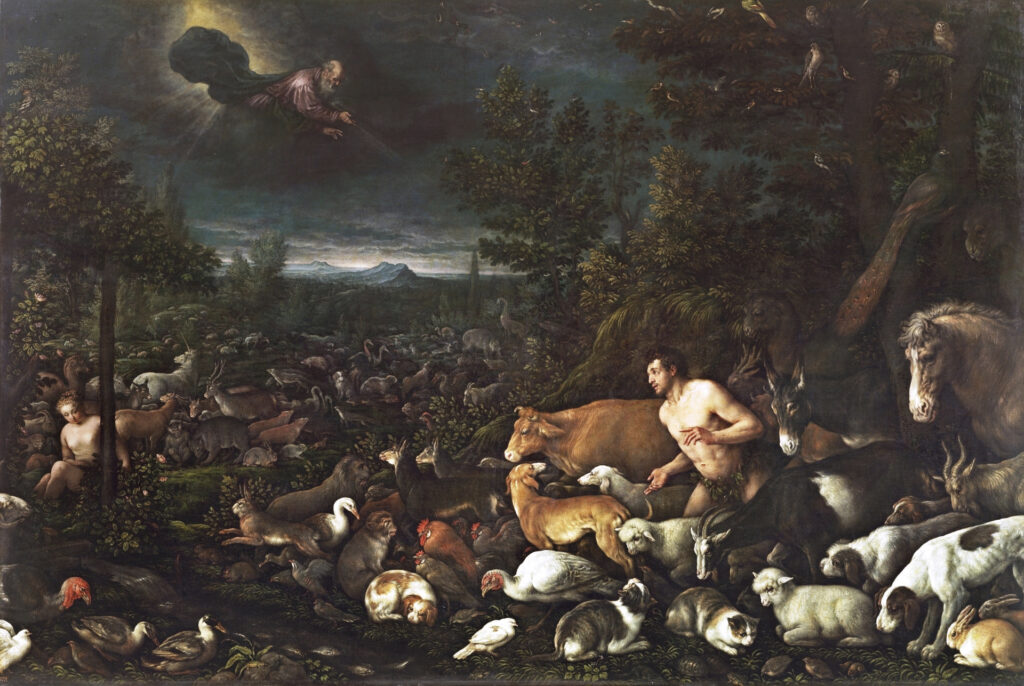
The scene depicted in this splendid still life of animals painted by Bassano corresponds to what is narrated in the second part of the third chapter of the Genesis. If the first part showed the story of the temptation and fall of our first parents, which we saw painted by Dürer, the second part represents the judgment to which God summons them for their sin. The third part, which we will see in a painting by Masaccio, represents the sentence of this judgment.
Therefore, we have an iconographic representation of a biblical scene that is very appropriate for reflecting on the meaning of sin and its place in the relationship of human beings not only with God, but also with their fellow human beings and with the Creation entrusted to their care. In it, Sacred Scripture teaches that sin is not a simple error, nor a psychological defect or weakness, nor a crime to whose realization an unjust society conditions the person. Sin is a rupture of the covenant with God, due to an abuse of freedom, for which the human being has to respond.
The Alliance and its Judge
The covenantal context, which is the framework in which biblical revelation draws the relationship between God and humanity, is established in Genesis 2. The Creator has made by free initiative a covenant with his creature, endowed with freedom to respond to him in love for him and for his fellow men. The fruit of this covenant is the enjoyment of the Garden of Eden and interpersonal harmony. Its condition is to use freedom properly, modeling its acts according to the precepts of the Creator and avoiding the prohibition of overstepping the forbidden limits. The breaking of this covenant, abusing freedom, necessarily entails a meeting between the parties to carry out a judgment in which man will answer to God.
This is the meaning of every sin, which is shown with patent clarity in the sin committed by Adam and Eve. In fact, after sin, man does not contemplate God as the Father who in his Mercy walks through Eden with his creatures, but as the Judge who appears to manifest his Justice before the creatures who have just lost the grace of original holiness. Before this vision, and seeing himself guilty and full of shame, as shown by the allusion to the fear of his nakedness, the human being hides from God (Genesis 3, 8).
Adam and Eve had already hidden from each other. In fact, in Genesis 3, 7 both are ashamed of their nakedness, lose the mutual trust and intimacy they enjoyed and hide from each other by covering themselves with fig leaves. The gap opened between them by the original sin is thus seen. As can be seen in the painting, the Judge appears before a humanity that has already lost the sincere communion between them, having broken with their freedom the precept of the Creator.
The judgment is narrated primarily in Genesis 3:9-12, and begins with the arrival of the Judge. As is frequent in the language of the Old Testament, the presence of God as Judge (also as Savior) is given in the picture in the midst of an impressive theophany. God appears as a transcendent and righteous Judge, wrapped in a purple robe of Supreme Lawgiver and, as Scripture says, “wrapped in a cloak of darkness; like a canopy, dark downpour and thick clouds surrounded him”.” (Psalm 18, 12). Terrible darkness brought by sin, which in the picture comes to hide the brightness of the sun, the star placed by the Creator to illuminate the day.
On this night the culprit is summoned for questioning, as is shown, for example, in this passage of Scripture: “our God is coming, and he will not keep silent; raging fire precedes him, a violent tempest surrounds him; from on high he summons heaven and earth to judge his people: gather together those who sealed the covenant with a sacrifice; let heaven proclaim his righteousness; God himself will judge.” (Psalm 50, 3-6). God summons from above, no longer in a pleasant Arcadian stroll, and the human being hides in the depths, hiding his responsibility in the breaking of the covenant. The fact that Adam exculpates himself and accuses Eve, as shown by the masterful play of his hands in the painting, indicates how sin makes it difficult for human beings to answer worthily for their free acts and to keep justice with their fellow men. Since then, before the divine judgment to which our own conscience summons us, it is common to avoid answering for our own acts and to excuse ourselves in those of others.
Creation as a jury
In this trial also appears, albeit implicitly, a jury. Creation itself, present in an overabundant way in the painting, seems to give a verdict of guilty to the human defendant. In the end, sin also has repercussions on Creation, which not only suffers the absence of a worthy custodian, but also suffers as a curse the consequences that sin inflicts on it. The abuse of freedom often entails the abuse of the resources granted by the Creator, so that, because of man's sin, Creation is groaning and oppressed by corruption, as St. Paul teaches (Romans 8, 22). In Jewish writings contemporary to St. Paul, we can also see how the animals accuse humans before God and ask him for justice for their excesses and abuses. The ecological impact of sin and the need for human beings to respond to Creation can also be seen in this picture.
Finally, and also implicitly, a defense attorney appears in this trial. The lamb that stands at Adam's feet is an evident figure of Christ, the promised savior figure in the protoevangelium of Genesis In fact, in order to contemplate correctly the meaning of sin, it is necessary to know Christ as the source of grace and forgiveness, and thus understand the meaning of Adam as the source of sin. The lamb, with its allusion to Christ's sacrifice on the Cross, is a symbol of how Christ's sacrifice, in obedience to the precepts and plan of God, forgives and makes superabundant reparation for the disobedience of Adam and Eve in the first sin. This figure in the painting, then, emotionally represents St. Paul's teaching on sin and righteousness: “for as by one man's disobedience all were made sinners, so by one man's obedience all will be made righteous.” (Romans 5:19).
Art historian and Doctor of Theology




 Español
  English
  Italiano