



By Carol Glatz, OSV
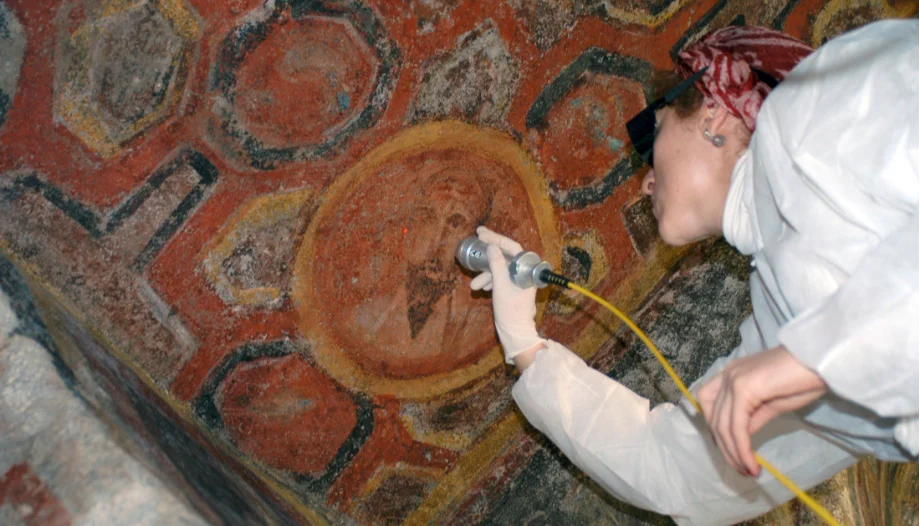
Christian archaeology seeks to see, hear, and touch the Word made flesh, said Pope Leo XIV, inviting bishops around the world and others to encourage young people, laypeople, and priests to study archaeology.
Ancient relics, catacombs, artifacts, and ruins from early Christian communities help the faithful «rediscover the roots of their faith» and speak «to those who are far away, to non-believers and to those who wonder about the meaning of life, because they find an echo of eternity in the silence of the tombs and in the beauty of the early Christian basilicas,» the Pope wrote in a new document.
«Furthermore, archaeology speaks to young people, who often seek authenticity and meaning; to academics, who see faith as a historically documented reality rather than an abstraction; to pilgrims, who find in the catacombs and shrines a sense of purpose and an invitation to pray for the Church,» he wrote.
The Vatican published Pope Leo XIII's apostolic letter «on the importance of archaeology» on December 11, «on the occasion of the centenary of the Pontifical Institute of Christian Archaeology,» founded by Pope Pius XI in 1925. The Pope also met with members of the institute at an audience at the Vatican that same day.
The institute is a postgraduate research and teaching institution offering degrees in Christian archaeology and has trained hundreds of archaeologists specializing in ancient Christianity.
In the six-page letter, Pope Leo reaffirmed «the essential role of archaeology in understanding Christianity and, consequently, its application in catechetical and theological formation.».
«It is not a question of reducing ecclesial life to a cult of the past,» he wrote. True Christian archaeology consists in making «the past speak to the present» and recognizing «the role of the Holy Spirit in guiding history.».
«In today's fast-paced world, there is a tendency to forget and to consume images and words without reflecting on their meaning,» wrote Pope Leo. «The Church, on the other hand, is called to educate people in memory, and Christian archaeology is one of its most noble tools for achieving this.».
Archaeology is «a ministry of hope, because it shows that faith has already survived difficult times and withstood persecution, crises, and changes,» he wrote. «Those who study the origins of Christianity discover that the Gospel has always had a generative force, that the Church is always reborn,» and that faith «has been renewed and regenerated, taking root in new peoples and flourishing in new forms.».
«We live in an age where misuse and excessive consumption have taken precedence over preservation and respect,» he wrote. «Archeology, on the other hand, teaches us that even the smallest piece of evidence deserves attention, that every detail has value, and that nothing can be discarded.».
Archaeologists, he wrote, «do not destroy, but decipher,» identifying «the spirit of an era, the meaning of faith, and the silence of prayer in a piece of pottery, a corroded coin, or a faded engraving.» This attitude and approach of respect «can teach us a lot about pastoral care and catechesis today.».
«Christian communities safeguarded not only the words of Jesus, but also the places, objects, and signs of his presence,» he wrote. «The empty tomb, Peter's house in Capernaum, the tombs of the martyrs, and the Roman catacombs bear witness that God has truly entered history, and that faith is not merely a philosophy, but a tangible path in the reality of the world.».
«At a time when culture often loses sight of its roots, archaeology becomes a valuable tool» for evangelization, he states in the new document.
Christian archaeology is not limited to looking at the past, he wrote, but also speaks to all people in the present: to the faithful, to those who are far away, to non-believers, to young people, and even to scholars.
«The mission of Christian archaeology continues to be to help the Church remember its origins, preserve the memory of its beginnings, and tell the story of salvation not only through words, but also through images, forms, and spaces,» he wrote.
Christian archaeology «seeks to touch, see, and hear the Word incarnate,» he wrote. «By focusing on the physical traces of faith, archaeology educates us in a theology of the senses: a theology that knows how to see, touch, smell, and hear.».
«Do we also believe in the power of study, education, and memory? Are we willing to invest in culture despite the current crises, to promote knowledge despite indifference, and to defend beauty even when it seems irrelevant?» asked Pope Leo.
He invited “bishops, as well as leaders and guides in the fields of culture and education, to encourage young people, lay people, and priests to study archaeology.”.
«Christian archaeology is a service, a vocation, and a form of love for the Church and humanity,» he wrote, encouraging the pontifical institute to «continue its excavations. Continue studying, teaching, and telling the story» to others, as well as «making the Word of life visible, bearing witness that God became flesh, that salvation has left its mark, and that this Mystery has become historical narrative.».
The Pontifical Institute of Christian Archaeology
The Pontifical Institute of Christian Archaeology was founded to complement the work of the Pontifical Commission for Sacred Archaeology, which oversees the protection, conservation, and administration of Christian catacombs and other sacred archaeological sites in Italy; the Pontifical Roman Academy of Archaeology, which promotes academic conferences and studies on archaeology ranging from ancient Rome to the medieval period; and the Pontifical Academy «Cultorum Martyrum,» which promotes the veneration, historical study, and liturgical memory of Christian martyrs.
Pope Leo urged the various organizations to cooperate, communicate, and support each other.
Christian archaeology is «a resource for everyone,» he wrote, promoting culture and inspiring «respect for diversity.».




 Español
  English
  Italiano