



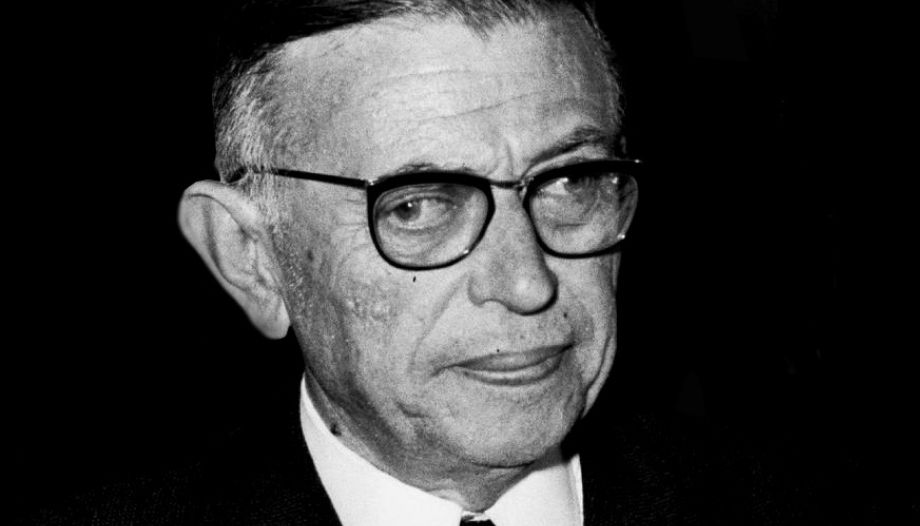
The first play by French philosopher and writer Jean Paul Sartre, Bariona, Son of Thunder, was conceived and performed in a Nazi camp, with Sartre as a prisoner there. The central theme was the mystery of Christmas, and the message was one of hope. The existentialist philosopher reserved the role of Balthazar, one of the main characters, for himself.
The story went as follows. In November 1940, some priests from Stalag 12D, a Nazi camp near Trier (Germany), obtained permission to celebrate Midnight Mass in one of the barracks, according to Javier Marrodán, a priest and professor from Navarre, in a review to the 2012 edition of Voz de Papel.
Genesis of the play ‘Barioná’
Among the 15,000 prisoners was Jean-Paul Sartre, already a well-known writer at the time. He had joined the French Army as a meteorologist and was arrested when the Germans occupied France.
Jean-Paul Sartre wanted to contribute to the celebration and offered to write and perform a play about Christmas. He was 35 years old, had already published Nausea, was writing Being and Nothingness, was an ‘official’ atheist, and organized courses on Heidegger and existentialism for his fellow camp inmates.
Act of spiritual and collective resistance
In just six weeks, Sarte not only wrote the script, but also distributed roles, organized rehearsals, supervised props and music, and played one of the main characters, Baltasar, himself.
The stage became an act of spiritual and collective resistance: an affirmation of meaning, hope, and coexistence in the face of oppression.
Barioná, a man without hope
The protagonist, Barioná, is the leader of the Jews of Bethsur, a village near Bethlehem. He hates the Romans and is skeptical of the shepherds' story. They claim that an angel has announced the birth of the Messiah in a nearby stable.
Barionah is a man without hope, defeated, with no illusions about the future. Not even the pregnancy of his wife Sarah alleviates his gloomy and pessimistic thoughts. He too had longed for the coming of the Messiah, but not that of a helpless child.
Balthazar highlights Jesus as a sign of hope
From this point on, the drama introduces the birth of Jesus as a sign of hope for the world. The shepherds bring the news of the arrival of the Messiah, and characters such as Balthazar (played by Sartre) talk with Barioná about the importance of hope, human dignity, and freedom.
Baltasar explains to him with theological depth—and patience, Marrodán notes—that God has come down to Earth for him, that he has chosen to carry out this madness even though it is hard to believe. And that is why every man is now much more than he ever aspired to be, that the birth of Jesus is a cause for hope and gives suffering its true meaning.
Profound impact among prisoners
The work had a profound impact on the prisoners. According to testimonies, many remember Sartre's words about the meaning of suffering and hope years later, even though the text was not widely circulated for decades.
Several authors highlight that Barioná combines history and life context, Christmas as a narrative of human hope, and existentialist philosophy applied to action: freedom, responsibility, and human commitment in the face of suffering.
The mystery of Christmas, and mystery in Sartre's life
Some prisoners converted, and others “clearly” remembered Sartre-Baltasar's words about suffering and the greatness of redemption years later. This has been documented, for example, by Charles Moeller, author of the famous volumes on ‘20th Century Literature and Christianity,’ and Professor José Ángel Agejas, philosopher and professor at the Francisco de Vitoria University (Madrid).
On that Christmas Eve in 1940, “Sartre added to the great mystery of Christmas the not insignificant mystery of his own life,” he concludes. Javier Marrodán, PhD in Communication from the University of Navarra. “With Baltasar's help, of course.” Incidentally, Marrodán wrote his doctoral thesis on Albert Camus. But that's another story.



 Español
  English
  Italiano