



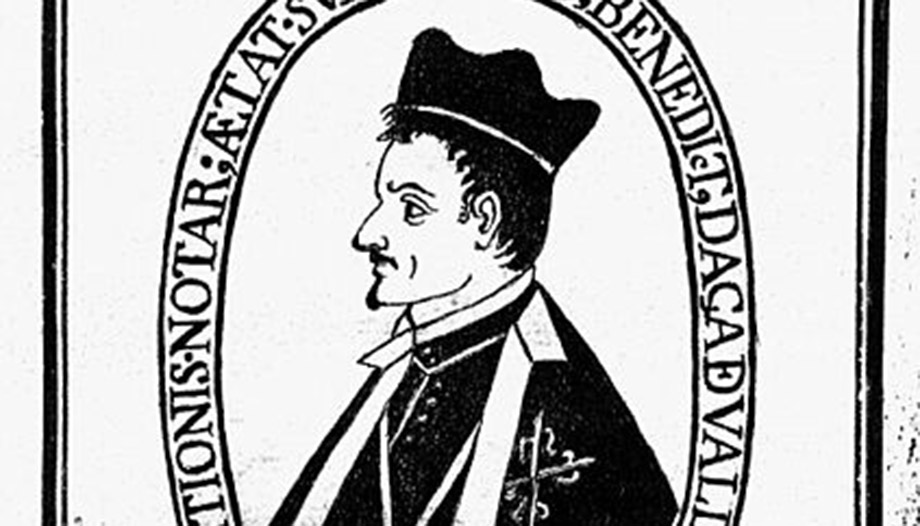
Benito Daza de Valdés (1591–1634) was a Dominican clergyman and pioneer in optics and optometry who was born in Córdoba on March 31, 1591. Educated by his uncle, a canon of the collegiate church of San Hipólito, Benito graduated with a degree in Arts and Philosophy in 1606 from the University of Seville. He served as a notary for the Inquisition tribunal in Seville and in 1623 published his only known work, Uso de los antoios (Use of Antoios), in which antoios refers to eyeglasses. The work reveals aspects of Daza's personal life. He suffered from serious illnesses in childhood, including lameness and «stone disease.» His devotion to the Virgin of Fuensanta is expressed in the dedication, where he thanks the Virgin for the miraculous healing of his illnesses.
The work, divided into three books, stands out as the first systematic study of corrective lenses. Book One addresses the anatomy and properties of the eyes, discussing the essential conditions for good vision. It also classifies visual defects as natural and acquired. Book Two, «On remedies for sight through lenses,» presents ten chapters in which Daza explores the manufacture and differences between concave and convex glasses. He also addresses the magnification and reduction of images, as well as the prescription of glasses following a scale similar to the current diopter scale. Book Three consists of four dialogues between a patient, an optician, and a doctor, detailing common clinical cases in the determination of corrective lenses. It also explains how to perform cataract surgery.
Although Daza's work went unnoticed in his day, it was rediscovered in 1901 by the historian Von Rohr, which made other authors aware of the importance of his work in the field of corrective lenses. His contribution to optics and optometry is now recognized as a milestone in the evolution of this science. That is why the CSIC's Institute of Optics is named the Daza de Valdés Institute in his honor.
Public University of Navarra.
Society of Catholic Scientists of Spain





 Español
  English
  Italiano