



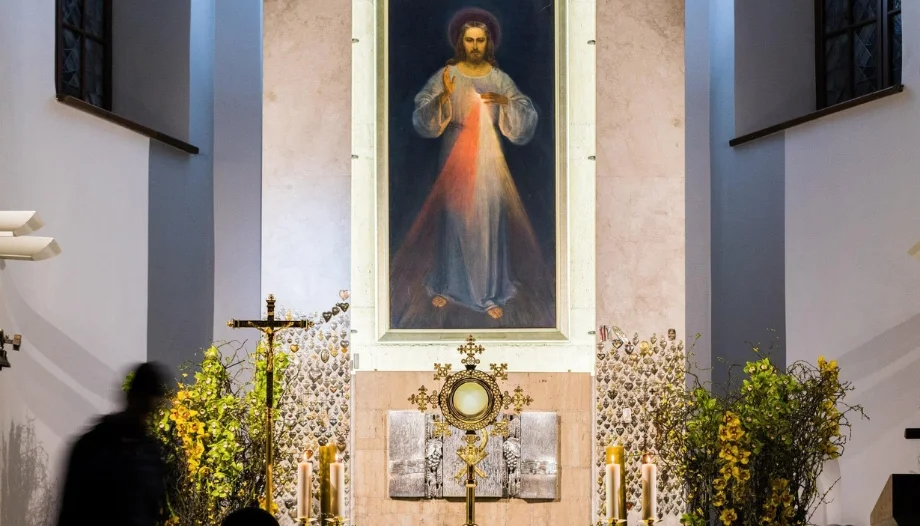
On a narrow cobblestone street in Vilnius’ Old Town, pilgrims and locals alike slip into a shrine that rarely closes its doors. Many kneel before the exposed Blessed Sacrament; others stand in awe before the original painting of Divine Mercy Jesus held inside the shrine.
In June 2026, Vilnius will host the Apostolic Congress of Mercy, drawing Catholics to the city where, through St. Faustina Kowalska and her confessor, Blessed Michał Sopoćko, the devotion took visible form and began to spread.
For many Catholics, it will be a chance to travel to a city closely linked to the Divine Mercy devotion, and to pray in the place where the message took visible form before spreading across continents.
However, if you ask the people who live closest to this devotion what the congress is really for, they speak of conversions, confessions and constructing the foundations of mercy in our changing societies.
Two voices in Vilnius offer a window into that deeper reality: Fr Povilas Narijauskas, who oversees as rector the Divine Mercy Sanctuary of Vilnius that stays open so pilgrims can do more than pass through and Sister Marcelina Weber, the mother superior of the Vilnius convent of the Sisters of Merciful Jesus, whose community safeguards and promotes the devotion through prayer, service, and daily acts of mercy. They both spoke to Omnes, talking about how they view mercy.
A shrine for staying
Fr. Povilas has watched how quickly pilgrimage can become a checklist. During Mass, groups sometimes enter, glance at the image, take photographs, and leave. “They can say, ‘Oh, I was in the shrine. I saw the original image,’” he says. “But it’s not just to see Him. We must also spend time with Him.”
He returns to a sentence that functions like a guardrail for the devotion: “The image is not just for show.” The shrine stays open 24 hours a day so that people can return anytime to pray whenever they feel God’s impulse to do so.
In conversation, Fr. Povilas does not treat mercy as an abstract theme for conferences. He keeps returning to the practices the shrine makes possible: constant prayer before the Blessed Sacrament, time for confession and daily masses throughout the day. He worries that large gatherings can leave people impressed but unchanged and he hopes the congress will teach pilgrims to stay with the Lord after the schedule ends and the emotions fade.
Mercy in the sacraments
When Fr. Povilas speaks about Divine Mercy, he leads with the Eucharist. “What gives me the most joy is still Holy Mass,” he says. “For me, the bread is becoming His Body. I am not merely just giving bread. I am giving the real, living Jesus to people. It is still a miracle.”
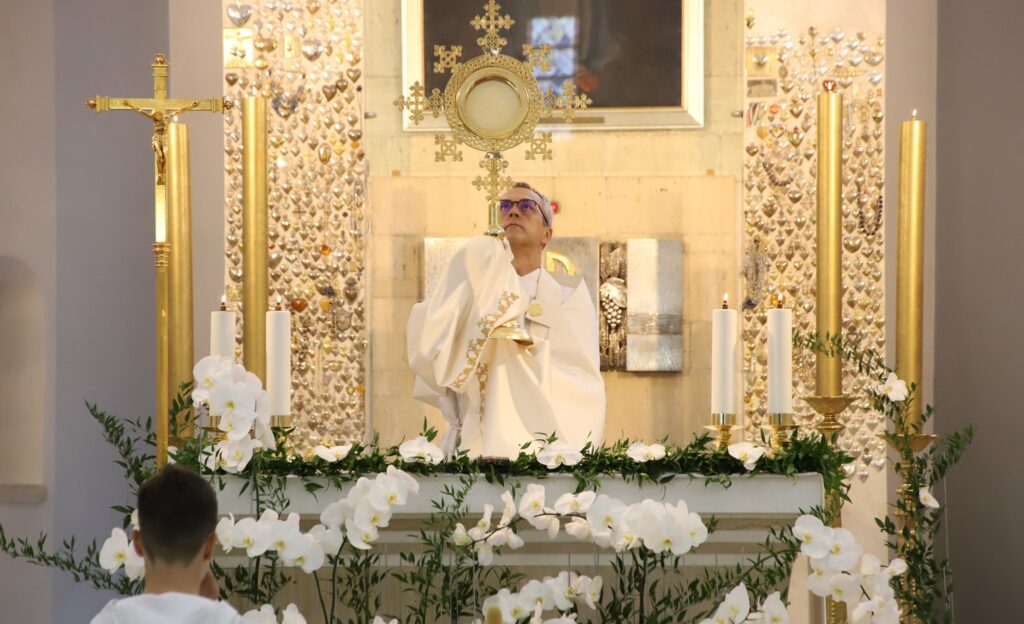
That “miracle,” he says, draws people toward reconciliation. “Every day, morning, afternoon and evening,” he says, “there are people coming for confession.”
Asked whether the message of Divine Mercy has been fully received in the world, he refuses to draw a neat conclusion. “Not enough, it can still be received more strongly,” he says. In his view, mercy does not reach a finish line; it must be received repeatedly, so mercy becomes a practiced interior and exterior reflex, not a rare spiritual highlight alone.
The chaplet and the crisis of the world
Fr. Povilas is careful to affirm the breadth of Catholic prayer. “All the prayers are inspired, and all the prayers are good,” he notes. Nevertheless, he insists the Divine Mercy Chaplet holds a distinctive place because of how it was given. “It was dictated to St. Faustina the same way Christ dictated the ‘Our Father’ to his disciples” he explains.
That claim leads to a practical conclusion about priorities. “Before we focused on the ‘Our Father’ and all other prayers,” he elaborates. “Now it must be our father, then the chaplet of Divine Mercy and then all other prayers.”
He describes the chaplet as a kind of spiritual “medicine” and urges people to stop bargaining with it. His advice is blunt yet impactful. “Take this prayer and pray it without hesitation.”
He then connects the devotion to the wider world. “When we look at a world at war, where so many terrible things are happening, why is this so? Is this because there is no God? or is this because there is not enough mercy?" he ponders. "If we want more mercy, we first need to call upon God for that mercy. We cannot give mercy to others, if we do not first have enough mercy within us.”
That final line is a theological claim and a psychological one. Mercy is not simply a social virtue to be cultivated; it is grace to be received. In Fr. Povilas’ framing, the chaplet is not a slogan for the world’s problems but a daily posture of dependence: a way of admitting need, asking for mercy, and letting Christ reshape what a person can give to others.
For pilgrims tempted to treat the congress as the beginning of their journey towards mercy, he presses the point: “Start now. Not tomorrow, not the day after tomorrow, now.”
The mercy of interruptions
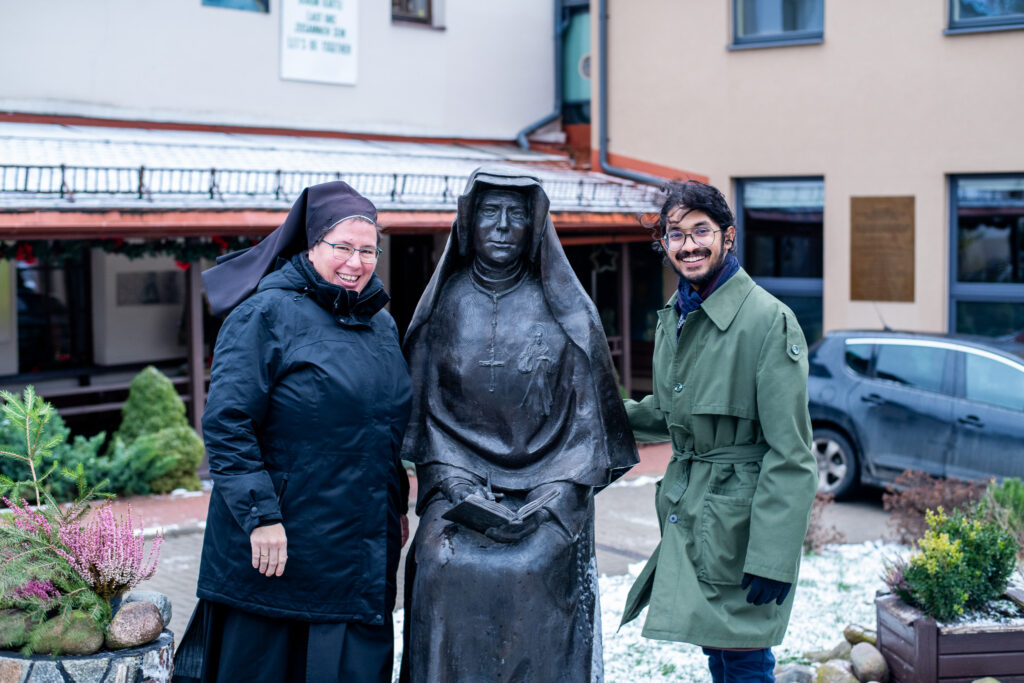
Sister Marcelina illustrates the practical aspects of mercy, with an example from her community’s daily life.
Each day at three o’clock, the nuns gather for prayer in their convent. Yet it is often interrupted by pilgrims ringing the convent doorbell, hoping to pray in the same chapel where St. Faustina once prayed. The interruption matters. It breaks silence, disrupts recollection and asks the sisters to choose between protecting their own personal prayer and responding to another’s longing. Mercy, then, becomes a decision that costs something. “What is more important,” she asks, “to stay with Jesus or to be merciful to this person who rings the bell?”. The nuns always respond to the bell.
Her point is not that prayer should be abandoned, but that prayer should produce a heart capable of being merciful by the unpredictability of life. Mercy, she explained, is often practiced in choosing gentle patience and quiet kindness over irritation and rudeness. “It’s really easy, but very important”, she said, because these choices happen “during the whole day”.
She clarified that such mercy is not the result of personal effort alone. “We are able to do this by praying, ‘Jesus, I trust in you,’” she explained, pointing to the central prayer of the devotion as the source of grace. She encourages others to do the same.
Silence that makes mercy possible
Sister Marcelina also speaks about modern conditions that can make mercy harder, namely distractions from the world that make it hard to hear God’s voice. Her congregation actively takes care of the Divine Mercy Sanctuary. There, she explains, silence is constant. “Silence in this time is very important,” she says, because “our heart and soul needs time to hear God.”
Her observation has practical implications for the congress. A pilgrim can attend every talk and still leave unchanged if they never learn to listen to God’s voice. In Sister Marcelina’s view, mercy begins before the doorbell rings and before difficult conversation happens; it begins when a person allows God to speak and allows that voice to soften their hearts.
After the Pilgrims leave
Both voices keep bringing the focus of Divine Mercy back to a formation that cannot be outsourced to any event. Fr. Povilas wants the devotion to become a routine of daily prayer and a part of sacramental life; Sister Marcelina wants mercy to influence our daily decisions and how we treat others. She tells pilgrims to “open their heart” and come ready to receive.
If those habits take root, the congress will not be remembered only for what happened in Vilnius, but for what happened afterwards: whether people returned home more capable of staying with Christ and more willing to meet their neighbor with the mercy they have received freely.
Founder of "Catholicism Coffee".



 Español
  English
  Italiano