



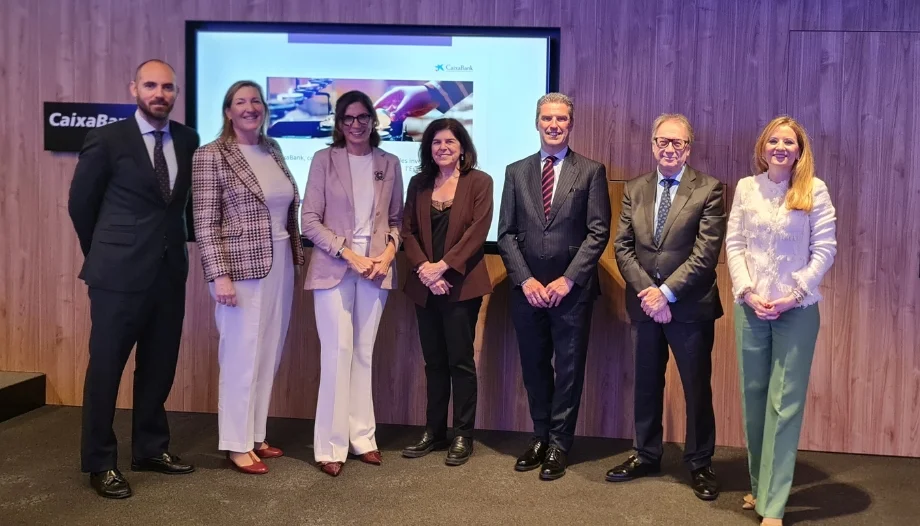
CaixaBank has taken a further step in its accompaniment of the Church in Spain with the celebration in Barcelona of the day “CaixaBank, committed to society and investments according to the criteria of the Social Doctrine of the Church.”, The purpose of the meeting was to present a specialized management model and to deepen the integration of the ethical principles of the Social Doctrine of the Church in financial activities.
The meeting was attended by more than 70 Church executives and financial managers. This is the second event of similar characteristics that CaixaBank has organized in Spain, thus reinforcing the dialogue between the bank and religious institutions.
A specialized model at the service of the mission
The territorial director of CaixaBank in Barcelona, Maria Alsina, opened the conference by stressing the importance of offering highly specialized attention to religious institutions, based on experience, knowledge of their specific needs and a long-term relationship of trust. As she explained, the bank seeks to provide tailor-made financial solutions to support their pastoral, social and patrimonial activity.
Patricia Rubio, Director of Institutional Banking in Barcelona, explained the comprehensive service model that coordinates the relationship with this type of client. The proposal combines expert advice, training and a highly specialized team, in order to offer a differential service that responds to the identity and mission of each institution.
During the session, legal, economic and pastoral church documents were also discussed, highlighting the need for professional management based on transparency, accountability and responsibility, principles that are increasingly relevant in the administration of ecclesiastical goods.
Ethical finance and social commitment
One of the main themes of the meeting was the integration of ethical and sustainable criteria in investment decisions. In this context, representatives of Fundación la Caixa presented the institution's social action, highlighting its work with vulnerable groups and the convergence of objectives with the humanist mission of the Church.
The day concluded with a round table discussion in which experts from CaixaBank Wealth Management and CaixaBank Asset Management analyzed how to apply the criteria proposed by Mensuram Bonam, The workshop was a reference document for investments consistent with the DSI. Sustainability policies, controversy analysis, specialized portfolios and investment vehicles specifically designed for religious institutions were addressed.
The importance of having strategic financial plans that include short-, medium- and long-term objectives and that help to align economic profitability with positive social impact was also emphasized.
Economy at the service of the common good
Those responsible for the entity reiterated that professionalism, commitment, trust and quality of service are the pillars for accompanying religious institutions in their operational, investment and insurance needs. The objective, they pointed out, is to promote an economy at the service of the charism and the mission, and not the other way around.
The event closed with a clear message: when finances are managed from ethical and responsible criteria, they can become an effective tool for promoting human dignity, social justice and the common good. Along these lines, CaixaBank reaffirmed its desire to continue collaborating closely with Church institutions, strengthening their spiritual and social work through asset management that is consistent with their values.




 Español
  English
  Italiano