



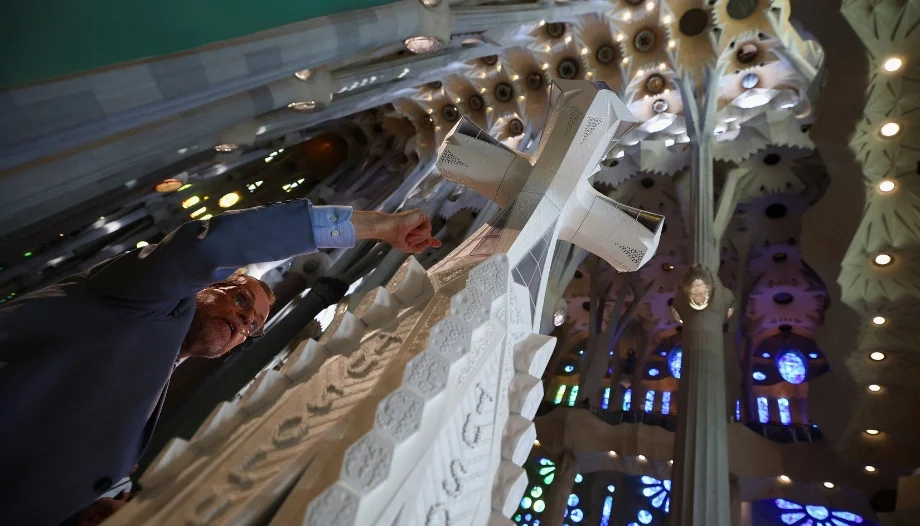
Abel de Jesús, in his third speech at the course of Arteology wanted to dwell on the origin of the Church. «The Fathers of the Church, when they think of the Church of Christ, think of it from the cross,» Abel explained. «From the open side of Christ flow the blood and water, signs of Baptism and the Eucharist. That is where the Church is born. Not as a human organization, but as a body sustained by love: the invisible mortar that holds up the temple whose mission is to evangelize and transmit the salvific act of Christ.
This original understanding helps to understand why Christian art, when it is faithful to its vocation, does not adorn the faith, but reveals it. Antoni Gaudí expressed it masterfully when he conceived the temple as a catechism of stone and light. In the Sagrada Familia, the highest tower is not that of Mary or the apostles, but that of Jesus Christ, crowned by a luminous cross. Christ thus appears as true light (cf. Jn 1:9) and as the supreme mediator between God and mankind. All architecture converges on this point: there is no Christianity without the cross, nor Christian light that is not born of it.
The scandal of the cross
However, for the man of yesterday and today, the cross is unbearable. St. John of the Cross warned that many desire the goods of the cross, but few want to be friends of the cross. In the dark night there are not many who accept to live a mystery that is radically incompatible with human security. The cross is not understood from ideologies or closed systems, but from the abandonment entrusted to the Father and the surrender to all.
The true thermometer of our experience of the Gospel is forgiveness. It is enough to observe how a person treats his enemies, how he reacts to injustice or undeserved criticism. That is the litmus test. Only the saint is capable of accepting with meekness an unjust criticism; even just criticism is often difficult for us. Forgiveness and reconciliation are at the heart of what Jesus proposes: a self-giving for all, carried by the Holy Spirit. εἰς τέλος τέλος, to the extreme (cf. Jn 13:1).
We often try to make the mystery of the cross more bearable by inventing shortcuts: off-center devotions, incessant searches for spiritual consolations, endless pilgrimages after extraordinary signs. It is not devotion to the saints that is being questioned, but the reduction of faith to phenomena that cushion the scandal of the cross. St. John of the Cross denounced as a great affront to God the eagerness for particular revelations, as if the definitive Revelation - Christ himself - were not enough. In the cross, God has said it all.
The cross as the fullness of revelation
Not all theologies have assumed this centrality. When the kingship of Christ is interpreted in an earthly or political key, it is perverted. Christ is king, yes, but his crown is of thorns, his scepter a reed with which he is beaten, his robe the purple of his own blood and his throne the cross. Before Pilate, when all the attributes of kingship are present, the nature of his kingship is unambiguously revealed. The messianic secret disappears: this is the King that Jesus came to announce.
This is why the Gospel cannot be read apart from the cross. Words like those of John 6-«he who eats my flesh and drinks my blood has eternal life»-can only be understood in the light of Christ's total self-giving. The same is true of difficult passages such as «I have not come to bring peace, but a sword» (Mt 10:34). Taken from the cross, these words can justify violence; read from it, they reveal that fidelity to the Gospel can provoke division and rejection, but never holy war. The cross is the hermeneutical key to the whole of Scripture.
False assurances and true Messiahs
Jesus' contemporaries did not understand this mystery either. They expected a political savior. Pharisees, Sadducees, Zealots and Essenes put their trust in religious, social or ideological securities that the cross came to undo. Jesus did not fit into any messianic expectation. His death on the tree - a sign of curse according to Deuteronomy - was not only a human failure, but a radical exclusion assumed out of love.
On the cross, everyone hands Jesus over: the Father, Judas, Pilate, the crowd that prefers Barabbas. The disciples flee, overcome by fear and despair. They do not yet know that the Passover is about to break out.
From failure to glory
The mystery of the Crucified One is only resolved in the Resurrection, which frees the apostles from the calculations of success or failure. The icon of the successful disciple is not the guerrilla, but the martyr. Not the one who occupies front pages, but the one who transforms the world from heart to heart. The parables of Jesus always point to the small: the mustard seed, the leaven, the discreet light. Evangelization is not born of programs, but of experiences that are contagious in proximity.
That is why the tower of the apostles and the evangelists in the temple of the Holy Family does not have a centralized light but a distributed light because it symbolizes the mission of transmitting light to the world. “You are the light of the world” (Mt 5:14).
The Church is born in this way, on the cross and in the surrender of love to the extreme. This is its true origin and its deepest tradition. From it springs a community sent out into the world, sustained by the Spirit, which announces to Jews and Gentiles that Jesus is Lord and that love has the last word. Where there is charity and love, there God is.
Journalist and poet.




 Español
  English
  Italiano