



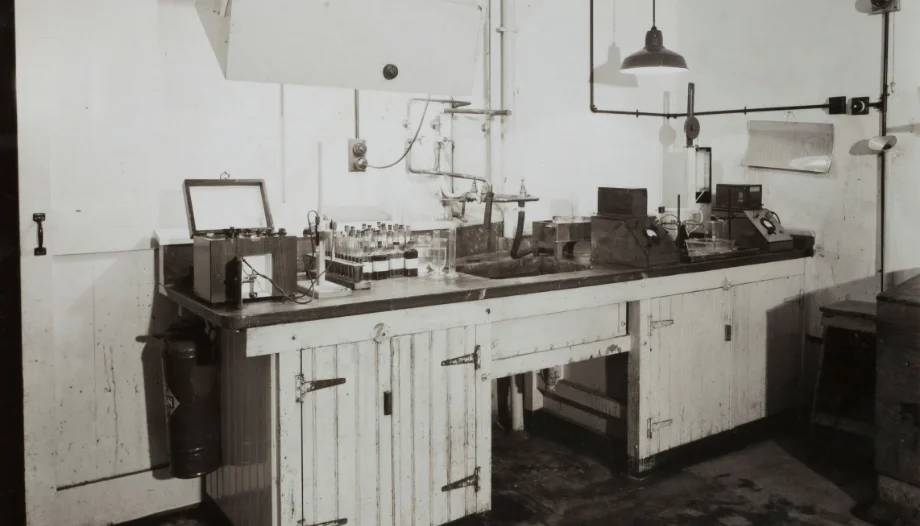
Julia Mª González Peña (1925 - 2010), born in the Burgos town of Revilla del Campo, graduated in Chemical Sciences from the Central or Complutense University of Madrid in 1948, receiving her doctorate in 1953 thanks to scholarships granted by the CSIC, the largest scientific institution in the history of Spain, founded by Catholic scientists. The CSIC also granted him pensions to Belgium and Holland (Ghent, Leuven, Vageningen and Delft), to train in techniques that did not exist in Spain, such as electron microscopy, which he taught both at the Institute of Ceramics and Glass of the CSIC and to industrialists in the sector.
In his thesis he studied the conductivities of soils and characterized many types of clays, collaborating with Vicente Aleixandre, founder of the current Institute of Ceramics and Glass of the CSIC.
In 1962 and 1963 he traveled to Paris with Dr. Madame Oberlin, author of the Encyclopedia of Electron Microscopy, with whom he learned transmission electron microscopy (TEM). He then directed four doctoral theses that opened up lines of research unpublished in Spain in the 1970s, such as glass-ceramic materials or fast-firing pastes. He even founded the Electron Microscopy Laboratory of the Institute of Ceramics and Glass of CSIC.
In addition, he directed research projects included in the Development Plans and the National Materials Plan, on dolomites, sericitic slate, Toledo clays, recycling of wastes for the manufacture of ceramic composites, etc., and produced more than 60 publications and numerous plenary lectures between 1967-1985. He also promoted and founded the Raw Materials Section of the Spanish Society of Ceramics and Glass, where he organized several meetings and courses.
He also collaborated with the Spanish Society of Ceramics and Glass, was a member of the Board of Directors of the Spanish Electron Microscopy Society and elected representative of the scientific staff in successive CSIC Governing Boards, elected member of the CSIC Scientific Commission in the field of Technology and of the CSIC Governing Board, acting in numerous advisory or decision commissions: research management, scientific policy, human resources and external relations.
Her Catholic faith never prevented her from developing a scientific activity of the highest international level. Science and faith were compatible in her, as in Copernicus, Galileo and so many others.
Spanish National Research Council (CSIC).




 Español
  English
  Italiano