



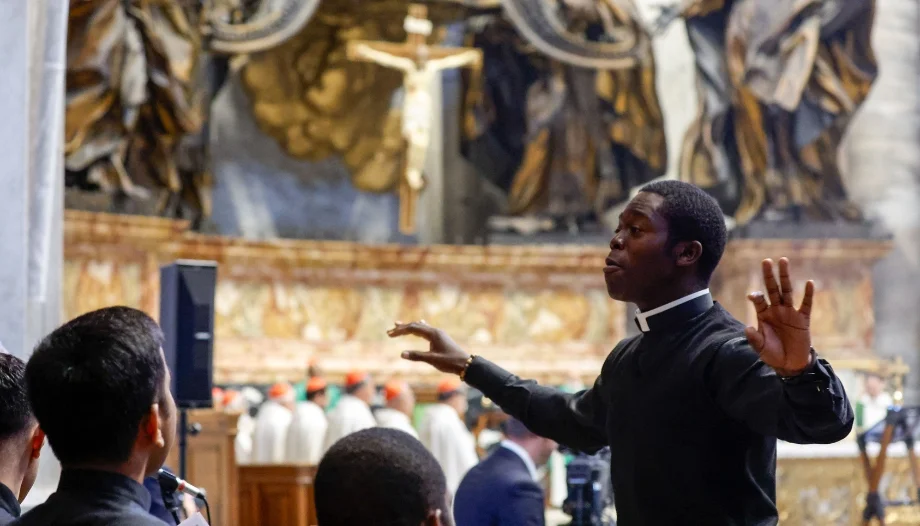
The Eucharistic celebration opens with the antiphon or entrance hymn, whose purpose is to foster unity among those gathered, introduce them to the mystery of the liturgical season or feast, and accompany the procession of priests and ministers. With regard to the manner of execution, it is intoned by the schola and the people, or a singer and the people, or all the people, or only the schola. They may be used for this chant or the antiphon with its psalm, as found in the Roman gradual or in the Simple gradual, or another hymn suited to the sacred action or the nature of the day or liturgical season, with a text approved by the episcopal conference.
The Roman Gradual contains the official repertoire of the ordinary and the proper for different occasions. Certainly, consulting this hymnal is one of several possibilities for choosing music during the Eucharist. However, objectively speaking, it is the most reliable criterion when establishing the entrance hymn for the celebration.
It is no coincidence that the incipit from the introductions to the Gradual have traditionally given names to certain days. The most significant examples are found in the high points of the liturgical year, such as, to give two examples, the third Sunday of Advent, called Gaudete, and the Fourth Sunday of Lent, Laetare. With regard to duration, it is advisable that this processional chant conform to the requirements for the duration of the entrance of the initial procession of the Mass.
It is also possible to use the organ alone or any other legitimately admitted instrument or ensemble of instruments before the priest arrives at the altar, as well as during the offertory, communion, and at the end of communion. There should therefore be no hesitation in replacing vocal music with instrumental music on these occasions, with the help of professional musicians. Far from undermining the sometimes misunderstood participation of the faithful, the liturgical celebration is enriched and becomes more colorful when there is the possibility of integrating different forms of vocal or instrumental music.
Kyrie, Glory and Hallelujah
With the Kyrie The faithful acclaim the Lord and ask for his mercy. The people and the clergy regularly take part in it. schola or a singer. When it is part of the third way of performing the penitential act, the Kyrie It is preceded by tropes, usually emphasizing the character of acclamation through the rhetorical figure of apostrophe, which consists of addressing Christ directly, using the expression “You.” The expressions of the tropes are biblical in content and show us aspects of Christ's life and actions. Therefore, the text never focuses on the sinful condition of man; that is, at this moment we do not ask for mercy because we are sinners, but because Christ has come to grant us forgiveness.
Normally, on Sundays and some holidays, the Glory. This is an ancient hymn with which the Church glorifies God the Father and the Lamb, and presents her supplications to them. It is intoned by the priest or, depending on the circumstances, by the cantor or the choir, and is sung either by everyone together, or by the people alternating with the cantors, or by the schola. It should be emphasized that, like the Creed, the Holy One, or the Lamb of God, the lyrics of this hymn may not be changed, since it is not an accompanying song, but constitutes a rite in itself.
After the reading that immediately precedes the Gospel, the singing of the Hallelujah, except during Lent, when the verse is sung before the Gospel or another psalm or tract from the Gradual. The chant has the character of an acclamation, constituting a rite in itself. With it, on the one hand, the faithful welcome and greet the Lord, who is going to speak to them in the Gospel, and, on the other hand, they profess their faith in Him through song. There are several possibilities for how it can be performed. If they are not sung, the Alleluia or the verse before the Gospel may be omitted. This omission, especially on weekdays, far from detracting from the celebration, helps to express the gradual solemnity of the different days. As stated in the missal, the participation of the assembly and the schola or a singer. While the assembly would repeat the acclamation, the choir or soloist would sing the verse.
Offertory and Holy Communion
In the Roman rite it is called Offertory the song that accompanies the procession of offerings to the altar. The rules for performing this song are the same as those for the entrance hymn. There are also two alternatives for this moment: first, the performance of polyphony or Gregorian chant by a choir; second, the organist playing a solo piece, without excluding the participation of other musical instruments.
The Saint It is an ancient acclamation integrated into the Eucharistic prayer. The acclamation is to be proclaimed by the people together with the priest. As the main chant of the Mass, it should be emphasized, since its full meaning cannot be conveyed by a mere recitation. The veneration of the text prevents, in principle, its replacement by another.
Lamb of God and communion
The existence of a song for peace. The breaking of bread is one of the most significant rites of the Eucharistic celebration, because it performs one of the most important gestures made by the Lord: breaking bread. The singing of the Lamb of God has the mission of accompanying this moment in a liturgical manner. The missal contemplates the participation of the people, at least in the response.
The communion song It is the last communal song planned for the Mass. The Roman Missal first provides for the song that will accompany the distribution of Communion. Its function is to express, through the union of voices, the spiritual union of those receiving Communion, to demonstrate the joy of the heart, and to clearly manifest the communal nature of the procession to receive the Eucharist.
As for the planned repertoire, it is possible to use either the antiphon from the Roman Gradual, with or without a psalm, or the antiphon with the psalm from the simple Gradual, or some other suitable chant. The communion chant may be performed by the choir alone or also by the choir or a cantor with the people. The performance of an instrumental work may also be appropriate at this point. Likewise, the missal presents the possibility of chanting a psalm, a hymn, or a song of praise after the distribution of communion and the accompanying chant.
The Mass does not establish a recessional hymn. There is therefore no, symmetry between the entrance hymn and the end of the celebration. However, the directory on singing and music in celebrations of the Spanish Episcopal Conference indicates that it may be appropriate, without detaining the faithful. It also positively values the possible performance of an organ piece.
Professor of liturgy. University of San Dámaso.




 Español
  English
  Italiano