



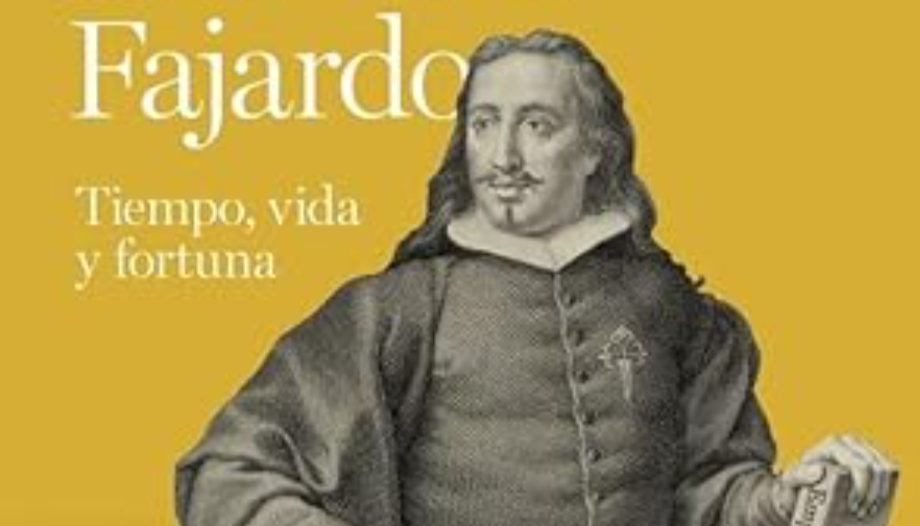
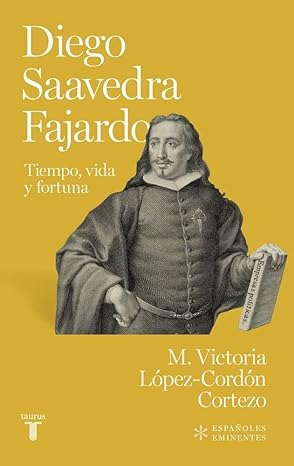
María Victoria López-Cordón Cortezo, professor of Modern History at the Complutense University of Madrid, has just added her name and scientific career to a collection of “eminent Spaniards,” which continues to grow in intensity and scope, as Taurus has now published ten major biographies with the March Foundation, under the direction of Ricardo García Cárcel and Juan Pablo Fusi and, of course, Javier Gomá.
On this occasion, we now have at our disposal the best biography ever written about Diego Saavedra Fajardo (Algezares, Murcia 1584 – Madrid 1648), agent of Preces of the King of Spain before the Holy See, secretary and collaborator of cardinals, ambassadors of Spain, and diplomat in Madrid, Rome, Naples, and Central Europe, in order to carry out tasks of coordination and liaison in a very complicated world, which ended with the Peace of Westphalia in 1648, the date of his death.
This century of consolidation of the great European monarchies following the debacle of Lutheran fragmentation in part of Europe and the break between the United Kingdom and the Holy See is interesting.
The influence of Salamanca
At the same time, let us not forget that Diego Saavedra Fajardo had studied in Salamanca. both rights and had been steeped in the spirit of the School of Salamanca, since Vitoria, Soto, and Cano not only achieved a reform and update of theology that was poured into the sessions of the Council of Trent and its dogmatic constitutions, but also into the great pastoral decisions of the Council, such as the episcopal residence, the constitution of the conciliar seminaries, and the reform of spirituality that produced a plethora of saints throughout Catholic Europe.
In Salamanca, Diego Saavedra Fajardo discovered the dignity of the human person emphasized by Francisco de Vitoria and its application to international law and natural law, both in the field of economics and law.
Finally, we must not forget that Diego de Covarrubias—a disciple of Vitoria and Martín de Azpilcueta—had left his chair in Salamanca and the Court of Granada to become Bishop of Segovia and President of the Council of Castile.
Great versatility
The appointment of clergymen, tonsured only in the case of Saavedra Fajardo, to high positions in the state administration developed by Philip II, was continued by Philip III and Philip IV during the lifetime and diplomatic activity of our humanist Saavedra.
Saavedra Fajardo was also a writer and poet, as can be seen in the compositions he wrote from time to time and published periodically, but above all in his reports, which he regularly presented to the Court, the Holy See, the Spanish Embassy, and the secretary of Cardinal Borja, whom he served faithfully for so many years.
Diego Saavedra Fajardo was a representative of “a generation” who read Tacitus, Seneca, and Machiavelli in order to learn what the ancients thought about political science and, of course, Boccalini, Lipsio, Mazarin, Quevedo, and so many other contemporaries who were preparing for enlightened despotism after the end of the wars of religion.
Pre-Enlightenment period
We are in the period of the European pre-Enlightenment, which is usually dated to the death of Descartes in 1650 and, therefore, to the beginning of rationalism and its criticism of the realist philosophy that prevailed in Europe and its immediate consequence, mistrust of the Church and God, which would become strong in the Age of Enlightenment.
Likewise, Saavedra Fajardo's work will be linked to the end of the religious wars that took place with the Peace of Westphalia in 1648 and the settlement of the breakup of Christian unity in the concert of nations.
This peace treaty would include the Treaty of Münster, signed in the same year in which Spain recognized the independence of the Republic of the Netherlands, which would eventually become a naval power trading with China and Japan.
We must not forget that, since the Battle of Lepanto coordinated by Philip II in 1571, the Ottoman threat had receded and European interests were more focused on trade with America and Asia than on the traditional Mediterranean routes.
Situation in Spain
In the 17th century, Spain had lost part of its empire in Europe, the Netherlands, and Germany, but remained strong with its monopoly on trade with America and the Philippines. The struggle with France continued as usual and reached a point of détente with the Peace of the Pyrenees (1659), which provided economic respite for Louis XIV, his regent, and Mazarin.
It is true that for Philip II and his successors, Spain's presence in the world meant serving the Catholic Church and defending the true faith against the Reformed and the infidels.
It is interesting how María Victoria López-Cordón Cortezo has taken the time to consider the presence of the works of Tacitus, the classic Roman historian who supported the empire. Tacitus respected the freedom of subjects and obedience to the laws of the Roman Empire, while Spain wished to be a staunch defender of the ideals of the empire, the Christian faith, and Roman law.
In this regard, we must highlight that Tacitus' works were published in all the major European languages during those years and were read and discussed throughout Christendom. In particular, Lipsius (1547-1606), the Flemish humanist, when he converted to Catholicism, promoted the people alongside his monarch, in accordance with the dictates of the Peace of Westphalia of 1648 and the classical echoes of the illustrious Tacitus. He took pragmatism, cold analysis, and raison d'état from the Latin classic.
Finally, we bring up Boccalini's (1556-1613) work on the commentaries on Tacitus that circulated in manuscripts, some of which can be consulted at the National Library of Spain or in the 1677 Italian print edition. Boccalini was very critical of Spain, as María Victoria López-Cordón Cortezo recalls, but he acknowledged the legality of Spain's presence in Milan and Naples and, above all, he was a supporter of Christian unity alongside the Roman Pontiff.
Diego Saavedra Fajardo



 Español
  English
  Italiano