


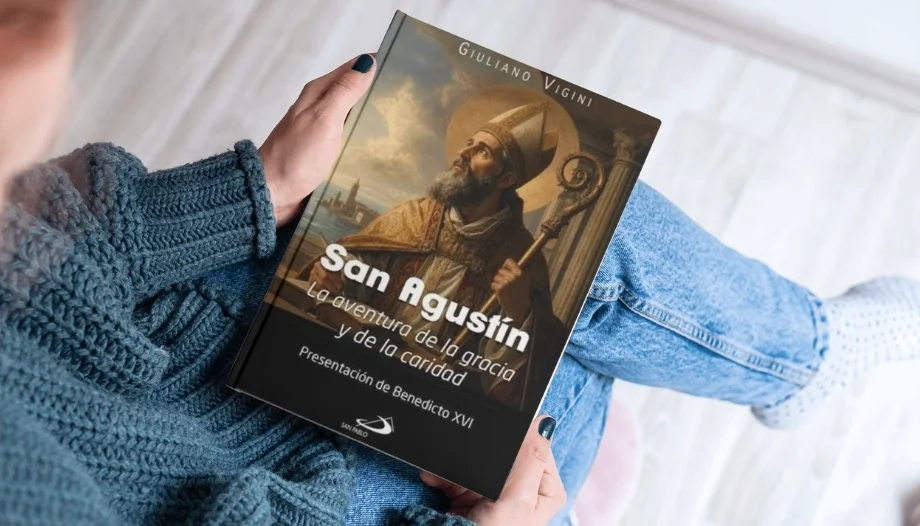
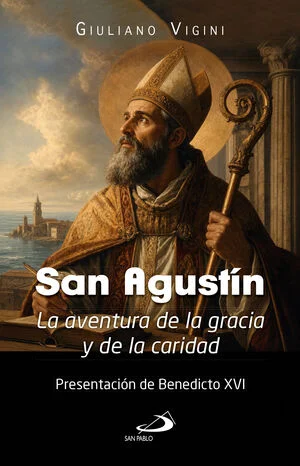
Before beginning this review of the work by Giuliano Vigini (Milan, 1946), it is worth noting that this is the Spanish edition of the magnificent biographical profile of St. Augustine (354–430) written by Professor Giuliano Vigini in 2025 in Italy and now published in Spain under the auspices of Ediciones San Pablo.
The work has been published with an introduction by Benedict XVI, but since it is undated, we do not know when he wrote it or for what purpose. It stands to reason that these may be some remarks on St. Augustine written for another work that may not have been published at the time.
This work, as the author explains in the introduction, was conceived as a synthesis of all the contributions that emerged in the history of recent theology during the two-year period of 1986–1987, on the occasion of the 16th centenary of St. Augustine’s baptism. It was St. John Paul II himself who published the apostolic letter on that occasion Augustine of Hippo, encouraging the Christian people to delve deeper into the teachings of this great Doctor of the Church.
The Augustinian Legacy in the Pontificate
Indeed, ever since his arrival at the See of Peter, Leon XIV has made constant references to St. Augustine—in his encyclicals, his speeches, and his Wednesday catechesis. Let us not forget the words he spoke in St. Peter’s Square on May 8, 2025, at the time of his election to the papacy: «I am an Augustinian, a son of St. Augustine.».
Naturally, we Christians believe that the Holy Spirit wants us to spend a few years reflecting on the teachings of the Teacher of Hippo, just as we did with the theology of Benedict XVI or with St. Ignatius of Loyola’s gift of discernment of spirits during Pope Francis’s pontificate.
The Confessions and the dynamics of love
We know the key details of St. Augustine's life from an autobiographical work titled Confessions, a seminal work of Christian, philosophical, and theological thought that has been reprinted many times throughout history. We highly recommend that readers revisit this work in the edition prepared by the renowned Mallorcan poet and writer Pedro Antonio Urbina.
At Confessions, St. Augustine starkly describes the clash between erotic love (eros) and the love of agape, as Benedict XVI summarized in his first encyclical, Deus caritas est, one of the finest treatises ever written on the dynamics of love and the call to holiness in the development of true love as the driving force behind happiness.
4. The Doctor of Grace in the Face of Theological Deviations
This entire doctrine of love as the path to happiness must be supplemented by the many texts that St. Augustine composed during his Pelagian controversy. Indeed, Pelagius, a British monk and contemporary of Augustine, was convinced that holiness could be attained solely through perseverance and constant, tenacious personal effort.
Indeed, in the Christian life of virtues and beatitudes, Saint Augustine—echoing the perennial teaching of the Church—reminded us that, in this work of holiness, the initiative always comes from God: grace accompanies us, sustains us, and brings the virtues and the Beatitudes to perfection. At the same time, we cannot forget that human beings must contribute their own freedom so that human acts may exist in which understanding and the will are united: «God, who created you without you, will not save you without you» (Sermon 169, 11).
It should be noted that St. Augustine has gone down in the history of theology as the «Doctor of Grace,» and his doctrine was crucial in resolving the controversy between freedom and grace—first with Pelagius, then later with the Lutherans, and finally with the Jansenists (p. 147).
Charity and the Mystical Legacy of Conversion
We should also note that St. Augustine has gone down in the history of spirituality for his significant contributions to the «theology of charity,» which are reflected by the great mystics of both the Spanish Golden Age and other authors throughout history —Master Eckhart and the Rhineland-Flemish School of spirituality—and which would culminate in the treatise by Thomas à Kempis, The Imitation of Christ (p. 137).
One need only look closely at Pope Leo XIV’s papal coat of arms—with its burning heart—to be reminded of how both the works of St. Augustine and the teachings of the Holy Father guide us to grow in love for God and for souls. One need only read carefully the Holy Father’s texts and speeches from his trip to Spain to see that the commandment of charity remains the essence of Christianity: we must live the experience of God daily, just as St. Augustine did (p. 78).
Of course, we cannot pass up the opportunity to cite the example of Saint Monica: the prayerful, loving mother who trusted both in the power of God’s grace and in her son’s ability to return to the true faith, even though he was certainly far from it and gripped by human passions. St. Augustine’s profound and radical conversion and his responsiveness to grace gave her the joy of seeing him centered in the faith and on the path to holiness (p. 66).
Intellectual Impact and Contemporary Relevance
Certainly, St. Augustine was more Neoplatonic than Aristotelian, just as the theologian Ratzinger was more Augustinian than Thomist. In fact, Professor Ratzinger’s doctoral dissertation was titled The People of God and the House of God in St. Augustine’s Doctrine on the Church. We should also remember that his habilitation thesis was The Theology of History According to St. Bonaventure, which contains a solid theological foundation and perspectives drawn from the works of the Bishop of Hippo.
Reading this fascinating profile of the Doctor of Hippo will also provide us with insights into Augustinian theology, which will undoubtedly enrich the theological debate of our time and our dialogue with the postmodern thought that shapes our world.
Giuliano Vigini, Saint Augustine: The Adventure of Grace and Charity






 Español
  English
  Italiano