




At the end of World War II, and in light of the magnitude of the Jewish holocaust, the clamor for a universal declaration of human rights prevailed as an unavoidable and urgent duty of humanity before history and the future of the human race.
Certainly, the declaration of human rights was made possible by total and universal agreement, and that Magna Carta has since served to unite people of all races and conditions, as if they were applications of natural law, of a global ethic, and of a starting point for preventing or at least condemning attacks on human dignity.
The problem is that, in the minds of Christians, Jews, and Muslims who believe in a single, transcendent God, it was very clear that human rights were based on the dignity of the human person as a child of God or, at least, as a creature of God.
The difficulty lay with non-believers, who were growing in number and who could not find a solid principle to support human rights other than human rights themselves.
The foundation of human rights
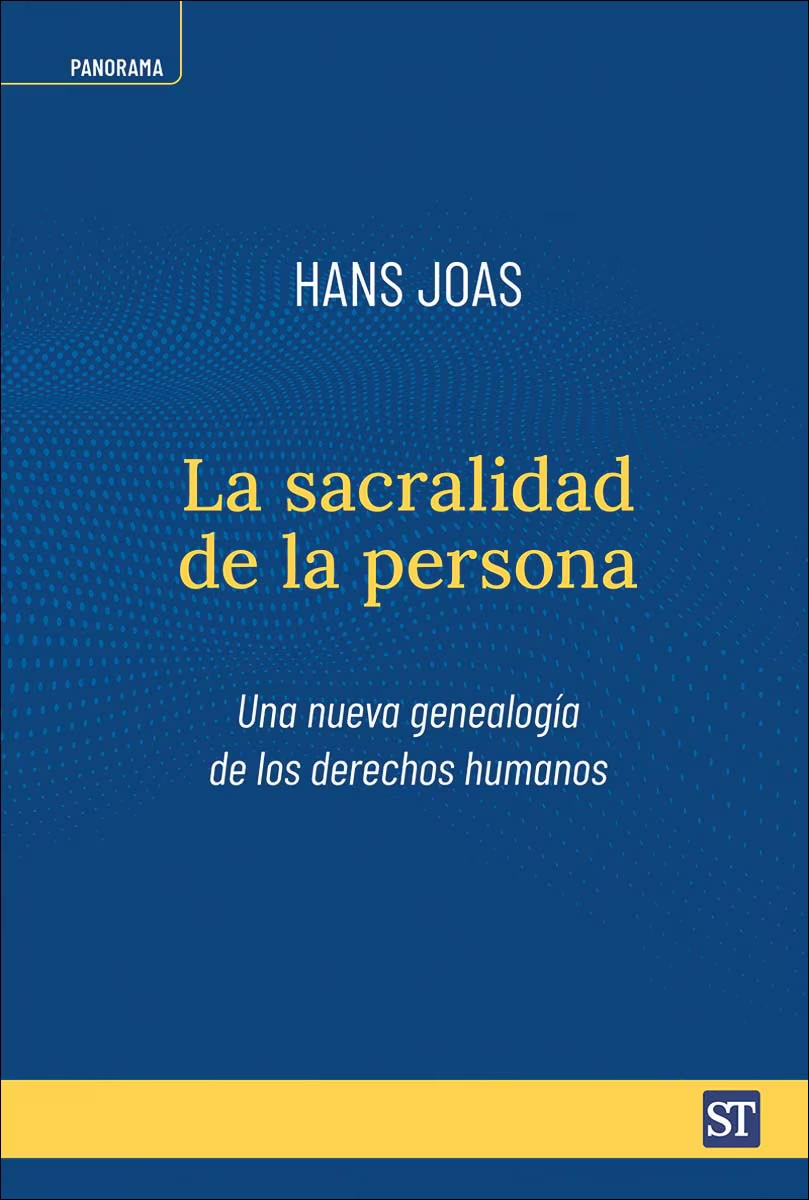
The idea developed by Hans Joas in the essay we are discussing here is precisely this: basing human rights on the dignity of the human person would be tantamount to sacralizing the human person, that is, giving them a dignity and renown that would truly ward off the temptation to attack, humiliate, or degrade that dignity.
In a way, Hobbes“ Leviathan pact would pale in comparison to the sanctification of the person who makes commitments of truth and freedom to other human beings, recognizing that this relationship dignifies and becomes a source of fruitful creativity. In short, it would be to interpret the Second Vatican Council, in the dogmatic constitution Gaudium et spes, when it affirms that man is the ”only earthly creature that God has loved for its own sake, and that it cannot find its own fulfillment except in the sincere gift of itself to others“ (n. 24).
This is very important, because Hans Joas believed that, after a few years, there was a risk that we would turn the 1948 Universal Declaration of Human Rights, which has underpinned the United Nations, into a “successful process of generalizing values” (p. 21).
Religious freedom
Even some, years later, could cite it as an example of the historical evolution of the good intentions of the 18th century in updating the ideas of the American Revolution or the French Revolution (p. 24).
Above all, let us bear in mind that the French Revolution was above canon and civil law and manipulated the people and the Church at will to become persecutors of God throughout French territory, leaving the country littered with guillotined corpses until they themselves were guillotined (p. 31).
The first consequence in the United States was the principle of religious freedom, whereby no one should be harassed for their beliefs or forced to adopt a religion or creed (p. 53). Years later, the Second Vatican Council itself would take up this freedom and spread it throughout the world: without freedom, it is impossible to love God.
This was logical, since human rights apply to all people of all races, cultures, and nations, and we are all equal before the law and have equal opportunities.
Torture
They also quickly put an end to torture in the constitutions of all European nations, so that torture ceased to be a systematic part of criminal law or the investigation of theft (p. 63).
The disappearance of torture is not simply the result of the humanization of punishments and penalties; it is something much deeper. It is a return to the principle of presumption of innocence and the idea that man should always be treated as the image and likeness of God, and that it is preferable for him to lie than to be tortured.
Torture is undoubtedly abhorrent in a state governed by the rule of law and far removed from all human logic (p. 69). Human rights therefore introduce a new sensitivity into criminal relations (p. 71).
Thus, since 1830, it has been practically abolished throughout Europe, and in Spain since the Cortes of Cádiz in 1812, although it is true that torture has occasionally been used in some places in the 20th century, but it is no longer official or systematic. Unfortunately, we must point out the case of China (p. 105).
It is also interesting that, as a result of those first declarations of human rights, they began to be exercised and slavery was soon abolished in Europe, so that, with varying degrees of agreement on the implementation, slavery, which was a shameful scourge, disappeared.
Finally, our author returns to the idea of the spiritualization of human rights. Specifically, speaking of the Holy Spirit, he suggests that with its help, “the sovereign force of recasting” could be achieved (188).
He then goes on to say that God “reveals himself in history and in human action” (193), which is why it is important for Christians to show that they have a personal relationship with God, so that we act in reliance on him, asking for his help and involving him in our plans.
He even goes so far as to say that “institutions without spirit would be unreliable” (p. 204). Therefore, human rights would end up being like “the Magna Carta of human autonomy” (206). He concludes by saying that humans either become sacred by uniting with God or become disenchanted with life (p. 244).
The sacredness of the person. A new genealogy of human rights




 Español
  English
  Italiano