



 Álvaro del Portillo: "What the man of today expects is that the priest speaks to him about God"."Karl Rahner explains the meaning of the Visit to the Blessed Sacrament
- Primitivo Tineo (Professor at the Faculty of Theology, University of Navarra)
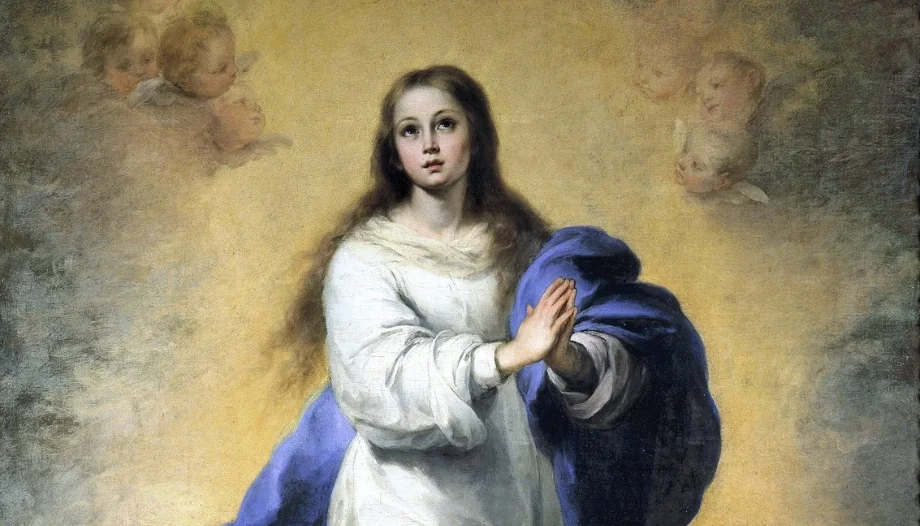
December 8, 2004, will mark the 150th anniversary of that solemn papal act in which Pope Pius IX declared the immaculate conception of the Virgin Mary to be a dogma of faith.
He did so with these words: «With the authority of our Lord Jesus Christ, of the blessed Apostles Peter and Paul, and with our own, we declare, proclaim, and define that the doctrine which holds that the most blessed Virgin Mary was preserved free from all stain of original sin from the first moment of her conception, by a singular grace and privilege of almighty God, in view of the merits of Christ Jesus, Savior of the human race, has been revealed by God and must therefore be firmly and constantly believed by all the faithful.».
Precisely on the occasion of this Marian anniversary, the Spanish bishops have proclaimed a special Year dedicated to the Immaculate Conception, which will last until December 8, 2005.
Pope Pius IX wanted to emphasize the approval of the universal Church and therefore wished that the proclamation of the dogma take place with great solemnity, in the presence of as many bishops as possible.
On December 8, 1854, 53 cardinals, 43 archbishops, and 99 bishops participated in the impressive proclamation ceremony. After the Council of Trent, it was the first time that so many bishops had gathered around the Pope, coming from different continents. In subsequent years, Pius IX would encourage these meetings to strengthen the union of the episcopate with the Roman Pontiff, thus reaffirming the unity of the Church.
The proclamation of the dogma took place during a solemn Mass celebrated in St. Peter's Basilica in the presence of numerous faithful. After the reading of the Gospel, the Veni Creator was sung to invoke the assistance of the Holy Spirit.
Then, with some emotion, the Pope read the decree of definition: «...by the authority of Our Lord Jesus Christ, of the holy apostles Peter and Paul, and by ours, we declare, pronounce, and define that the doctrine according to which the Blessed Virgin Mary was preserved immune from all stain of original sin from the first moment of her conception, by a singular grace and privilege of almighty God, in view of the merits of Jesus Christ, Savior of the human race, has been revealed by God and, therefore, must be firmly and constantly believed by all the faithful.».
«So, if some, God forbid, should presume to think differently from what we have defined, let them learn and know that, condemned by their own judgment, they have shipwrecked themselves outside the faith, abandoning the unity of the Church; and furthermore, if they dare to express these feelings of their hearts in writing or by any other external means, they would ipso facto incur the penalties established by law.».
Those present observed that Pius IX was moved as he read this decree.
Three years later, Pius IX himself, speaking of that moment, said: «When I began to read the dogmatic decree, I felt that my voice was unable to be heard by the immense crowd that filled the Vatican basilica; but when I reached the formula of the definition, God gave the voice of his Vicar such strength and supernatural vigor that it resounded throughout the basilica. And I was so impressed by this divine help that I was forced to interrupt myself for a moment to give free rein to my tears. Moreover, while God was proclaiming the dogma through the mouth of his Vicar, God himself gave my soul such a clear and comprehensive knowledge of the incomparable purity of the Blessed Virgin Mary... that no language can describe. My soul was flooded with unspeakable delights that are not earthly, that can only be found in heaven...».
After reading the dogmatic decree, Pius IX authorized the publication of the bull Ineffabilis Deus—as it had already been drafted—which repeated the dogmatic definition and presented a highly developed theological argument.
On the night of that memorable day, Rome was lit up as on great days to celebrate: «The city was literally a city of fire,» said one witness; «not a balcony, not a window, not a skylight without its lamps. The city's main thoroughfares, the Corso, the Via Papale, and the Ripetta, were rivers of light; the public squares, monuments, and churches seemed to be ablaze. The Capitol sparkled, and outdoor orchestras greeted, on behalf of the Roman people, the triumph of the Queen of Heaven, who is also the Queen of the Church and of Rome. Everywhere there were transparencies, images of the Virgin Mary, inscriptions in her honor; everywhere the motto, Mary conceived without original sin.A huge crowd fills the city; everyone is out on the streets and in the squares, especially in St. Peter's, whose dome rises into the air like a sparkling crown.
A column would soon be erected in Plaza de España to commemorate that dogmatic proclamation. It is adorned with four sculptures of Moses, David, Ezekiel, and Isaiah surrounding the pedestal, which is decorated with two bas-reliefs: one depicts Saint Joseph being warned of the miracle of the Incarnation by an angel during his sleep; the other depicts Pius IX proclaiming the dogma of the Immaculate Conception.
In addition, other monuments will be erected around the world in honor of the event, including churches dedicated to the Immaculate Conception, statues, commemorative plaques, etc.
Lourdes
Four years later, Pius IX's dogmatic proclamation received heavenly confirmation following the apparition of the Virgin Mary in Lourdes. Throughout 1858, the Virgin Mary appeared eighteen times to Bernadette Soubirous. In the fourteenth apparition, on March 25, the Virgin revealed her identity in the dialect of Lourdes: I am the Immaculate Conception.
December 8 will remain engraved in the pontificate of Pius IX, in which there are three key events. Along with the dogma of the Immaculate Conception, the First Vatican Council and the publication of the Syllabus are the cornerstones of his pontificate. Pius IX himself pointed out the continuity of the three events: the dogma was proclaimed on December 8, 1854, the Pope symbolically dated the Syllabus on December 8, 1864, and ordered the inauguration of the First Vatican Council on December 8, 1869.
In his homily during the Mass for the beatification of Pius IX, John Paul II, in addition to highlighting John XXIII's great devotion to Pius IX, emphasized that the new blessed, «amid the turbulent events of his time, was an example of unconditional adherence to the immutable deposit of revealed truths. Faithful to the commitments of his ministry in all circumstances, he always knew how to give absolute primacy to God and spiritual values.».
«His very long pontificate was not easy, and he had to suffer greatly to fulfill his mission in the service of the Gospel. He was much loved, but also hated and slandered. However, it was precisely in the midst of these contrasts that the light of his virtues shone most brightly: his prolonged tribulations tempered his trust in Divine Providence, whose sovereign dominion over human events he never doubted. From this sprang Pius IX's profound serenity, even in the midst of misunderstandings and attacks from many hostile people. He used to say to those around him: ‘In human affairs, it is necessary to be content with doing one's best; in everything else, one must abandon oneself to Providence, which will make up for man's defects and inadequacies.»".
«Sustained by this inner conviction, he convened the First Vatican Council, which clarified with magisterial authority some of the issues then under debate, confirming the harmony between faith and reason. In times of trial, Pius IX found support in Mary, to whom he was very devoted. In proclaiming the dogma of the Immaculate Conception, he reminded everyone that, in the storms of human existence, the light of Christ shines in the Virgin, stronger than sin and death.».
The Immaculate Conception in Scripture
It should be clarified that the immaculate conception of the Mother of God has been defined, not as a theological truth or conclusion, but as a truth revealed by God and supported by Church tradition.
It is not possible to extract direct or strict proof from Scripture. However, there are two groups of texts that deserve different consideration: The first group comprises the texts that have been invoked by defenders of the Immaculate Conception, which we can classify as primary texts. The second group consists of secondary passages that do not constitute direct proof, such as texts from the wisdom books, those referring to figures of the Virgin in the Old Testament, texts from St. John relating to the woman clothed with the sun, etc.
The main texts are found in the Book of Genesis (3:15) and the Gospel of Luke (1:28). The first scriptural passage containing the promise of redemption also mentions the Mother of the Redeemer: «I will put enmity between you and the woman, between your offspring and her offspring: he will crush your head while you lie in wait for his heel.» The sentence after the first sin was accompanied by the first Gospel, which puts enmity between the serpent and the woman.
The seed of the woman who will crush the head of the serpent is Christ; the woman is Mary. God placed enmity between her and Satan, just as there is enmity between Christ and the seed of the serpent. Only Mary's continuous union with sanctifying grace sufficiently explains the enmity between her and Satan. The Protoevangelium directly contains a promise of the Redeemer. And in union with the manifestation of the masterpiece of His Redemption, the perfect preservation of His Mother from original sin.
Another key passage consists of the angel's greeting and that of Saint Elizabeth (Luke 1:28; 1:42). They are spoken by two different characters, who speak in different circumstances, but both do so in the name of God or under the action of the Holy Spirit: «Hail, full of grace, the Lord is with you,» says the angel at the Annunciation; «Blessed are you among women, and blessed is the fruit of your womb.».
Does this fullness of grace and this singular blessing of the Mother of God refer to the privilege of an immaculate conception? The members of the Theological Consultation, instituted by Pius IX in 1848, adopted the same attitude they had taken with regard to the Protoevangelium.
Most proposed it as a valid argument, and those who had not accepted the probative force of the text of Genesis would not accept the words of the angelic salutation as direct and specific proof either. But the Special Commission reasons the arguments for admitting it with unanimous consent, with this precision: The words of the angel would not be sufficient, taken materially, to prove the privilege of the Immaculate Conception; they do prove it, if one takes into account the exegetical tradition of the Holy Fathers.
The passage in the bull referring to the angelic salutation is worded in the same terms. Therefore, the proof that can be deduced from it is inseparably linked to the teaching of the Fathers and ecclesiastical writers. The immaculate conception of Mary is implicitly contained therein, as an element or integral part of that fullness of grace, of that special union with God, of that singular blessing attributed to the Virgin on two counts: for being the mother of the Incarnate Word and for being the new Eve.
There are other secondary texts, such as those referring to the spotless spouse, the holy city, or divine wisdom. We find many passages from the Old Testament, such as the Song of Songs, the Wisdom Books, and the Psalms. These passages, applied to the Mother of God, can be understood by those who know Mary's privilege, but they do not serve to prove the doctrine dogmatically and are therefore omitted by the Constitution Ineffabilis Deus and by the Special Commission. These texts directly proclaim attributes of divinity; when referring to the Virgin, they can be useful for piety and love, but they presuppose prior knowledge of the privilege.
Chapter 12 of the Book of Revelation contains a passage that, at first glance, relates to Mary's glorious privilege: St. John recounts one of his mysterious visions on the island of Patmos: «A great sign appeared in heaven: a woman clothed with the sun, with the moon under her feet, and on her head a crown of twelve stars.» Christian artists have been inspired by this verse to create the finest representations of the Immaculate Virgin. St. Pius X used it in his encyclical Ad diem illum, dated February 2, 1904, on the fiftieth anniversary of the definition. Although these applications do not constitute an authentic interpretation, a simple accommodation is sufficient to justify them. For what is most directly manifested is not so much the Immaculate Conception as the glorification and spiritual motherhood of the new Eve, which are closely related to the Immaculate Conception.
Those who have denied or deny the immaculate conception of the Virgin—Protestants, Greek schismatics, Old Catholics—have also relied on Sacred Scripture to support their opinions. The texts they cite refer to four general points: the universality of sin in the descendants of Adam; the universality of the redemption wrought by Jesus Christ; the universality of death, considered as the effect or punishment of sin; and the condition of the human race in the present order.
It is true that Scripture affirms the universality of sin, redemption, and death, and that the descendants of Adam are subject to them, unless God makes an exception by an act of His free will. For as the supreme Lord, He has the power and the right not to apply the law in a specific case, without thereby compromising the existence of the law itself. This exception must be proven, not simply assumed. But once proven, the Immaculate Conception of the Virgin Mary is not incompatible with the universality of the other laws.
We can therefore conclude that in Sacred Scripture, apart from secondary texts, the Protoevangelium and the angelic salutation, considered within the tradition of the Church, contain the Immaculate Conception of Mary. It is contained in the enmity with the serpent, in the fullness of grace, in the union with God, in the blessing given to Mary, mother of Jesus, closely united to her Son, not only as mother, but also as the new Eve.
In the tradition
In the studies and research that preceded the declaration of the dogma of the Immaculate Conception, the doctrine of the Fathers and writers deserved special attention, given the importance of the faith professed in the Church. The periods are very diverse, and it is not possible for us to dwell on them, but simply to make some general considerations.
In the period from the Council of Nicaea to the Council of Ephesus (325-431), other topics took center stage in literature and controversy. This was the era of the great doctors, and there is abundant Marian literature in the writings of St. Athanasius, Basil, the Gregories, Cyril, and Chrysostom. Apart from the apocrypha, it appears in homilies on the Annunciation and Nativity of the Virgin and in panegyrics or sermons in her honor.
The Fathers concentrated their efforts on controversies against heretics regarding the mysteries of the Trinity and the Incarnation, because these were the most attacked. That is why they spoke about the Virgin Mary in discourses on the various circumstances of her life. In the Latin Church, St. Ambrose and St. Augustine stand out. Both in the East and in the West, we find certain truths continually reaffirmed, including the implicit experience of the Immaculate Conception. One of these is the holiness of the Blessed Virgin: we would be obliged to transcribe a multitude of passages.
But there are two points that stand out in the testimony of the Fathers: Mary's absolute purity and her position as the second Eve.
In both Eastern and Western writings, we find the antithesis of Eve in various forms. St. Jerome sums it up succinctly and familiarly: «Death through Eve, life through Mary.» St. Ambrose often highlights the roles of Eve and Mary and the virginal nature of the latter, which has since been passed down in literature.
The doctrine of the two Eves is very present in the Fathers, although most are content to state the traditionally repeated antithesis: from Eve, death and expulsion; from Mary, life and salvation. Certainly, Mary is always considered in relation to the Word, from which relationship they draw wonderful consequences. Even Nestorius, a fierce enemy of Mary's divine motherhood, excludes Mary from original sin. He affirms that through her came blessing and justification to the human race, just as through Eve came the curse. This opposition between Eve and Mary, the birth of Christ from sinless flesh, deserves special attention.
Nestorius continues the parallel between the two mothers of humanity. The first gives birth in pain, a pain that is common to all who give birth, daughters of Eve, suffering from original sin. For the second, Mary, God has prepared a painless birth. Mary is the new mother, but a virgin mother, whom God has given to human nature. The condemnation pronounced against Eve has been destroyed by the angel's greeting to Mary. To Eve, the pains and groans, fruits of sin; to Mary, the joy, fruit of the grace with which she is filled.
Patristic writings abound on the absolute purity of Mary, using the most expressive terms. Didymus of Alexandria affirms her absolute virginity with these expressive words, which are like a definition: «Immaculate virgin always and in everything.» When they speak of perfect virginity, they are not referring only to physical integrity, but also to the integrity of spirit and soul: Mary, always a virgin, would also be Mary, always holy.
An ancient text, dated by some to the fourth century and by others to the fifth century, contains expressions that have been widely used and exploited by defenders of the Immaculate Conception. It contains the following reasoning: The first man had been created and formed from immaculate earth, so it was necessary for the perfect man to be born of the immaculate virgin.
It is impossible to cite all the authors and works in which the Fathers express their thoughts. A few expressions that demonstrate their conviction will suffice. The Fathers call Mary the tabernacle free from profanation and corruption. Origen calls her worthy of God, immaculate of the immaculate, the most complete holiness, perfect justice, neither deceived by the serpent's persuasion nor infected by his poisonous breath.
St. Ambrose says that she is incorrupt, a virgin immune by grace from every stain of sin. Refuting Pelagius, St. Augustine declares that all the righteous have truly known sin «except the Blessed Virgin Mary, of whom, for the honor of the Lord, I would not question anything concerning sin.».
The Syrian Fathers never tired of praising Mary's impeccability. St. Ephrem did not consider certain terms of praise excessive when describing the excellence of Mary's grace and holiness: «The Most Holy Lady, Mother of God, the only one pure in soul and body, the only one who exceeds all perfection of purity, the only dwelling place of all the graces of the Most Holy Spirit, and therefore exceeding all comparison even with the angelic virtues in purity and holiness of soul and body... my most holy Lady, most pure, without corruption, inviolate, immaculate pledge of Him who clothed himself with light and pledge... unfading flower, purple woven by God, the only immaculate one.» For St. Ephrem, she was as innocent as Eve before the fall, a virgin far from any stain of sin, holier than the seraphim, seal of the Holy Spirit, pure seed of God, forever intact and without stain in body and spirit.
Many other testimonies could be cited. In all of them, it is clear that the belief in Mary's immunity from sin at her conception prevailed among the Fathers, especially those of the Greek Church. But the rhetorical nature of these and similar passages warns us against overly forced tendencies and interpretations in a strictly literal sense. The Greek Fathers never formally or explicitly discussed the question of the Immaculate Conception.
Council of Ephesus
It is unquestionable that the Council of Ephesus had a considerable influence on Marian worship and theology. By solemnly proclaiming that the Virgin Mary was truly the mother of God, it drew the attention of doctors to the sublime dignity expressed by this title. That is why magnificent praises, graceful comparisons, and endless litanies of laudatory epithets proliferate in preaching and writings.
At the same time, Marian devotion progressed rapidly: feasts in honor of the Virgin spread throughout the Eastern world. The feast that seems to have inaugurated the cycle, the feast of the Annunciation, has been celebrated since the fifth century in Jerusalem, Constantinople, and other cities, although it was not until the middle of the sixth century that the date of March 25 was set for its celebration.
From the long series of texts from these centuries and the following ones, it can be concluded that since the Council of Ephesus, not only has the Catholic dogma of the Immaculate Conception been formulated implicitly, but faith in it has been explicitly manifested with sufficiently clear expressions. They have expressed it with positive rather than negative formulas. Instead of saying «Mary has been preserved from original sin,» they say, «Mary is full of grace, fully sanctified from her appearance in her mother's womb. She is a new creature, created in the likeness of innocent Adam.».
The period from the Council of Ephesus to the definitive separation of the Eastern Church (1054) is characterized by a tendency to conceive of and insist on the divine motherhood, holiness, and fullness of grace proper to the Virgin Mary. Conditions differed between East and West: doctrine developed rapidly and vigorously in the East, but slowly and indecisively in the West. This can be explained by two main causes: the imbalances and instability caused by invasions in Latin countries, and the reaction of theology in its struggle against Pelagianism.
Nevertheless, testimonies exist and reveal an explicit belief in the immaculate conception. The doctrinal development coincides with the cultural development that is manifested above all in the introduction of feasts in honor of the Virgin. The feast of the Immaculate Conception is not one of the first, as it appears at the end of this period, but it is remarkable in itself and above all in the influence it was to exert in the affirmation and propagation of this pious belief.
Postesino parents
Among the testimonies of the post-Eusebian Latin Fathers, there are both positive and negative ones regarding belief in the immaculate conception. The negative ones are found mainly in St. Augustine and among his disciples, as they are inspired solely, or almost solely, by the Saint's anti-Pelagian writings. Understandably, in these writings St. Augustine rejects and refutes Pelagian doctrines and must reaffirm the universality of original sin and the connection between human generation and conception in sin.
There are other positive testimonies favorable to the belief in the Immaculate Conception, either because they prepare the way for a pious transcendent notion of the mother of God, or because they already contain the belief in the immaculate conception. For them, Mary is the new Eve, the instrument of our salvation and the mother of the living in the order of grace. Little by little, the idea of holiness or perfect and perpetual innocence appears intimately linked to that of Mary, mother of God.
In the second half of the 11th century and early 12th century, the great controversy over the Immaculate Conception was brewing, which would unfold over the next two centuries. Provoked by the development of the feast of the Conception, the debate focused mainly on the object of the feast itself and the beliefs it implied. The problem was addressed with clarity and depth, with objections raised on the merits of the issue. As a result, the triumph of pious belief prevailed and gradually became complete and definitive.
Some writers and saints argued that the words of Scripture should apply to everyone except the Savior: "In wickedness I was formed, and in sin my mother conceived me." They contrasted the flesh of Christ the Savior with that of Mary, since one was conceived without sin and the other in sin.
But then the great initiator and doctor, Saint Anselm, Archbishop of Canterbury, appears and responds to this objection. Since Christ is God and He reconciles sinners by His own virtue, He must be free from all sin, which means affirming that He comes from a sinful mass, but freed from sin. Despite recognizing the mystery, in the face of his adversaries' insistence, Saint Anselm proposes an explanation that will become part of later doctrine.
The fruits of redemption do not only extend to those who have lived after the Savior, but also to those who lived before him, who should benefit from faith in the future redeemer by being purified of their sins. Thanks to this act of faith, the Virgin was purified by an anticipatory application of her Son's merits, and it is from the purified Virgin that Christ was conceived. The particular and privileged purification of the Virgin Mary is an anticipatory application of the merits of her Son, the one and universal Redeemer.
The controversy arose—taking into account the previous doctrines—when the Feast of the Immaculate Conception was celebrated again in England. It had been celebrated before the Norman conquest, but had declined until it disappeared. However, opposition to the feast and the doctrine arose when Anselm the Younger, nephew of St. Anselm, and others wanted to restore it, provoking lively recriminations: opponents of the feast declared that it had no raison d'être. The outcome of the controversy was important for the feast, but also for belief in Mary's privilege. To respond to the objections of those who contradicted the legitimacy of this cult, its defenders made an effort to promote and explain why and under what concept they considered the mother of God worthy of veneration. In doing so, they affirmed the purity and original holiness of the Blessed Virgin Mary.
The controversy in the West is like an extension of the previous one, caused by the same issue, but with greater resonance due to the status and renown of the individuals involved. Among the claims made by the English, it was said, with much evidence, that the festival was celebrated on the continent as it was in England.
The movement of expansion reached Lyon, and the canons of the primatial see adopted the feast, prompting the intervention of St. Bernard. For some time he remained silent, with a certain impatience, out of consideration for the piety of those who venerated her in the simplicity of their hearts and out of love for the Virgin. But he thought that the time had come, and around 1138 he wrote his famous Letter to the canons of Lyon.
After praising his primatial see, he prepares his attack. He protests against what he considers a bad innovation and a reprehensible acceptance of a strange solemnity in the Church, lacking rational foundation and not supported by ancient tradition. He maintains that Mary was sanctified in her mother's womb before she was born, because her birth and she herself were also holy. But Mary cannot be holy before she exists, and she does not exist before she is conceived.
Therefore, if the Virgin could not have been sanctified before her conception, because she did not yet exist at the moment of her conception, because she was affected by sin, we must admit that she received the gift of holiness after her conception, when she already existed in her mother's womb. Her birth is holy, but not her conception. Consequently, if holiness is lacking in Mary's conception, she cannot be an object of worship.
The intervention of such an important figure as the abbot of Clairvaux could not go unnoticed and sparked a long controversy, which has come down to us in numerous writings defending the feast of the Conception. The affirmation of the glorious privilege gained ground and increased the number of its supporters, who defended the feast of the Immaculate Conception. It can be said that in the 12th century, the conception of Our Lady was celebrated in many places.
In the 13th century
We arrive at the critical point of the controversy in the 13th century. Theologians of this century usually address the problem in relation to the sanctification of Mary, and also in relation to the feast of the Conception: when does the first sanctification of the mother of God take place, before or after the animation by the infusion of the soul into a capable body? These two moments, before animation and after animation, are broken down into many other points and questions. Everyone agrees to admit sanctification after animation, since God could not deny his mother the privilege he had granted to Jeremiah and St. John the Baptist.
Franciscan theologians consider Alexander of Hales and St. Bonaventure to be their principal teachers. Alexander of Hales (d. 1245) summarizes his doctrine in four points, which in turn break down and encompass many other issues: The Blessed Virgin was not sanctified before her conception; the Blessed Virgin was not sanctified at the moment of her conception; the Blessed Virgin could not have been sanctified after her conception and before the infusion of the soul; therefore, we must admit that the Blessed Virgin was sanctified after the union of body and soul, but before her birth.
Saint Bonaventure (d. 1274), professor in Paris from 1248 to 1255, teaches essentially the same doctrine as his master, but treats the sanctification of the flesh and the soul separately, and reduces the questions. Mary's soul would have been sanctified at the very moment of its creation, and therefore would not have contracted original sin. She has been freed by Jesus Christ, but not like the others, for while all the others have been pulled out of the precipice into which they had fallen, the mother of God has been held at the very edge of the precipice so that she would not fall. Mary owes her exemption from original sin to the grace that depends on and comes from the Savior. But, despite the above statements, when referring to the body and the whole person, he affirms that the Virgin was not sanctified until after she had contracted original sin.
At the end of his life, Alexander of Hales acknowledged this glorious privilege and composed a treatise in its favor. St. Bonaventure, elected Minister General of the Friars Minor, did the same, instituting the feast of the Conception for his Order at the chapter in Pisa in 1263. The Franciscan theologians and disciples who taught in Paris during the 13th century repeated the doctrine of these two masters, and none of them accepted or defended the doctrine of the Immaculate Conception.
Among Dominican theologians, St. Albert the Great (d. 1280), professor in Paris from 1245 to 1248, stands out. He addresses this question in two articles: Was the Blessed Virgin Mary sanctified before or after she was conceived? The answer is clear: Mary could not have been sanctified before her conception. The Virgin was conceived like other mortals; the grace of sanctification cannot come through the flesh, but rather the flesh participates in sanctification through the soul, which is distinct from the flesh.
And the question arises again: was the flesh of the Virgin sanctified before or after animation? St. Albert rejects the hypothesis of sanctification prior to animation, already condemned by St. Bernard in his letter to the canons of Lyon and by the theologians of Paris. The flesh itself has no capacity to receive sanctifying grace; there can be no sanctification before animation.
The debate continued throughout the 13th and 14th centuries, with illustrious names lining up on both sides. Saint Peter Damian, Peter Lombard, Alexander of Hales, Saint Bonaventure, and Albertus Magnus are cited in opposition.
St. Thomas first spoke in favor of the doctrine in his treatise on Sentences (in 1 Sent. c. 44, q. 1 ad 3); however, in his Summa Theologica he came to the opposite conclusion. Many discussions have arisen either in favor of or against St. Thomas, denying that the Blessed Virgin was immaculate from the moment of her animation, and books have been written to deny that he reached that conclusion. Nevertheless, it is difficult to say that St. Thomas did not consider, at least for a moment, the subsequent animation of Mary and her prior sanctification. This great difficulty arises from the question of how she could have been redeemed if she did not sin. He expresses this difficulty in at least ten passages of his writings. But even if St. Thomas retained this as essential to his doctrine, he himself provided the principles which, after being considered together and in relation to these works, gave rise to other thoughts that contributed to the solution of this difficulty from his own premises.
In the 13th century, opposition was largely due to a desire to clarify the subject under dispute. The word «conception» was used in different senses, which had not been separated from the definition. If St. Thomas, St. Bonaventure, and other theologians had known the meaning of the 1854 definition, they would have defended it firmly against their opponents. We can formulate the question discussed by them in two propositions, both contrary to the meaning of the 1854 dogma: Mary's sanctification took place before the infusion of the soul into the flesh, so that the soul's immunity was a consequence of the sanctification of the flesh and there was no risk on the part of the soul of contracting original sin. Sanctification took place after the infusion of the soul for redemption from the bondage of sin, which the soul carried from its union with unsanctified flesh. This formulation of the thesis excludes an immaculate conception.
Theologians forgot that between sanctification before infusion and sanctification after infusion there was a middle ground: sanctification of the soul at the moment of infusion. They seemed oblivious to the idea that what was subsequent in the order of nature could be simultaneous at a point in time. Speculatively considered, the soul would be created before it could be infused and sanctified, but in reality the soul is created and sanctified at the very moment of infusion into the body. Their main difficulty was St. Paul's statement that all men have sinned in Adam. The implication of this Pauline statement, however, insists on the need that all men have for Christ's redemption. Our Lady was no exception to this rule.
A second difficulty was the silence of the early Fathers. But the theologians of that time were distinguished not so much by their knowledge of the Fathers or of history, but by their exercise of the power of reasoning. They read the Western Fathers more than those of the Eastern Church, who expounded more extensively on the tradition of the Immaculate Conception. And some works of the Fathers that had been forgotten became relevant at this time.
Doctor Subtilis
The famous Duns Scotus, Doctor Subtilis, defender of the Immaculate Conception, was born in Scotland in 1265 or 1266. He entered the Franciscan Order and studied theology under William Ware, one of the most passionate defenders of the Immaculate Conception. Scotus succeeded his teacher in the chair at Oxford and here began to defend the Immaculate Conception. From Oxford he went to Paris and obtained his doctorate and teaching qualification at the Sorbonne. His teacher, Ware, had also taught in Paris, but does not seem to have had the opportunity to publicly defend Mary's privilege. It was Scotus who drew the most attention to the Immaculate Conception and prevailed. This was in the early 1300s. A few years later, a determined opponent of the Virgin's privilege, the Dominican Gerard Renier, called Scotus «the first sower of this error» (referring to the opinion defending the privilege of the Virgin Mary). This was in 1350.
Regarding the influence that Scotus had on the triumph of the doctrine of the Immaculate Conception, a story later became popular about a remarkable dispute held in Paris by order of the Holy See and in the presence of its delegates. Its purpose was to dispel the doubts that were accumulating in theological schools against the distinguished privilege of the Mother of God.
Bernardino de Bustis, in the liturgical office he composed in honor of Mary Immaculate, approved by Sixtus IV in 1480, expresses it this way: «There was a time when certain religious figures were so enraged against the Immaculate Conception that they called the Franciscans heretics because in their preaching they defended that the Virgin had been conceived without sin. By order of the Holy See, a public dispute was held at the Sorbonne. The accusers took part in the discussion with a large number of doctors. But our Lord, in order to protect the dignity of his beloved Mother, unexpectedly sent Scotus, an eminent doctor of the Franciscan Order, to this meeting. He refuted all the foundations and arguments of the adversary with irrefutable reasoning. In doing so, he shed such light on the sanctity of the Virgin's conception that all those friars, filled with admiration for his subtlety, fell silent and ceased the discussion. As a result, the opinion of the Franciscans was approved by the Sorbonne, and Scotus was called the »subtle doctor.".
This discussion took place at the end of 1307 or the beginning of 1308. Scotus had come to Paris expressly from Oxford. When the day of the Sorbonian event—as the discussion was called—arrived, while Scotus was on his way to the place of discussion, he knelt before an image of the Virgin Mary that stood in his path and addressed this prayer to her: «Grant me that I may praise you, holy virgin: give me strength against your enemies.» The Virgin, as if in gratitude for this act, bowed her head: a position she has retained ever since.
Once the discussion began, Escoto's opponents launched a barrage of arguments against him; it is said that there were more than two hundred. Escoto listened to them all attentively, but with a calm expression on his face. When his opponents fell silent, he began to refute their arguments, rebutting them one by one in the same order in which they had been presented. The result of that discussion was not only the Sorbonne's approval of the immaculate conception, but also the university's adoption of the corresponding feast day and the denial of academic degrees to those who dared to express a contrary opinion.
Francisco Mayroni, a disciple of Scotus, summarized his teacher's argument as follows: «God was able to preserve Mary from sin: it was fitting that he should do so: therefore, he did so.».
Scotus laid the foundations of true doctrine so solidly and dispelled doubts so satisfactorily that henceforth the doctrine prevailed. He showed that sanctification after animation required that it be carried out in the order of nature, not of time; he resolved St. Thomas's great difficulty by showing that far from being excluded from redemption, the Blessed Virgin obtained from her Divine Son the greatest of redemptions through the mystery of her preservation from all sin. He also introduced, by way of illustration, Eadmer's dangerous and dubious argument: «decuit, potuit, ergo fecit.».
The controversy
Since the time of Scotus, the doctrine not only became common opinion in universities, but the feast spread throughout those countries where it had not previously been adopted. With the exception of the Dominicans, all or almost all religious orders adopted it: the Franciscans, at the General Chapter of Pisa in 1263, adopted the Feast of the Conception of Mary throughout the Order; this, however, does not mean that they professed the doctrine of the Immaculate Conception at that time. Following in the footsteps of Duns Scotus, his disciples Peter Aureolo and Francis of Mayrone were the most fervent defenders of the doctrine, even though their former teachers (including St. Bonaventure) had opposed it.
The controversy continued, but the defenders of the opposite opinion were mostly members of the Dominican Order. In 1439, the dispute was brought before the Council of Basel, where the University of Paris, previously opposed to the doctrine, proved to be its most ardent defender and requested a dogmatic definition. The two speakers at the council were Juan de Segovia and Juan Torquemada. After two years of discussion before the assembly, the bishops declared the Immaculate Conception to be a pious doctrine, in accordance with Catholic worship, Catholic faith, rational law, and Sacred Scripture; from now on, they said, it was not permitted to preach or declare anything contrary to it. The Fathers of the council said that the Church of Rome was celebrating the feast. This is true only in a certain sense. It was observed in some churches in Rome, especially those of religious orders, but it was not adopted in the official calendar. Since the council at that time was not ecumenical, it could not speak with authority. The memorandum of the Dominican Torquemada served as armor against all attacks on the doctrine made by St. Anthony of Florence and by the Dominicans Bandelli and Spina.
By a decree dated February 28, 1476, Sixtus IV finally adopted the feast for the entire Latin Church and granted an indulgence to all who attended the Divine Offices of the solemnity. The Office adopted by Sixtus IV was composed by Bernardo de Nogarolis, while the Franciscans used a beautiful Office penned by Bernardino de Busti from 1480 onwards, which was also granted to others (e.g. in Spain, 1761) and was sung by the Franciscans until the second half of the 19th century. As Sixtus IV's public recognition of the feast did not sufficiently calm the conflict, he published a constitution in 1483 in which he punished with excommunication anyone whose opinion was accused of heresy. In 1546, when the question was addressed, the Council of Trent declared that «it was not the intention of this Holy Synod to include in a decree anything concerning the original sin of the Most Holy and Immaculate Virgin Mary, Mother of God.» Since this decree did not define the doctrine, theologians opposed to the mystery, although few in number, did not give up. St. Pius V not only condemned Bayo's proposition 73, according to which «none other than Christ was without original sin and, moreover, the Blessed Virgin died because of the sin contracted in Adam and suffered afflictions in this life, like the rest of the righteous, as punishment for actual and original sin,» but also published a constitution prohibiting all public discussion. Finally, he inserted a new and simplified Office of the Conception into the liturgical books.
While these disputes lasted, the great universities and most of the major orders became bastions of the defense of dogma. In 1497, the University of Paris decreed that henceforth no one would be admitted as a member of the university who did not swear to do everything in their power to defend and uphold the Immaculate Conception of Mary. Toulouse followed suit, as did Bologna and Naples in Italy; Cologne, Mainz, and Vienna in the German Empire; Leuven in Belgium; Oxford and Cambridge in England before the Reformation; Salamanca, Toledo, Seville, and Valencia in Spain; Coimbra and Évora in Portugal; and Mexico City and Lima in the Americas.
In 1621, the Friars Minor confirmed the choice of the Immaculate Mother as patroness of the Order and pledged under oath to teach the mystery in public and in private. The Dominicans, however, felt a special obligation to follow the doctrines of St. Thomas, and St. Thomas's common conclusions were opposed to the Immaculate Conception. The Dominicans, therefore, claimed that the doctrine was an error against the faith. Although they adopted the feast, they persistently spoke of the «Sanctification of the Virgin Mary,» not of the «Conception,» until in 1622 Gregory V abolished the term «sanctification.» Paul V (a. 1617) decreed that it should not be publicly taught that Mary was conceived in original sin, and Gregory V (a. 1622) imposed absolute silence, both in writings and in sermons, even if private, on the opponents of the doctrine, until the Holy See defined the question. To put an end to all further speculation, Alexander VI promulgated the famous constitution Sollicitudo omnium Ecclesiarum on December 8, 1661, defending the true meaning of the word conception and prohibiting any further discussion against the common and pious sentiment of the Church. He declared that Mary's immunity from original sin at the first moment of the creation of her soul and its infusion into her body were objects of faith.
Towards the definition
We come to the final period, characterized by the definitive triumph of the Immaculate Conception during the pontificate of Pius IX. But before that, in the first half of the 19th century, especially from 1830 onwards, a series of particular events took place. From 1800 to 1830, during the pontificates of Pius VII and Leo XII, actions in favor of the Marian privilege were rare, although there are some specific details.
Cardinal Mauro Capellari, a Camaldolese monk, was elected pope on February 2, 1831, and took the name Gregory XVI (1831-1846). From the beginning, he was favorable to the privilege of the Virgin Mary. In the first year of his pontificate, at the request of the Franciscans of Santa Fe de Bogotá, he granted indulgences to the faithful who attended the Mass of the Immaculate Conception in the church of these religious, honoring the Mother of God «conceived without sin,» and in 1834 he confirmed the foundation of the Society of Mercy in the expression of Mary «immaculate in her conception.».
Supporters of the definition felt encouraged to insist on their demands. A wonderful event had occurred that encouraged them to resume that path and shed supernatural light on that belief.
Requests from bishops
The first requests that were made did not seek to define the privilege, but rather to obtain authorization to say in the preface to the feast: Et te in conceptione immaculata. The request from the Cardinal of Seville was followed by no fewer than 211 petitions, which gave the same reasons as those set out by the Cardinal in his letter to Monsignor Quélen: «Considering that the pontifical concessions granted thus far refer to the worship given to Mary in the choral office and other ordinary tributes, and that the faithful cannot take part in them to honor the Blessed Virgin, and that the Christian people justly demand that the simple faithful be offered the means to exercise this pious worship; and I see that one means that can serve this purpose is to add this praise and invocation to the litany of Our Lady: Regina sine labe concepta, ora pro nobis.» This movement spreads, and many bishops, superiors of religious orders, rectors of particular churches, etc., request the same favor., also to introduce it into the preface of the Mass. Both requests were heard and granted at the same time to several bishops between April 1844 and May 1847. In 1843, Cardinal Lambruschini, Secretary of State to Gregory XVI, published a controversial dissertation on the Immaculate Conception. The author summarized the evidence for the privilege: expediency, Sacred Scripture, pontifical acts, testimonies of the Fathers, and the doctrine of theologians, especially the common consent of the faithful, presented as a guarantee of certainty and as preparation for the formal definition, which he declared possible, useful, and expedient. He also cited the wonderful spread of the miraculous medal and the conversions that had taken place. This dissertation was translated into the main languages and had a great impact in Catholic circles.
Gregory XVI was in favor of a solemn pronouncement, but he deferred to circumstances. In a letter addressed to the bishop of La Rochelle, he said that «nothing would be more pleasing to him than to proclaim with solemn judgment the Immaculate Conception of the holy Mother of God,» but that he had not done so for reasons of extreme prudence dictated by circumstances.
Fears and apprehensions about possible complaints, in the event of a solemn sanction of privilege, were not unfounded, particularly on the part of Germany. In France, there was silent opposition among Jansenist or Jansenist-leaning circles and among a certain number of Gallicans, although this opposition became more vocal later during the pontificate of Pius IX.
Pius IX
Giovanni Maria Mastai Ferretti was elected Pope on June 16, 1846, and took the name Pius IX, in memory and recognition of Pius VII, whom he had succeeded as bishop of Imola and to whom he owed his ordination as a priest. Personally, he was one of those who defended the privilege of the Virgin Mary. It was a great honor for him to ratify a notable sign of devotion to the Immaculate Virgin that the bishops of North America, gathered in Baltimore for a provincial council, had decided, with enthusiasm and unanimity, to acclaim the Blessed Virgin Mary, conceived without sin, as patroness of the United States of America. Other pontifical acts reinforce the good dispositions of the Pontiff.
Between July 1846 and May 1847, the bishops continued to ask for a double favor: to insert the epithet Immaculate into the preface of the Mass and the invocation Queen conceived without sin into the litanies. At the same time, there were numerous requests for a definition between 1846 and 1848, in addition to those that had already been made during the pontificate of Gregory XVI. It was a great joy for the new Pope to receive a hundred petitions from bishops from various parts of the world, apostolic vicars, superiors of religious orders, and others from the King of the Two Sicilies, with a personal request from Ferdinand II, King of Naples.
Before these requests reached Rome, Pius IX had already expressed his feelings: signed by himself, a decree of the Sacred Congregation of Rites, dated September 30, 1847, authorized an Office entirely dedicated to the Immaculate Conception of Mary, with Mass for the feast day and during the octave.
In that same year, 1847, Father Juan Perrone, prefect of studies at the Roman College, published a paper entitled Disquisición teológica (Theological Disquisition), in which he examined «whether the Immaculate Conception of the Blessed Virgin Mary could be the subject of a dogmatic definition.» After a first historical-critical part, in which he summarizes the history of the controversy and its many phases, he raises and discusses the real value of the arguments brought forth both for and against the privilege. He comes to the following conclusion: nothing truly contrary to this privilege is found in Sacred Scripture, nor in the Holy Fathers, nor in the ancient ecclesiastical writers, nor in liturgical documents, nor in the acts of councils or Roman pontiffs, nor in theological reasons; the clearly opposed testimonies belong to the period of the controversy. On the contrary, both Sacred Scripture and tradition from the early centuries bear positive witness to the existence of this belief.
In the second part, theological-critical, after examining the conditions required for a doctrine to be the subject of a dogmatic definition and how they were fulfilled in this case, he investigates the written or transmitted revelation and finds sufficient reasons to issue a pontifical decree on the Immaculate Conception as a dogma of faith.
Pius IX begins the process that will culminate in the dogmatic proclamation of December 8, 1854. On June 1, 1848, he establishes a commission of theologians charged with examining this question. It is composed of 20 members: prelates belonging to Roman congregations, superiors general of various religious orders, and renowned teachers.
During his stay in Gaeta, on December 6, 1848, he had appointed a commission of eight cardinals and five consultants to meet in Naples under the presidency of Cardinal Lambruschini and thus constitute a preparatory congregation. It was held on December 22. The deliberations focused on two questions: The first concerned whether, in view of the requests of the bishops of the Catholic world and of Ferdinand II, it was advisable for the Holy Father to declare that the Blessed Virgin Mary had enjoyed the special privilege of having been conceived without original sin. The second concerned whether, in the current circumstances, it was appropriate for His Holiness to proceed with such a declaration.
After discussing the matter, all the members present answered affirmatively to the first question, while there was no unanimity on the second and it was delayed, advising His Holiness to address an encyclical to the bishops of the whole world to ask for prayers in view of the definition and also to invite them to give their opinion on the opportunity. Those consulted were asked to respond to the following five points: Whether they found that the Church of our day demands a dogmatic definition of the Immaculate Conception of Mary; whether the Church, spread throughout the world since apostolic times, has admitted the privilege, excluding any shadow of original sin, following the doctrine explicitly held by the early apologists who have dealt ex professo with this subject; what the Old Testament offers in favor of or against the Immaculate Conception, if it says anything at all; what the New Testament also says; whether the data that can be gathered from an examination of the Greek-Oriental and Latin texts of the third century and immediately following, and of others up to the present day, allow us to affirm the pious belief of the Church in the Immaculate Conception of the Virgin Mary.
The answers to the first two questions and the last question were affirmative. Those referring to Sacred Scripture required further study. A consultant was tasked with studying the mode of definition, choosing a definition in positive form and with anathema, in a dogmatic bull with the usual formalities, which would be published at the appropriate time and place.
The encyclical «Ubi Primum»
Pius IX endorsed the measures suggested by the members of the preparatory congregation. From Gaeta, where he was staying, he issued the encyclical Ubi primum on February 2, 1949. He informed the bishops of his decision to submit the Immaculate Conception to a definitive examination. To this end, he had appointed a commission of theologians and instituted a cardinal congregation, from which he expected to receive the results of the investigation. With this same purpose in mind, he asked all the bishops to pray in their dioceses to implore God's enlightenment in order to make the right decision and bring this matter to a successful conclusion. «We earnestly desire,» he told them, "that you let us know as soon as possible what the sentiments of the clergy and the people in your diocese are regarding the conception of the Immaculate Virgin and to what extent you think the question should be settled by the Apostolic See; we wish to know above all what you, in your wisdom, think should be done in this matter." This was followed by a general authorization, if he deemed it appropriate, for his priests to pray the Divine Office proper to the Immaculate Conception, as he had already granted to the priests of the diocese of Rome.
What was the outcome of this «written council»? The responses received were edited into ten volumes with the following result: of the 603 bishops, 593 responded in writing to the Pope, of whom only eight stated that such a belief could not be defined theologically, although two were not entirely sure about this. More numerous were those who, while declaring their faith in this belief, considered the dogmatic definition inappropriate (these were 35, among whom was Cardinal Pecci, Archbishop of Perugia, the future Leo XIII) or were doubtful (48 bishops). As can be seen, the vast majority of bishops were in favor of proclaiming the dogma. The largest group of bishops had simply accepted the proposed definition, also testifying that they considered the privilege to be more or less implicitly contained in the deposit of Revelation. Some had elaborated on this point, either in their letters to the Pope or on this occasion in lectures or speeches on the Immaculate Conception. The majority defended the timeliness of a definition, and then explained its convenience, advantages, and even moral necessity.
The bishops' responses, together with the work of the theologians of the commission and the preparatory congregation, formed an extensive dossier to be used by those responsible for drafting the bull of definition.
Special congregation to draft the bull of definition (between May 10, 1852, and August 2, 1853).
The almost unanimous response from bishops around the world reaffirmed Pius IX's intention to finally define this universally held belief. Nor can it be said that he acted hastily. Six years and six months had passed between the creation of the first theological advisory commission on the subject and the promulgation of the bull of dogmatic definition. No fewer than four different commissions, both cardinal and theological, had examined the question from three angles: the definition of the belief, the appropriateness of its definition, and the dogmatic wording.
In agreement with those who thought it appropriate to attach to the dogmatic definition an exposition of the foundations and evolution of the belief in the Church, he devoted himself in March 1851 to the preparation of a papal bull. At the Pope's request, the Jesuit priest Giovanni Perrone had drafted a first draft of the definition in 1850. This text was submitted for review by sixteen theological consultants, followed by seven other drafts. Pius IX was convinced of the revealed nature of the doctrine of the Immaculate Conception, since it had been an object of faith in the universal Church for several centuries. But he also wanted the definition to respond to the theological objections of the doctrine's opponents.
Another outline follows, probably the work of Passaglia, which was novel in that the definition was accompanied by an explicit condemnation of modern errors. This second outline, like the first, was never used. Pius IX, determined to broaden the discussion, instituted a special congregation of twenty theologians on May 10, 1852, under the presidency of Cardinal Fornari. It began its work from the ground up, proposing the most fundamental questions: what characteristics or indications should a proposition have in order to be considered worthy of receiving a solemn judgment from the Catholic magisterium, what should be its wording in positive and negative terms, what were the implicit and explicit testimonies of Sacred Scripture and Tradition, the connection with other dogmas, the teaching of the episcopate, the piety of the faithful, etc. Considerations on the timeliness and appropriateness were added as a conclusion.
As a result of this work, it was decided to use convenience, Sacred Scripture, patristic tradition, the feast of the Conception, and the sentiment of the universal Church as evidence in the bull. Some explanatory notes were added to clarify the arguments proposed and resolve objections from a scriptural and patristic point of view.
Discussion of the text of the bull (March 22 to December 4, 1854)
The new outline, the third, contains what has essentially remained in the final draft, but with a form and order that has given rise to numerous modifications: the text was revised and refined six times. There were many reviewers: consulting theologians, cardinals convened on March 22, 1854, in a consultative congregation, archbishops or bishops present or summoned to Rome to form a commission from November 20 to 24 under the presidency of Cardinals Brunelli, Caterini, and Santucci. Some of these revisions are worth highlighting because they shed light on the drafting of the bull Ineffabilis, and especially on the meaning and context of the dogmatic definition of December 8.
In the first three drafts, the testimonies of the Fathers and ecclesiastical writers were explicitly and extensively recorded and cited; they were removed in the fourth draft, but appear in the following drafts in footnotes alongside their cited writings. In response to the observation made by a cardinal that, written and cited in this way, the bull resembled more a polemical or scholastic dissertation, the references were removed. More generic terms were used, which required a great deal of research, regrouped in a logical and systematic order, to conclude that constantem fuisse et esse catholicae Ecclesiae doctrinam. All of this was reflected in the eighth draft and in the final version.
Dom Guéranger actively participated in all this preparatory work. Pius IX had great esteem for the reformer of Solesmes, because he truly cooperated in bringing the French dioceses back to the Roman liturgy. The Pope asked him to study the subject of the definition. In April 1850, Dom Guéranger had completed an important Memoir on the Immaculate Conception, which was greatly appreciated by Pius IX, and at the end of 1851, the Pope sent him to Rome to remain there for some time. He had decided to appoint him as a consultant to the Congregation of Rites and the Index, because he appreciated his intellectual capacity and the firmness of his doctrine.
During his stay in Rome, Dom Guéranger met and was received on several occasions by Pius IX and was also asked to carry out various doctrinal tasks. He was asked to revise his Memoir, and in January 1852 he was entrusted with the drafting of the bull of dogmatic definition. As we have seen, other projects had already been undertaken, such as those of Fr. Perrone and Fr. Pasaglia, which had been deemed unsatisfactory. Those projects by the Jesuit Fathers were now joined by that of a Benedictine.
Dom Guéranger worked diligently, and on January 30 he presented the Pope with a new draft of the bull, which initially satisfied Pius IX, but to which the Pope added numerous clarifications. Then, on February 27, he requested a complete revision of the draft, because he wanted the bull of dogmatic definition to also solemnly condemn the great contemporary philosophical and theological errors. An article had just appeared in Civiltà Cattolica, which the Pope had prepared with the Jesuits, suggesting that the proclamation of the dogma be combined with the condemnation of errors.
On the 29th, Pius IX received Dom Guéranger. The latter openly and vigorously expressed to the Pope his opposition to the plan to include the condemnation of errors in the bull, and suggested that two separate and distinct texts be drafted. But Pius IX explained to the abbot of Solesmes that he was very keen to combine the proclamation of the privilege of the Immaculate Conception with the other proclamation, rejecting the errors he considered contrary to the faith. He also repeated that for years he had felt a kind of inner movement urging him to combine the two proclamations. Dom Guéranger humbly obeyed.
After the abbot of Solesmes left Rome, Pius IX adopted his idea of separating the two proclamations, and to this end, two distinct and separate constitutions would be drafted. He left the solemn condemnation of errors for later—which he would later carry out in the Syllabus, published exactly ten years later—and commissioned a new draft of the dogmatic definition. The final text was completed four days before the solemn definition, after the Pope personally intervened to correct some expressions.
The preparatory work had actually been completed on December 1. Pius IX held a secret consistory, in which, after a brief address to the cardinals, he asked them if they agreed to proceed with the dogmatic definition. The cardinals responded affirmatively, thus ending the debates, and the Pope designated December 8, the feast day, to promulgate the solemn decree of the dogma.
After the proclamation
Once the dogma was proclaimed, with the events narrated at the beginning of the article, the faithful and a vast majority of the Catholic Church welcomed the official definition of the privilege with joy and enthusiasm. It was a cause for joy and gladness comparable to what had happened in the wake of the Council of Ephesus, when the divine motherhood of the Virgin was defined against Nestorius. We have already referred to the celebrations in Rome and other cities to mark the event. On the occasion of the proclamation, the bishops published pastoral letters, writings, etc.
But opponents and those opposed to the dogma continued to attack it after its proclamation. This was to be expected from other denominations separated from the Catholic Church, as they did not recognize either the magisterial authority of the Pope or the dogmatic principles implied in the declaration of December 8, 1854.
One might have expected all Catholics to be obedient to the Pope's word, but unfortunately this was not the case, although it is also true that, when one examines the list of writings published against the papal definition, one finds no genuinely Catholic figures, but rather those with Jansenist or Gallican tendencies.
Among the opponents of the dogma of the Immaculate Conception, the case of Döllinger at the end of his life is striking: it is known that in 1854 he was not in favor of the definition. Personally, he considered the sinless conception to be a matter about which nothing had been revealed or transmitted to the Church. But both before and immediately after December 8, he remained publicly silent. Moreover, in 1863, at a conference in Munich, he presented the Immaculate Conception as a consequence of the dogma of the Incarnation. The most direct opposition came after his defection caused by the definition of the infallibility of the Roman Pontiff in 1870. Döllinger completely changed his attitude and language, which became much harsher than that used by non-Catholics. At the congress for the union of churches, held in Bonn in September 1874, which he presided over, he signed a very harsh statement: «We reject the new Roman doctrine of the immaculate conception of the Virgin Mary as contrary to the tradition of the first thirteen centuries, according to which only Christ was conceived without sin.».
But the real cause of it all is explained by Döllinger himself: «We German theologians have two reasons for speaking out openly against the new doctrine. The first is that history shows us that its introduction into the Church is due to a series of intrigues and falsifications. The second is that the dogmatic definition of this doctrine by the Pope is intended to prepare the way for the definition of papal infallibility.» This was the real reason for his outright opposition: to reject papal infallibility. These principles led him to be not only an opponent of the definition, but of the belief itself.
The various Christian communities remained indifferent to that papal act, or opposed it because they considered it scandalous.
But the opposition and controversy also had its benefits: it gave Catholics the opportunity to explain the doctrine of the Immaculate Conception, the Catholic view of the Virgin Mary, and the dogma itself. This led to the creation of books, writings, rituals, and prayers defending the privilege.
After December 8, 1854, there was a twofold advance in relation to the Virgin, and more specifically to the Immaculate Conception: a cultic advance and a doctrinal advance. Regarding the former, Pius IX published a new office and a new Mass on September 25, 1863, to replace the previous ones; the texts of the prayer were born from the same studies and discussions for the definition, from the bull and from the preceding studies. All this was completed by Leo XIII who, on November 30, 1879, elevated the feast of the Immaculate Conception to a feast of the first class.
Doctrinal progress, in addition to doctrinal explanations, writings, etc., is also present on a general scale. The definition was a definitive and irreformable act of magisterium. But that did not prevent the Catholic bishops, gathered for Vatican I, from wanting to join their voices to those of the Supreme Pastor, as an act of collective and solemn adherence to the pontifical act. It came up in the outline on Catholic doctrine when dealing with original sin.
At the same time, the Magisterium not only had to declare the dogma, but in later times also had to clarify and reject false interpretations. Theologians themselves have not been able to ignore the dogma of the Immaculate Conception. They had a twofold task here: to defend the doctrine and to explain it as best they could. One need only consider the works written and published during these years in all nations, monographs, etc., to realize the place it occupied in theology. The publication in various countries of large Catholic dictionaries and encyclopedias has served the defenders of the Roman faith and provided the general public with the means to judge the adversaries of this faith, such as rationalists, Protestants, Jansenists, and Old Catholics.
Thanks also to the considerable number and importance of the new documents that have been discovered and published, the history of the cult of the Immaculate Conception and belief in this truth have served to provide a better understanding of the faith of both the Byzantine Church and the Latin Church from the 11th to the 13th centuries. The research carried out allows us to affirm that the privilege of the Virgin Mary was not ignored or unknown in the first thirteen centuries.
Furthermore, theology has been careful to consider the Immaculate Conception of Mary as a truth isolated from the rest of the truths of faith. On the contrary, it has been studied and considered as part of the Virgin's entire role, especially her divine motherhood. Specifically, it has been studied in harmony with the dogma of the Incarnation and Redemption. They have emphasized the role of the Virgin—the new Eve—assigned to her by her Son—the new Adam—as an instrument subordinate to his redemptive work.




 Español
  English
  Italiano