



ARTISTIC COMMENTARY
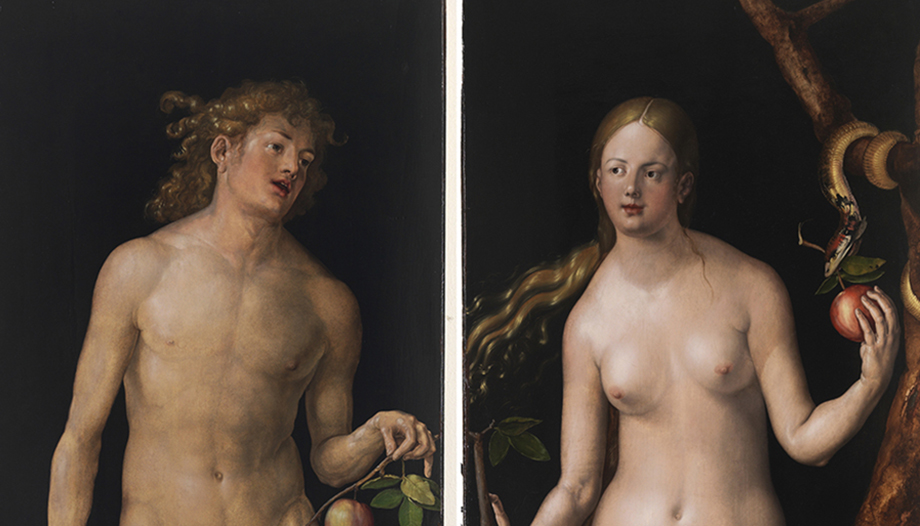
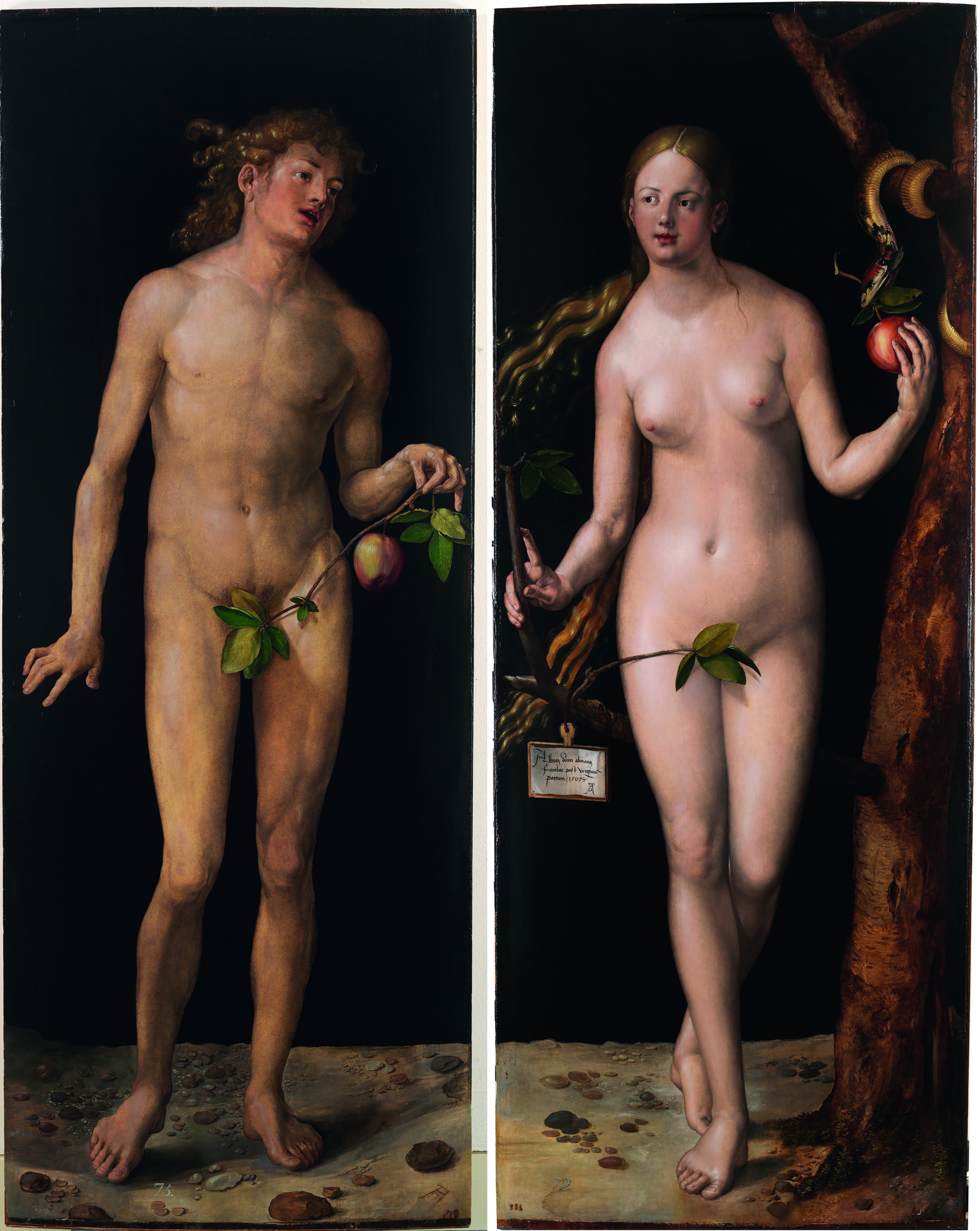
God created man and woman as the culmination of creation, the final touch. The figures of Adam and Eve, depicted here life-size, transport us to paradise, and remind us of the perfection of paradise before original sin took place. The uniform black background and the very low horizon line enhance the beauty and elegance of the bodies, ensuring that our attention is focused on the figures. These are two masterful works that encapsulate the ideals of Renaissance humanism and Dürer's technical skill.
As usual, Adam and Eve are depicted naked, covering their genitals with branches, a detail that accentuates their vulnerability and humanity. The two figures subtly lean towards each other, in a silent dialogue, closing the composition; Eve looks at Adam, although he has his eyes fixed on a distant point, perhaps on God. The serpent coiled around the Tree of the Knowledge of Good and Evil reinforces the biblical narrative of original sin, reminding viewers that this depiction is more than a mere study of the human body: it is a detailed study of the fall of humanity.
Before original sin
Dürer captures the purity of man before the original sin, with a scene charged with Renaissance symbolism and beauty. Dürer's attention to detail is extraordinary. Eve's hair, the different skin tones that distinguish the man from the woman, the meticulous rendering of the hands, the stones in the foreground, reveal his mastery of oil painting, a skill learned in his native Germany. Both panels bear Dürer's signature; that of Adam with his monogram AD, and that of Eve with a tablet indicating that the work was painted after the birth of Christ from the Virgin Mary, thus placing the painting in a specific temporal context and alluding to Mary as the new Eve, redeeming humanity from original sin.
In 2004, both panels were restored at the Prado Museum. Previous interventions had caused the surface to darken with layers of varnish and dirt, distorting the original colors and flattening the images. The supporting structures, particularly that of Adam, were in poor condition, which had created shadows, irregularities and vertical cracks. The restoration process involved meticulously removing the damaged structures from the Adam panel and stabilizing the Eve panel before addressing the painted surfaces.
The results can now be seen at El Prado, where Dürer's technical mastery shines once again.
Classical Renaissance in the work of Dürer
Dürer painted this pair after his trip to Venice, where he immersed himself in the study of human proportions. The results are visible in these paintings, with a much simpler composition than the engraving with the same subject (1504) on which they are based: the paintings move away from the detailed background of the engraving to focus solely on the human form. The classical ideals that Dürer encountered in Italy, particularly the revival of classical aesthetics, profoundly influenced the realization of these tables. The discovery of statues such as Venus, Apollo or the Laocoon with his children inspired Renaissance artists, including Dürer, who studied these models to emulate their perfect proportions and ideal beauty and adapt them to new characters, as in the case of these works.
The Adam and Eve panels are a sample of this classical renaissance, showing idealized human forms that contrast with the more gothic figures typical of northern European art. For Dürer, perfectly measured and proportioned beauty is synonymous with the good, and this in turn reflects the creative power of God. The depiction of Adam and Eve before their fall serves as a testament to immaculate human beauty, not yet tainted by sin.
The origin of these panels remains a mystery. There is no documentation of the commission or the specific reasons why Dürer painted them. They are not part of any altarpiece or other religious work. After the death of the artist's wife, the paintings were acquired by the city of Nuremberg. In 1624 Queen Christina of Sweden gave them as a gift to King Philip IV of Spain, securing their place in the Spanish royal collection.
These panels are not just works of art; they are cultural objects that unite the Renaissance traditions of Northern Europe and Italy, and invite viewers to reflect on human nature, beauty and the creative power of God.
CATECHETICAL COMMENTARY
The story of the Creation narrated in the first chapter of the Genesis culminated with the presentation of the human being, created male and female as the image and likeness of God. This completion of the opus ornatus In short, he presents humanity as the supreme ornament of divine creation, brimming with harmony, beauty and order, as Dürer shows us in his panels on Adam and Eve. In them we see a perfect pictorial representation of how the human being has been created in goodness and harmony, not only in bodily proportions, but in full balance with himself, with creation and with God, his Creator. If Bosch emphasized this threefold harmony more in The Garden of Earthly Delights, Dürer seems to invite us to contemplate the harmony of the human being, diversity of male and female, in itself.
The original perfection of the human being
The figures of Adam and Eve, therefore, can help us to contemplate the harmony and perfection of the last of God's creatures, his masterpiece, a harmony that reflects his initial state of righteousness and holiness. Christian revelation reminds us that all the greatness, beauty, order and faculties of the human being derive from the participation that God has given him in his very life. Therefore, contemplating this apotheosis of the human being leads to discovering an epiphany of the glory of God.
In this initial state, the human creature, united to God, enjoyed special gifts, both in the spirit and in the body; the freshness and beauty of Dürer's strokes express how Adam and Eve were free from suffering, sickness and death. Their perfect classical, humanistic and Renaissance order evokes the solid order that both live in their existence, as those who are not yet infested by the triple disorder of concupiscence: the submission to sensuality, the desires for earthly goods and the selfishness that hijacks reason. None of this is seen in the immaculate beauty of these kings of creation, whose dominion extends not only to all creatures but especially to themselves. The power granted by God to the human being is exercised particularly in his self-mastery, in being master of himself, so that he can properly exercise his power over the whole of creation.
As much as original sin, which is insinuated again in this panel with the serpent as it was in Bosch's, has ruined this divine power and order in the human being, leading him to his present fallen state, Adam and Eve do not lose their capacity to recover the divine image. Thus, just as a ruined Romanesque cloister is not contemplated as a heap of rubble, but as an evocation of a beauty and a constructive order that can be restored, so the present state of humanity is contemplated by Christian faith as a ruin that can be restored to its original condition, even improved, by its Creator. Without this, as we see in transhumanist or antihumanist theories, the human creature, marked in its fallen state by evil and selfishness, is simply a defective being to be removed and replaced by another new being, or else a harmful animal to be relegated and controlled.
A fall called to salvation
The fallen state has arrived precisely in the same scenario where God models the first human couple. The second chapter of the Genesis narrates the creation of Adam and Eve within the framework of that marvelous garden, so splendidly contemplated in the work of Bosch. There he receives from God his first Covenant: he can receive everything from the Creator, he can take care of everything, as long as he renounces to take the fruit of the tree of the knowledge of good and evil, planted by God in Paradise next to the tree of life. We have a Covenant between God and humanity that promises some goods, prescribes some tasks and establishes a prohibition, as a first sample of the successive covenants that God will complete with humanity throughout the Old Testament.
And, as in all alliances, the presence of sin will ruin the covenants between God and man. This first sin is present in the serpent, artfully coiled on the branch that hangs over Eve. We can notice that, following a medieval tradition, Dürer paints this tree as an apple tree, because the name of its fruit (called malus in Latin) clearly evokes the fruit that will bring humanity its first sin. But we can also look at the color of the serpent, a disturbing tinsel, or false gold, that evokes the deception of temptation.
The temptation of the first parents of humanity, fanned by the diabolical serpent, consists precisely in the fact that Satan presents to them as gold what is in reality ruin; he makes them see that the act of disobeying God (and therefore breaking his Covenant and his goods, both being reduced to rubble) will lead them to acquire the gold of full equality of nature with God (you will be gods, he whispers to them), thus surpassing with their own actions their condition of image and likeness.
The cunning serpent, then, appears in this painting deceiving Adam and Eve and preparing their ruin, although Dürer himself also includes in his work the promise of their restoration. Even before they both eat the fruit, -which is the moment chosen by the painter to represent the two figures-, it is already being announced that a New Adam and a New Eve would restore the human being from his ruin, raising him to a state even greater than that of the original justice. The inscription on the cartouche containing the date is sufficiently expressive: the painting is not dated simply with the year of its execution, as is usually done, but the precision is added post virginis partum.
This discreet presence of Mary (Virgin) and Jesus Christ (the birth of the Virgin) in the painting is what provides the fundamental meaning of the painting. The human being, created as a radiant divine image, was deceived by the serpent, so that his freedom, still innocent and tender (as some Fathers of the Church used to say) succumbed to temptation. At the very moment of the temptation, however, God wants to remind us that he had already disposed ab aeterno a project to redeem the fallen human couple with a new couple. The New Adam and the New Eve, living their freedom toward full obedience to God, would lead humanity not only to a new paradise and to recover the original gifts, but to share the same divine nature by being adopted as sons in Jesus Christ, the Only Begotten of the Father.
The work
Art historian and Doctor of Theology





 Español
  English
  Italiano