



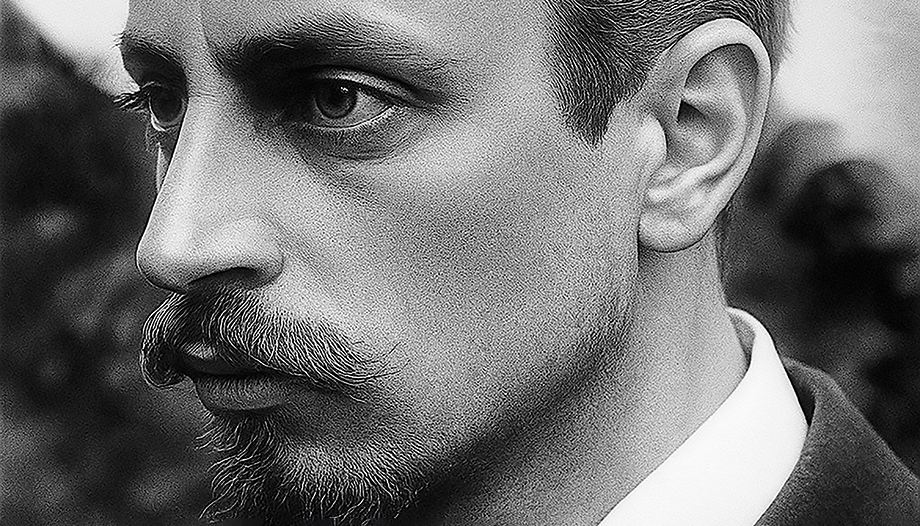
Although no one questions the significance of Rainer Maria Rilke's work, his personality has been equally decisive in the interest aroused by his poetic universe. His life experiences fed his biography and creative sensibility: his complex relationship with his mother, the influence of various women, the reinvention of his identity—from changing his name to inventing a fictional nobility—and his constant travels throughout Europe. Born in Prague, he chose German as his literary language and, on occasion, French.
Beyond these circumstances, his writing is based on an essential conviction: “The creator must be a world unto himself, finding everything in himself and in the nature to which he has adhered.”, as he expressed in the first of his Letters to a Young Poet, where he summarizes his ideal of inner life and his ethics of art: silence, patience, and fidelity to oneself. In the third of these letters, we read: “Go inside yourself. Explore the reason that drives you to write (...) Would you die if you were denied the ability to write?”It is not about writing to be read, but to be.
A spirituality without dogma
From this premise, his poetry seeks to convert existence into spiritual substance: to transform lived experiences—love, death, loneliness—into revelation. Hence his status as a metaphysical poet, a reference point for those who dare to look inward.
Although he was not a Catholic author in the strict sense, his work retains a reinterpreted Christian imprint. As Gonzalo Torrente Ballester observed: “Rilke's thinking, although not Catholic, presupposes Catholicism. It presupposes it historically, as a cultural achievement (...). It is Christianity without Christ.”In Rilke, God is not an external presence, but a creation of the soul; an inner reality that arises from human experience and is elevated through poetic language.
To which Torrente Ballester himself adds: “Rilke's poetry, prose, and letters frequently refer to God; but God, for Rilke, is something that man creates. Reversing biblical terms, man, according to Rilke, creates God in his own image and likeness. This idea is not unique to Rilke. (...) We find it in Scheler, in Unamuno, in Antonio Machado. From such a God, Christ cannot be the Word.".
This context is key to understanding his spirituality, which inherits Christian symbols but reformulates them from within, stripping them of dogma. The divine is not an external presence, but a construction of the soul, a reality that springs from human experience and is elevated through poetic language.
Duino Elegies
One of the highlights of his work is the Duino Elegies (1923), written over more than a decade and born, according to the author himself, from a visionary experience facing the Adriatic Sea. In them, the figure of the angel acts as a central symbol: not the biblical angel, but a being of unbearable intensity, an image of the absolute, which terrifies the poetic self with its perfection. In the first elegy we read: “Every angel is terrible. / And so I hold back, stifling the cry / of a dark sob, Oh! To whom / can we / turn then? Not to angels, nor to human beings either...".
This tension between the longing for the transcendent and the impossibility of sustaining its brilliance sums up his spiritual drama: the desire for the eternal in the face of human fragility. His poetry thus inhabits that boundary between the earth and what transcends it. It offers no certainties, but suggests revelations. Instead of consolation, it proposes a radical acceptance of mystery, since “beauty is nothing more than the beginning of the terrible".
To exist in song
Another essential example is Sonnets to Orpheus (1923), composed in a few days as a tribute to a young woman who had died. The cycle celebrates the transformative power of song, embodied in Orpheus, who was able to tame death with his lyre. In Sonnet II, Rilke writes: “Singing is existence. For God, it's easy. / But when are we?”. Here, a key idea is condensed: singing—creating, describing the world—is not an aesthetic act, but an ontological one. For the god, existing comes easily; for humans, living and singing are almost heroic tasks. Poetry, understood in this way, is not decoration: it is resistance and devotion.
Added to this is what could be called a poetics of the moment: the idea that the ephemeral contains the eternal if one knows how to look. In a letter written in 1921, Rilke notes: “You have to love the ephemeral. That is where the eternal lies hidden.”This attitude toward time distances him from both nihilism and transcendent hope. For Rilke, redemption lies in living fully, in transforming every experience into consciousness, and every consciousness into words.
The panther
Perhaps no poem of his better sums up than The panther that tension between the prison of the visible and the longing for the invisible. The animal, locked behind the bars of its gaze, turns in circles, oblivious to the outside world, but with a latent strength that still vibrates: “Only sometimes does the curtain of his eyelids rise / silently. An image travels inward, / traverses the tense calm of his limbs / and, when it falls into his heart, it melts and fades away.”Like the panther, the poet lives in a cage: that of language, that of his era, that of his body. But from that space, as Rilke teaches us, he can rise—even if only for a few moments—toward eternity.
The panther
In Le Jardin des Plaintes. Paris)
His gaze has grown weary from so much observing.
those bars before him, in an endless parade,
that nothing else could enter it anymore.
It seems to you that there are only thousands of bars
and that behind them no world exists.
Meanwhile, time and again, he moves forward, drawing
with their narrow footprints,
the movement of their nimble, gentle legs
shows a resounding dance
around a center where he remains alert
an impressive will.
Only sometimes does the curtain of her eyelids rise
silent. An image travels inward,
run through the calm tension in your limbs
and, when it falls into your heart, it melts and vanishes.



 Español
  English
  Italiano